



Associations of Uric Acid with Polymorphisms in the δ-Aminolevulinic Acid Dehydratase, Vitamin D Receptor, and Nitric Oxide Synthase Genes in Korean Lead Workers
Supporting Files

-
Nov 2005
File Language:
English
Details
-
Alternative Title:Environ Health Perspect
-
Personal Author:Weaver, Virginia M. ; Schwartz, Brian S. ; Jaar, Bernard G. ; Ahn, Kyu-Dong ; Todd, Andrew C. ; Lee, Sung-Soo ; Kelsey, Karl T. ; Silbergeld, Ellen K. ; Lustberg, Mark E. ; Parsons, Patrick J. ; Wen, Jiayu ; Lee, Byung-Kook
-
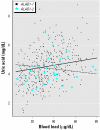
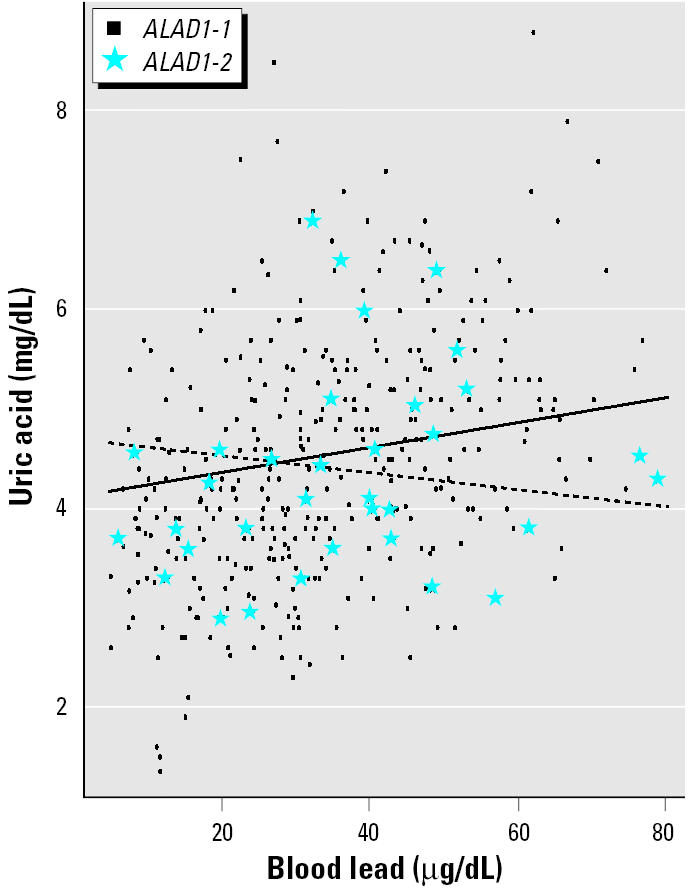
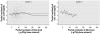
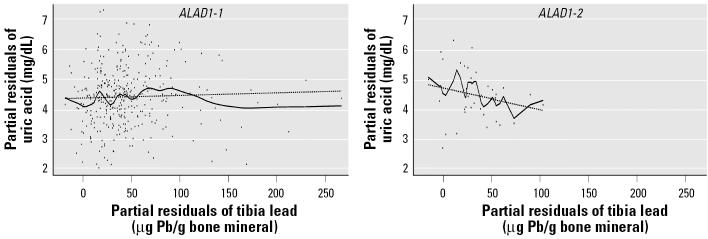
Description:Recent research suggests that uric acid may be nephrotoxic at lower levels than previously recognized and that it may be one mechanism for lead-related nephrotoxicity. Therefore, in understanding mechanisms for lead-related nephrotoxicity, it would be of value to determine whether genetic polymorphisms that are associated with renal outcomes in lead workers and/or modify associations between lead dose and renal function are also associated with uric acid and/or modify associations between lead dose and uric acid. We analyzed data on three such genetic polymorphisms: delta-aminolevulinic acid dehydratase (ALAD), endothelial nitric oxide synthase (eNOS), and the vitamin D receptor (VDR). Mean (+/- SD) tibia, blood, and dimercaptosuccinic acid-chelatable lead levels were 37.2 +/- 40.4 microg/g bone mineral, 32.0+/- 15.0 g/dL, and 0.77+/- 0.86 microg/mg creatinine, respectively, in 798 current and former lead workers. Participants with the eNOSAsp allele had lower mean serum uric acid compared with those with the Glu/Glu genotype. Among older workers (age > or = median of 40.6 years), ALAD genotype modified associations between lead dose and uric acid levels. Higher lead dose was significantly associated with higher uric acid in workers with the ALAD1-1 genotype; associations were in the opposite direction in participants with the variant ALAD1-2 genotype. In contrast, higher tibia lead was associated with higher uric acid in those with the variant VDRB allele; however, modification was dependent on participants with the bb genotype and high tibia lead levels. We conclude that genetic polymorphisms may modify uric acid mediation of lead-related adverse renal effects.
-
Subjects:
-
Source:Environ Health Perspect. 2005; 113(11):1509-1515.
-
Document Type:
-
Funding:2 ES07198/ES/NIEHS NIH HHS/United States ; ES00002/ES/NIEHS NIH HHS/United States ; ES07198/ES/NIEHS NIH HHS/United States ; F30-ES05922-02/ES/NIEHS NIH HHS/United States ; R01 ES007198-05/ES/NIEHS NIH HHS/United States ; R01 ES007198-06/ES/NIEHS NIH HHS/United States ; R01 ES007198-07/ES/NIEHS NIH HHS/United States ; R01 ES007198-08/ES/NIEHS NIH HHS/United States ; TS288-14/14/TS/ATSDR CDC HHS/United States
-
Place as Subject:
-
Volume:113
-
Issue:11
-
Download URL:
-
File Type:
 [PDF - 146.46 KB]
 -
Collection(s):
-
Main Document Checksum:urn:sha256:355e6a5bb708790b8668bcad49e996fff5d39739f0e73c80657809f613222b6f
Supporting Files


File Language:
English
 Was this page helpful?
 Found an issue?



CDC STACKS serves as an archival repository of CDC-published products including
scientific findings, journal articles, guidelines, recommendations, or other public health information authored or
co-authored by CDC or funded partners.
As a repository, CDC STACKS retains documents in their original published format to ensure public access to scientific information.
As a repository, CDC STACKS retains documents in their original published format to ensure public access to scientific information.
You May Also Like
COLLECTION
CDC Public Access