



Posttraumatic Stress Disorder after Hurricane Sandy among Persons Exposed to the 9/11 Disaster
Supporting Files
Peer Reviewed

-
2015/01/01
-
Available in CDC Stacks on 2015-05-07T00:00:00Z
File Language:
English
Details
-
Journal Article:International Journal of Emergency Mental Health
-
Personal Author:
-
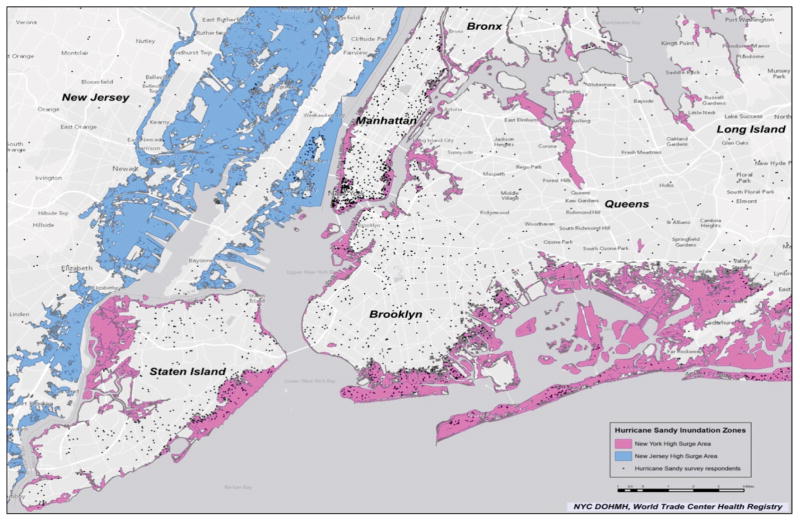
Description:Background:Traumatic exposure during a hurricane is associated with adverse mental health conditions post-event. The World Trade Center Health Registry provided a sampling pool for a rapid survey of persons directly affected by Hurricane Sandy in the New York City (NYC) metropolitan area in late October 2012. This study evaluated the relationship between Sandy experiences and Sandy-related posttraumatic stress disorder (PTSD) among individuals previously exposed to the September 11, 2001 (9/11) disaster. Methods: A total of 4,558 surveys were completed from April 10-November 7, 2013. After exclusions for missing data, the final sample included 2,214 (53.5%) respondents from FEMA-defined inundation zones and 1,923 (46.5%) from non-inundation zones. Sandy exposures included witnessing terrible events, Sandy-related injury, fearing for own life or safety of others, evacuation, living in a home that was flooded or damaged, property loss, and financial loss. Sandy-related PTSD was defined as a score of .44 on a Sandy-specific PTSD Checklist. Results: PTSD prevalence was higher in the inundation zones (11.3%) and lower in the non-inundation zones (4.4%). The highest prevalence of Sandy-related PTSD was among individuals in the inundation zone who sustained an injury (31.2%), reported a history of 9/11-related PTSD (28.8%), or had low social support prior to the event (28.6%). In the inundation zones, significantly elevated adjusted odds of Sandy-related PTSD were observed among persons with a prior history of 9/11-related PTSD, low social support, and those who experienced a greater number of Sandy traumatic events. Conclusions: Sandy-related stress symptoms indicative of PTSD affected a significant proportion of persons who lived in flooded areas of the NYC metropolitan area. Prior 9/11-related PTSD increased the likelihood of Sandy-related PTSD, while social support was protective. Public health preparation for events similar to Sandy should incorporate outreach and linkages to care for persons with prior disaster-related trauma. Description provided by NIOSH
-
Subjects:
-
Keywords:
- World Trade Center; WTC; Hurricanes; Disaster response; Exposure-levels; Risk-factors; Traumatic-injuries; Mental-health; Stress; Injuries; Psychological-effects; Psychological-responses; Psychological-reactions; Psychology;
- Author Keywords: 9/11; posttraumatic stress disorder; PTSD; hurricanes; disasters; World Trade Center Health Registry; social support
-
Source:Int J Emerg Mental Health 2015 May; 17(1):356-362
-
ISSN:1522-4821
-
Pubmed ID:25960693
-
Pubmed Central ID:PMC4424196
-
Document Type:
-
Funding:
-
Genre:
-
Place as Subject:
-
CIO:
-
Topic:
-
Location:
-
Pages in Document:15 pdf pages
-
Volume:17
-
Issue:1
-
NIOSHTIC Number:nn:20046222
-
Contact Point Address:Kimberly Caramanica, MPH, New York City Department of Health and Mental Hygiene, USA
-
Email:kcaramanica@health.nyc.gov
-
Federal Fiscal Year:2015
-
Performing Organization:New York City Health/Mental Hygiene
-
Peer Reviewed:True
-
Download URL:
-
File Type:
 [PDF - 504.29 KB]
 -
Collection(s):
-
Main Document Checksum:urn:sha-512:b2b24786c11819bb4ef6701c034bb7c4756c67dbfe05a13d2fe01f0723fec10bcfb61f21c354b219e798e8de74dcc6a2889250bf82cc025a07177ba410129ac5
Supporting Files


File Language:
English
 Was this page helpful?
 Found an issue?


CDC STACKS serves as an archival repository of CDC-published products including
scientific findings, journal articles, guidelines, recommendations, or other public health information authored or
co-authored by CDC or funded partners.
As a repository, CDC STACKS retains documents in their original published format to ensure public access to scientific information.
As a repository, CDC STACKS retains documents in their original published format to ensure public access to scientific information.
You May Also Like