



Genetic Analysis of Viruses Associated with Emergence of Rift Valley Fever in Saudi Arabia and Yemen, 2000-01
Supporting Files
Public Domain

-
Dec 2002
File Language:
English
Details
-
Alternative Title:Emerg Infect Dis
-
Personal Author:Shoemaker, Trevor ; Boulianne, Carla ; Vincent, Martin J. ; Pezzanite, Linda ; Al-Qahtani, Mohammed M. ; Al-Mazrou, Yagub ; Khan, Ali S. ; Rollin, Pierre E. ; Swanepoel, Robert ; Ksiazek, Thomas G. ; Nichol, Stuart T.
-
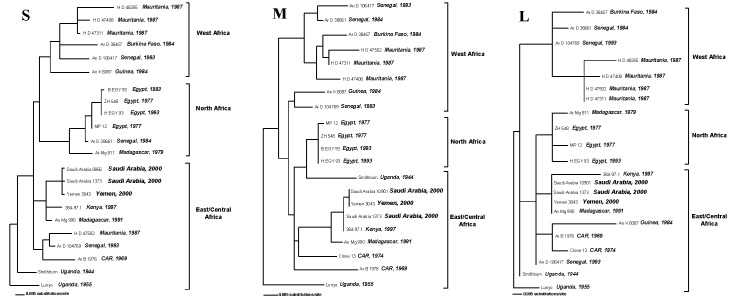
Description:The first confirmed Rift Valley fever outbreak outside Africa was reported in September 2000, in the Arabian Peninsula. As of February 2001, a total of 884 hospitalized patients were identified in Saudi Arabia, with 124 deaths. In Yemen, 1,087 cases were estimated to have occurred, with 121 deaths. Laboratory diagnosis of Rift Valley fever virus (RVFV) infections included virus genetic detection and characterization of clinical specimens by reverse transcription-polymerase chain reaction, in addition to serologic tests and virus isolation. Genetic analysis of selected regions of virus S, M, and L RNA genome segments indicated little genetic variation among the viruses associated with disease. The Saudi Arabia and Yemen viruses were almost identical to those associated with earlier RVF epidemics in East Africa. Analysis of S, M, and L RNA genome segment sequence differences showed similar phylogenetic relationships among these viruses, indicating that genetic reassortment did not play an important role in the emergence of this virus in the Arabian Peninsula. These results are consistent with the recent introduction of RVFV into the Arabian Peninsula from East Africa.
-
Subjects:
-
Source:Emerg Infect Dis. 8(12):1415-1420.
-
Document Type:
-
Place as Subject:
-
Location:
-
Volume:8
-
Issue:12
-
Download URL:
-
File Type:
 [PDF - 305.97 KB]
 -
Collection(s):
-
Main Document Checksum:urn:sha-512:c8b288200428bf4cec095dbdb85929bbeddc5ff1492d4cc73463727c7fad8f202ec4888c55f2d1fd80826ab86d080bd3cdebf68ad2234ca3325d4855efc953bc
Supporting Files


File Language:
English
 Was this page helpful?
 Found an issue?

CDC STACKS serves as an archival repository of CDC-published products including
scientific findings, journal articles, guidelines, recommendations, or other public health information authored or
co-authored by CDC or funded partners.
As a repository, CDC STACKS retains documents in their original published format to ensure public access to scientific information.
As a repository, CDC STACKS retains documents in their original published format to ensure public access to scientific information.
You May Also Like
COLLECTION
Emerging Infectious Diseases