


Detecting Spread of Avian Influenza A(H7N9) Virus Beyond China
Supporting Files
Public Domain

-
May 2015
-
File Language:
English
Details
-
Alternative Title:Emerg Infect Dis
-
Personal Author:Millman, Alexander J. ; Havers, Fiona ; Iuliano, A. Danielle ; Davis, C. Todd ; Sar, Borann ; Sovann, Ly ; Chin, Savuth ; Corwin, Andrew L. ; Vongphrachanh, Phengta ; Douangngeun, Bounlom ; Lindblade, Kim A. ; Chittaganpitch, Malinee ; Kaewthong, Viriya ; Kile, James C. ; Nguyen, Hien T. ; Pham, Dong V. ; Donis, Ruben O. ; Widdowson, Marc-Alain
-
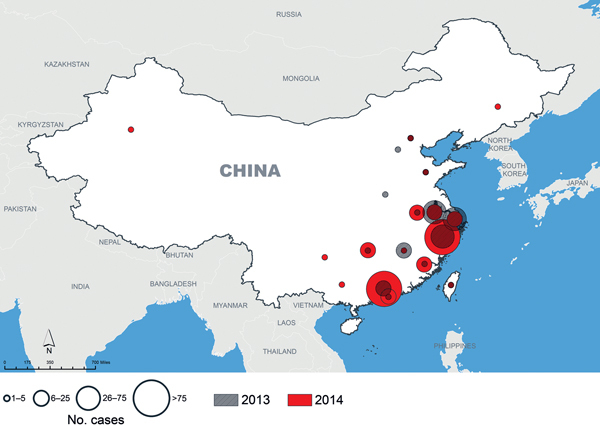
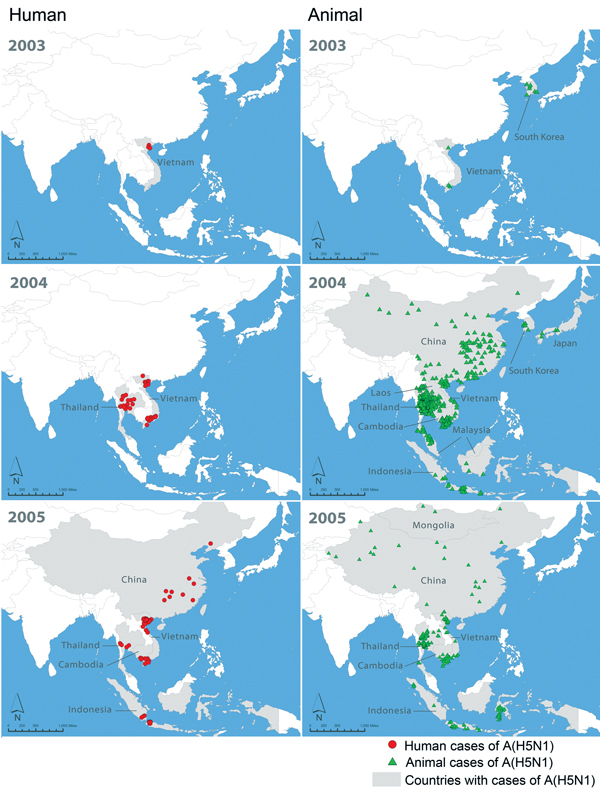
Description:During February 2013-March 2015, a total of 602 human cases of low pathogenic avian influenza A(H7N9) were reported; no autochthonous cases were reported outside mainland China. In contrast, since highly pathogenic avian influenza A(H5N1) reemerged during 2003 in China, 784 human cases in 16 countries and poultry outbreaks in 53 countries have been reported. Whether the absence of reported A(H7N9) outside mainland China represents lack of spread or lack of detection remains unclear. We compared epidemiologic and virologic features of A(H5N1) and A(H7N9) and used human and animal influenza surveillance data collected during April 2013-May 2014 from 4 Southeast Asia countries to assess the likelihood that A(H7N9) would have gone undetected during 2014. Surveillance in Vietnam and Cambodia detected human A(H5N1) cases; no A(H7N9) cases were detected in humans or poultry in Southeast Asia. Although we cannot rule out the possible spread of A(H7N9), substantial spread causing severe disease in humans is unlikely.
-
Subjects:
-
Source:Emerg Infect Dis. 21(5):741-749.
-
Document Type:
-
Place as Subject:
-
Location:
-
Volume:21
-
Issue:5
-
Collection(s):
-
Main Document Checksum:urn:sha256:36e57aeef7ab7aec1b977fa609c36b6f1d2e30a89f348b90f980b3d4bc98acc2
-
Download URL:
-
File Type:
 [PDF
- 2.34 MB
]
[PDF
- 2.34 MB
]
Supporting Files


File Language:
English
ON THIS PAGE



CDC STACKS serves as an archival repository of CDC-published products including
scientific findings,
journal articles, guidelines, recommendations, or other public health information authored or
co-authored by CDC or funded partners.
As a repository, CDC STACKS retains documents in their original published format to ensure public access to scientific information.
As a repository, CDC STACKS retains documents in their original published format to ensure public access to scientific information.
You May Also Like
COLLECTION
Emerging Infectious Diseases