



Emerging Pattern of Rabies Deaths and Increased Viral Infectivity
Supporting Files
Public Domain

-
Feb 2003
File Language:
English
Details
-
Alternative Title:Emerg Infect Dis
-
Personal Author:
-
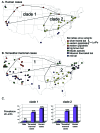
Description:Most human rabies deaths in the United States can be attributed to unrecognized exposures to rabies viruses associated with bats, particularly those associated with two infrequently encountered bat species (Lasionycteris noctivagans and Pipistrellus subflavus). These human rabies cases tend to cluster in the southeastern and northwestern United States. In these regions, most rabies deaths associated with bats in nonhuman terrestrial mammals are also associated with virus variants specific to these two bat species rather than more common bat species; outside of these regions, more common bat rabies viruses contribute to most transmissions. The preponderance of rabies deaths connected with the two uncommon L. noctivagans and P. subflavus bat rabies viruses is best explained by their evolution of increased viral infectivity.
-
Subjects:
-
Source:Emerg Infect Dis. 9(2):151-154
-
Pubmed ID:12603983
-
Pubmed Central ID:PMC2901935
-
Document Type:
-
Volume:9
-
Issue:2
-
Download URL:
-
File Type:
 [PDF - 314.08 KB]
 -
Collection(s):
-
Main Document Checksum:urn:sha-512:cd084e1b96bf8b1af77152c5eb75d0e3df4b9646e02029ceac53409af9f307fcf8176b09dc9930782adc9cf74afb389ceec66e72d63457c2bffcc1defdf17b26
Supporting Files


File Language:
English
 Was this page helpful?
 Found an issue?



CDC STACKS serves as an archival repository of CDC-published products including
scientific findings, journal articles, guidelines, recommendations, or other public health information authored or
co-authored by CDC or funded partners.
As a repository, CDC STACKS retains documents in their original published format to ensure public access to scientific information.
As a repository, CDC STACKS retains documents in their original published format to ensure public access to scientific information.
You May Also Like
COLLECTION
Emerging Infectious Diseases