


Factors associated with maintenance of antibody responses to influenza vaccine in older, community-dwelling adults
Supporting Files

-
Apr 23 2015
-
File Language:
English
Details
-
Alternative Title:BMC Infect Dis
-
Personal Author:
-
Description:Background
Little is known about factors associated with maintenance of hemagglutinin inhibition (HAI) antibodies after influenza vaccination in older adults.
Methods
Adults ≥50 years of age were vaccinated prior to the 2009–10 influenza season. Serum was drawn pre-vaccination (S1), 21–28 days post-vaccination (S2), and after the influenza season (S3) for HAI assays. Seroconversion was defined as ≥ 4-fold increase S1 to S2 (or if S1 < 10, by an S2 ≥ 40) and seroprotection was defined as S2 ≥ 40. Maintenance of antibody response was measured in participants with an S2 ≥ 40, and defined as an S3 ≥ 40.
Results
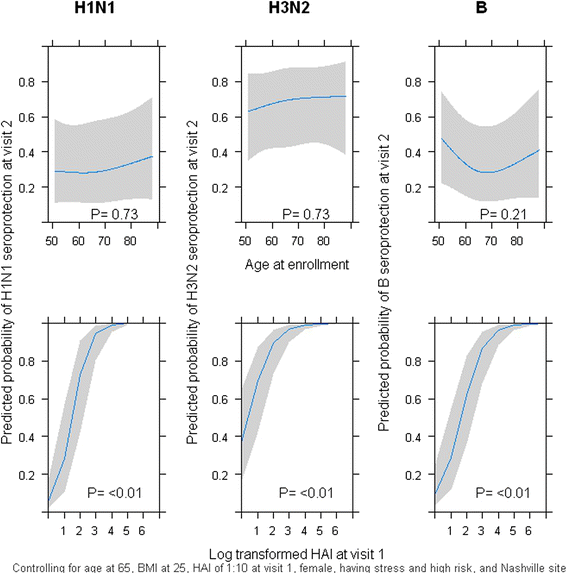
We enrolled 510 participants during Fall 2009 at Vanderbilt University Medical Center and Marshfield Clinic Research Foundation. Participants’ mean age was 64 years with 62% female and 96% white. Seroconversion and seroprotection rates were lowest for influenza A H1N1 (12% and 26%, respectively), highest for influenza A H3N2 (45% and 82%), and intermediate for influenza B (28% and 72%). Of the participants with an S2 ≥ 40, 36% (46/126), 71% (289/407), and 74% (263/354) maintained an S3 ≥ 40 for H1N1, H3N2, and B influenza vaccine strains, respectively. S1 HAI titer was strongly associated with both post-vaccination seroprotection and maintaining seroprotection at S3 for all three influenza antigens. Age, sex, body mass index, self-reported stress, and vaccination site were not consistently associated with vaccine response or maintenance of response.
Conclusions
Pre-vaccination antibody titer was the only study variable consistently and positively associated with both serologic response to vaccination and maintenance of response. Antibody responses were lowest for the H1N1 vaccine strain.
ClinicalTrials
gov Identifier: NCT02401893
Electronic supplementary material
The online version of this article (doi:10.1186/s12879-015-0926-8) contains supplementary material, which is available to authorized users.
-
Subjects:
-
Source:BMC Infect Dis. 15.
-
Pubmed ID:25903659
-
Pubmed Central ID:PMC4415221
-
Document Type:
-
Funding:
-
Volume:15
-
Collection(s):
-
Main Document Checksum:urn:sha256:889835bb9a54beed9c7ede190c754731a7356728ec1fa2df20d164f30b6bde0a
-
Download URL:
-
File Type:
 [PDF
- 834.45 KB
]
[PDF
- 834.45 KB
]
Supporting Files


File Language:
English
ON THIS PAGE



CDC STACKS serves as an archival repository of CDC-published products including
scientific findings,
journal articles, guidelines, recommendations, or other public health information authored or
co-authored by CDC or funded partners.
As a repository, CDC STACKS retains documents in their original published format to ensure public access to scientific information.
As a repository, CDC STACKS retains documents in their original published format to ensure public access to scientific information.
You May Also Like
COLLECTION
CDC Public Access