


Sun Exposure and Malignant Melanoma among Susceptible Individuals
Supporting Files

-
1989/05/01
File Language:
English
Details
-
Journal Article:Environmental Health Perspectives
-
Personal Author:
-
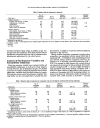
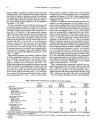
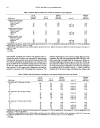
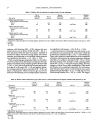
Description:This study was performed in efforts to clarify the relationship between sun exposure and incidence of melanoma by considering host susceptibility factors. Susceptible subgroups were primarily based on pigmentary characteristics. The type of sun exposure was identified as chronic or intermittent. Cases and comparisons comprised a 1979 through 1982 subset of an earlier study and contained 289 consecutive patients with melanoma and 527 randomly selected comparisons without cancer. The risk of melanoma associated with sun exposure was shown to be greater for individuals expected to be susceptible on the basis of poor ability to tan, but not other pigmentary traits. There were also some interactions between age and sun exposure. The risk of melanoma among subjects with poor tanning ability associated with outdoor occupation was three times greater than those with poor tanning ability who were employed indoors. Mixed indoor and outdoor job exposures were protective among good tanners, but not among poor tanners. For recreational sun exposure a similar pattern was noted. The quantitative assessment of average hours of sun exposure was not a good indicator of melanoma risk, even among the susceptible individuals. A history of severe sunburn with blistering was associated with nearly a three fold risk among poor tanners but was protective among good tanners. A history of nonmelanoma skin cancer or solar keratosis was a very strong risk factor. This factor did not significantly differ in magnitude among susceptibility subgroups. [Description provided by NIOSH]
-
Subjects:
-
Keywords:
-
Source:Environ Health Perspect 1989 May; 81:139-151
-
ISSN:0091-6765
-
Pubmed ID:2759056
-
Pubmed Central ID:PMC1567515
-
Document Type:
-
Funding:
-
Genre:
-
Place as Subject:
-
CIO:
-
Topic:
-
Location:
-
Pages in Document:13 pdf pages
-
Volume:81
-
NIOSHTIC Number:nn:00189779
-
Contact Point Address:Environmental Medicine New York University 550 First Avenue New York, N Y 10016
-
Federal Fiscal Year:1989
-
NORA Priority Area:
-
Performing Organization:New York University, New York, New York
-
Peer Reviewed:True
-
Collection(s):
-
Main Document Checksum:urn:sha-512:af4d77e6a08117799cc41b6260c11c20463b03387f166e5771e5740c9ea4628b032ee204cc80803f60915bbb1a70dd006d3446b50c7708300b39f212b0ffad0c
-
Download URL:
-
File Type:
 [PDF
- 2.30 MB
]
[PDF
- 2.30 MB
]
Supporting Files


File Language:
English
ON THIS PAGE





CDC STACKS serves as an archival repository of CDC-published products including
scientific findings,
journal articles, guidelines, recommendations, or other public health information authored or
co-authored by CDC or funded partners.
As a repository, CDC STACKS retains documents in their original published format to ensure public access to scientific information.
As a repository, CDC STACKS retains documents in their original published format to ensure public access to scientific information.
You May Also Like