



Grueneisen relaxation photoacoustic microscopy
Supporting Files

-
Oct 20 2014
-
Available in CDC Stacks on January 08, 2015, 12:00 AM
Details
-
Alternative Title:Phys Rev Lett
-
Personal Author:
-
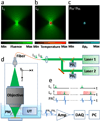
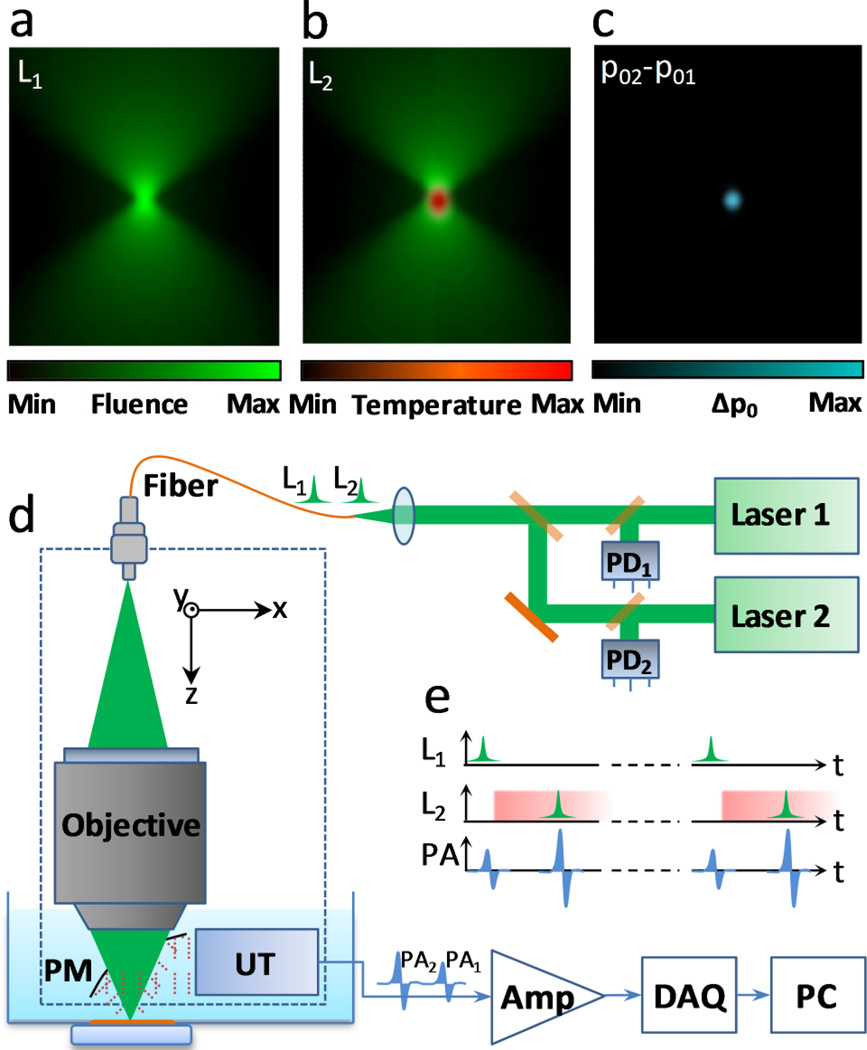
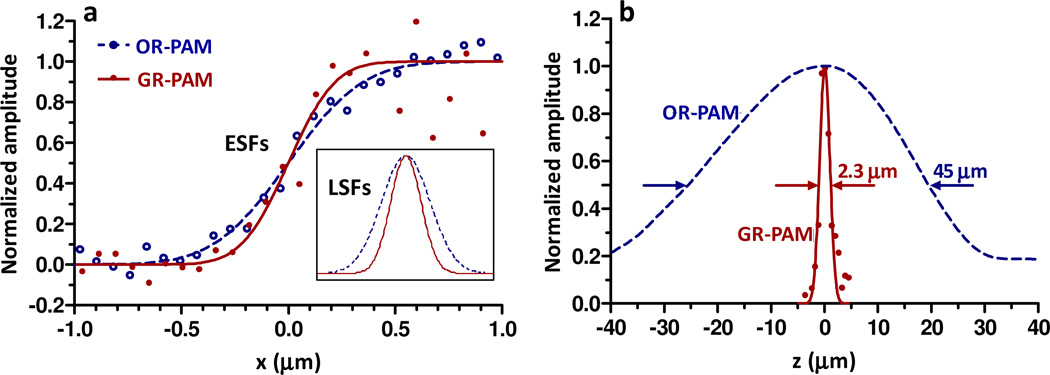
Description:The temperature-dependent property of the Grueneisen parameter has been employed in photoacoustic imaging mainly to measure tissue temperature. Here we explore this property using a different approach and develop Grueneisen relaxation photoacoustic microscopy (GR-PAM), a technique that images nonradiative absorption with confocal optical resolution. GR-PAM sequentially delivers two identical laser pulses with a microsecond-scale time delay. The first laser pulse generates a photoacoustic signal and thermally tags the in-focus absorbers. When the second laser pulse excites the tagged absorbers within the thermal relaxation time, a photoacoustic signal stronger than the first one is produced, owing to the temperature dependence of the Grueneisen parameter. GR-PAM detects the amplitude difference between the two colocated photoacoustic signals, confocally imaging the nonradiative absorption. We greatly improved axial resolution from 45 μm to 2.3 μm and, at the same time, slightly improved lateral resolution from 0.63 μm to 0.41 μm. In addition, the optical sectioning capability facilitates the measurement of the absolute absorption coefficient without fluence calibration.
-
Subjects:
-
Source:Phys Rev Lett. 113(17):174301.
-
Pubmed ID:25379919
-
Pubmed Central ID:PMC4287460
-
Document Type:
-
Funding:
-
Volume:113
-
Issue:17
-
Download URL:
-
File Type:
 [PDF - 1.23 MB]
 -
Collection(s):
-
Main Document Checksum:urn:sha256:c94064d7dcd2f0b30560dc90f34ca8a29e7ae0f49ee2f355738fb27c87a3d174
Supporting Files


 Was this page helpful?
 Found an issue?




CDC STACKS serves as an archival repository of CDC-published products including
scientific findings, journal articles, guidelines, recommendations, or other public health information authored or
co-authored by CDC or funded partners.
As a repository, CDC STACKS retains documents in their original published format to ensure public access to scientific information.
As a repository, CDC STACKS retains documents in their original published format to ensure public access to scientific information.
You May Also Like
COLLECTION
CDC Public Access