


Heterogeneity among studies in rates of decline of ART adherence over time: Results from the MACH14 study
Supporting Files

-
Dec 15 2013
-
File Language:
English
Details
-
Alternative Title:J Acquir Immune Defic Syndr
-
Personal Author:
-
Corporate Authors:
-
Description:Objective
To use electronic drug monitoring to determine if adherence to HIV antiretroviral therapy changes over time, whether changes are linear, and how the declines vary by study.
Design
We conducted a longitudinal study of pooled data from 11 different studies of HIV infected adults using antiretroviral therapy. The main outcome was antiretroviral therapy adherence (percent of prescribed doses taken) measured by electronic drug monitoring. We modeled and compared changes in adherence over time using repeated measures linear mixed effects models and generalized additive mixed models. Indicator variables were used to examine the impact of individual studies, and the variation across studies was evaluated using study-specific parameter estimates calculated by using interaction terms of study and time.
Results
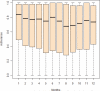
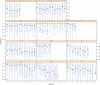
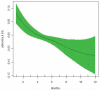
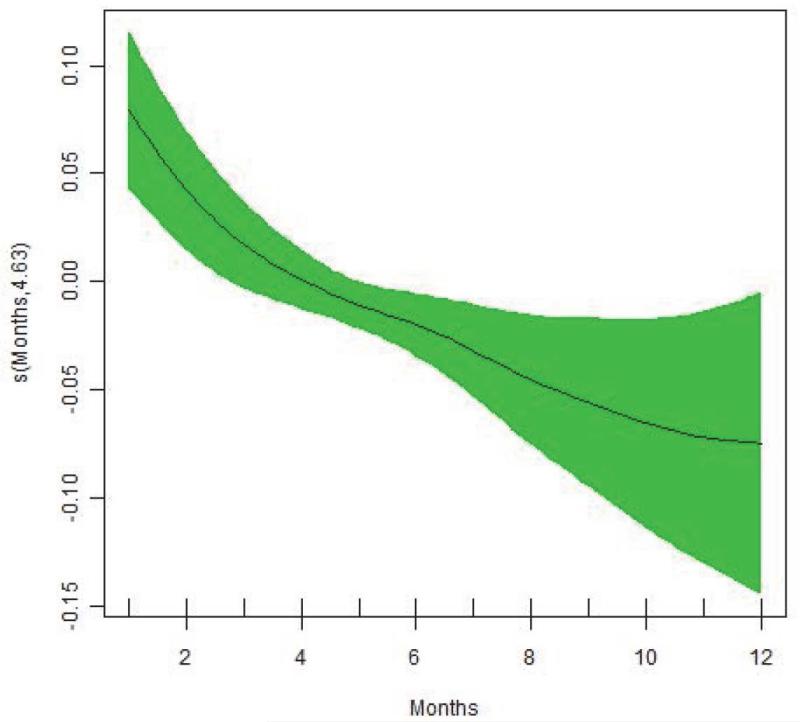
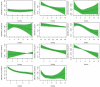
The mean age of the subjects was 41 years, 35% were female, most had high school education or less, and 46% were African-American. In generalized additive mixed models, adherence declined over time. The generalized additive mixed models further suggested that the decline was non-linear, and in both sets of models there was considerable study-to-study variability in how adherence changed over time.
Limitations
Findings may not be generalizable to non-US populations or to patients not in clinical studies.
Conclusions
Although overall antiretroviral therapy adherence declined with time, not all studies showed declines, and a number of patterns of change were seen. Studies that identify clinical and organizational factors associated with these different patterns are needed. Models of changes in adherence with time should take account of possible non-linear effects.
-
Subjects:
-
Source:J Acquir Immune Defic Syndr. 64(5):448-454.
-
Pubmed ID:24225904
-
Pubmed Central ID:PMC4212649
-
Document Type:
-
Funding:2R01NR04749/NR/NINR NIH HHS/United States ; AI069419/AI/NIAID NIH HHS/United States ; CC02-SD-003/CC/ODCDC CDC HHS/United States ; CC99-SD-003/CC/ODCDC CDC HHS/United States ; D43 TW001277/TW/FIC NIH HHS/United States ; K02 DA017277/DA/NIDA NIH HHS/United States ; K23MH01862/MH/NIMH NIH HHS/United States ; K24 MH092242/MH/NIMH NIH HHS/United States ; K24 RR020300/RR/NCRR NIH HHS/United States ; M01 RR000054/RR/NCRR NIH HHS/United States ; MH01584/MH/NIMH NIH HHS/United States ; MH54907/MH/NIMH NIH HHS/United States ; MH58986/MH/NIMH NIH HHS/United States ; NIH/NIAID AI38858/PHS HHS/United States ; P01 DK045734/DK/NIDDK NIH HHS/United States ; P01 MH49548/MH/NIMH NIH HHS/United States ; P30 AI042853/AI/NIAID NIH HHS/United States ; R01 AI41413/AI/NIAID NIH HHS/United States ; R01 DA015679/DA/NIDA NIH HHS/United States ; R01 DA13826/DA/NIDA NIH HHS/United States ; R01 MH083595/MH/NIMH NIH HHS/United States ; R01 MH092238/MH/NIMH NIH HHS/United States ; R01 MH61173/MH/NIMH NIH HHS/United States ; R01DA015679/DA/NIDA NIH HHS/United States ; R01DA11869/DA/NIDA NIH HHS/United States ; R01DA15215/DA/NIDA NIH HHS/United States ; R01MH068197/MH/NIMH NIH HHS/United States ; R01MH078773/MH/NIMH NIH HHS/United States ; R01MH61695/MH/NIMH NIH HHS/United States ; R01NR04749/NR/NINR NIH HHS/United States ; R21 MH073420/MH/NIMH NIH HHS/United States ; RC4 AG039072/AG/NIA NIH HHS/United States
-
Place as Subject:
-
Volume:64
-
Issue:5
-
Collection(s):
-
Main Document Checksum:urn:sha256:39f545cd3ba2da763c647810a437da25070d606b2976f4b3868bc9820b8ae3e6
-
Download URL:
-
File Type:
 [PDF
- 1.08 MB
]
[PDF
- 1.08 MB
]
Supporting Files


File Language:
English
ON THIS PAGE




CDC STACKS serves as an archival repository of CDC-published products including
scientific findings,
journal articles, guidelines, recommendations, or other public health information authored or
co-authored by CDC or funded partners.
As a repository, CDC STACKS retains documents in their original published format to ensure public access to scientific information.
As a repository, CDC STACKS retains documents in their original published format to ensure public access to scientific information.
You May Also Like
COLLECTION
CDC Public Access