


Opportunities for Merging Chemical and Biological Synthesis
Supporting Files

-
Apr 18 2014
Details
-
Alternative Title:Curr Opin Biotechnol
-
Personal Author:
-
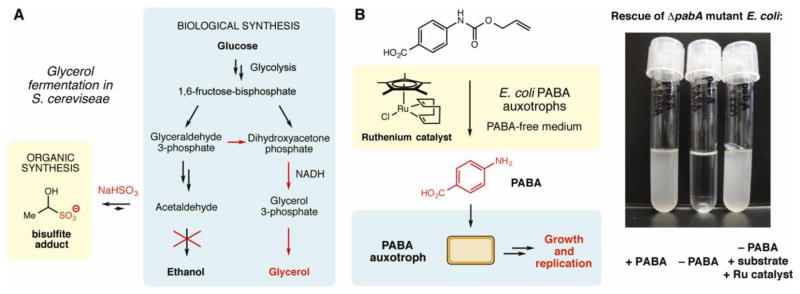
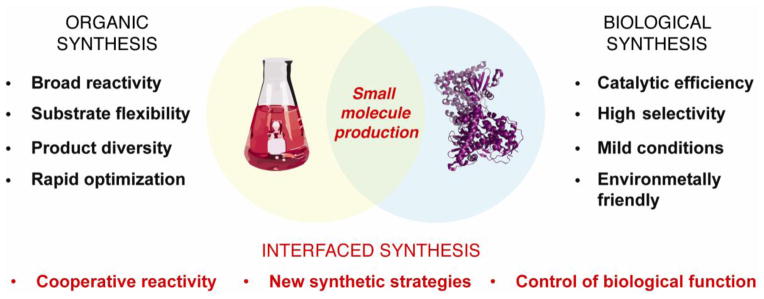
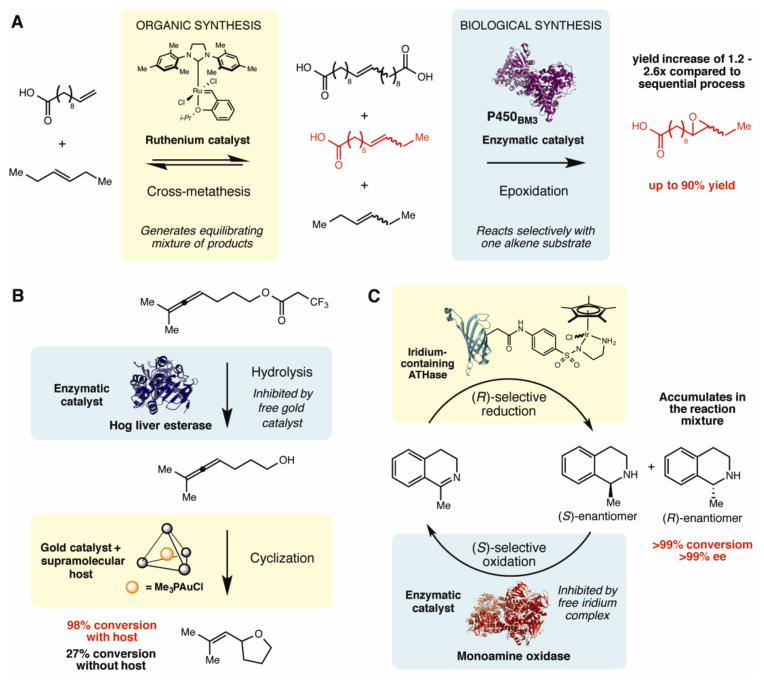
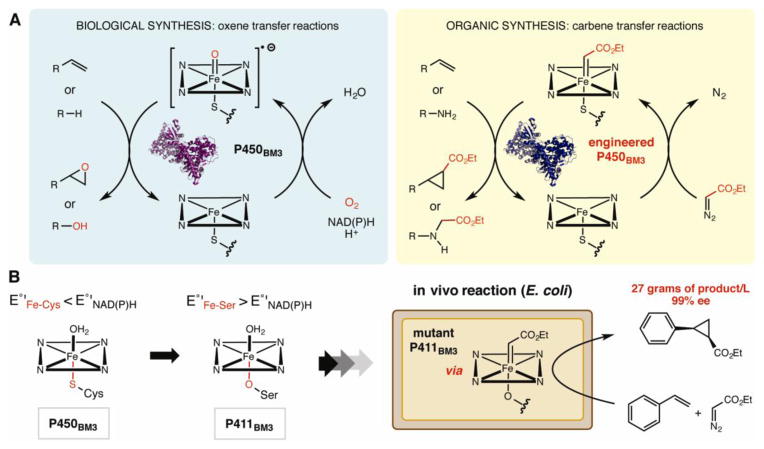
Description:Organic chemists and metabolic engineers use largely orthogonal technologies to access small molecules like pharmaceuticals and commodity chemicals. As the use of biological catalysts and engineered organisms for chemical production grows, it is becoming increasingly evident that future efforts for chemical manufacture will benefit from the integration and unified expansion of these two fields. This review will discuss approaches that combine chemical and biological synthesis for small molecule production. We highlight recent advances in combining enzymatic and non-enzymatic catalysis in vitro, discuss the application of design principles from organic chemistry for engineering non-biological reactivity into enzymes, and describe the development of biocompatible chemistry that can be interfaced with microbial metabolism.
-
Subjects:
-
Source:Curr Opin Biotechnol. 2014; 30:1-8.
-
Pubmed ID:24747284
-
Pubmed Central ID:PMC4199929
-
Document Type:
-
Funding:
-
Volume:30
-
Collection(s):
-
Main Document Checksum:urn:sha256:f521135c57a5db4c8dd48b5c3052a274be40b448e876d090e4eb1ee72ba4a168
-
Download URL:
-
File Type:
 [PDF
- 723.60 KB
]
[PDF
- 723.60 KB
]
Supporting Files


ON THIS PAGE

CDC STACKS serves as an archival repository of CDC-published products including
scientific findings,
journal articles, guidelines, recommendations, or other public health information authored or
co-authored by CDC or funded partners.
As a repository, CDC STACKS retains documents in their original published format to ensure public access to scientific information.
As a repository, CDC STACKS retains documents in their original published format to ensure public access to scientific information.
You May Also Like
COLLECTION
CDC Public Access