



Population-Based Incidence and Prevalence of Systemic Lupus Erythematosus
Supporting Files

-
2 2014 ; 2-2014
-
Available in CDC Stacks on October 15, 2014, 12:00 AM
File Language:
English
Details
-
Alternative Title:Arthritis Rheumatol
-
Personal Author:
-
Description:Objective
To estimate the incidence and prevalence of systemic lupus erythematosus (SLE) in a sociodemographically diverse southeastern Michigan source population of 2.4 million people.
Methods
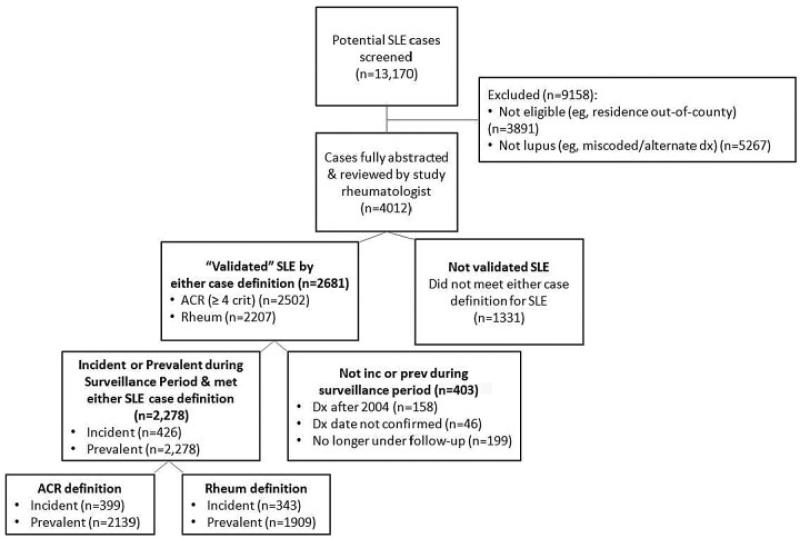
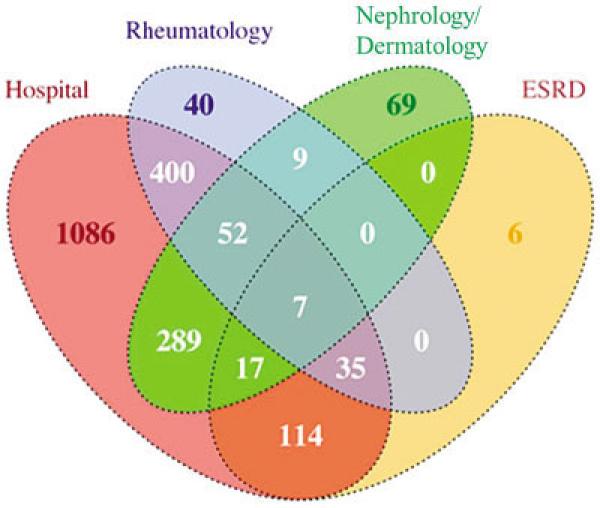
SLE cases fulfilling the American College of Rheumatology classification criteria (primary case definition) or meeting rheumatologist-judged SLE criteria (secondary definition) and residing in Wayne or Washtenaw Counties during 2002–2004 were included. Case finding was performed from 6 source types, including hospitals and private specialists. Age-standardized rates were computed, and capture–recapture was performed to estimate underascertainment of cases.
Results
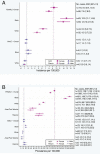
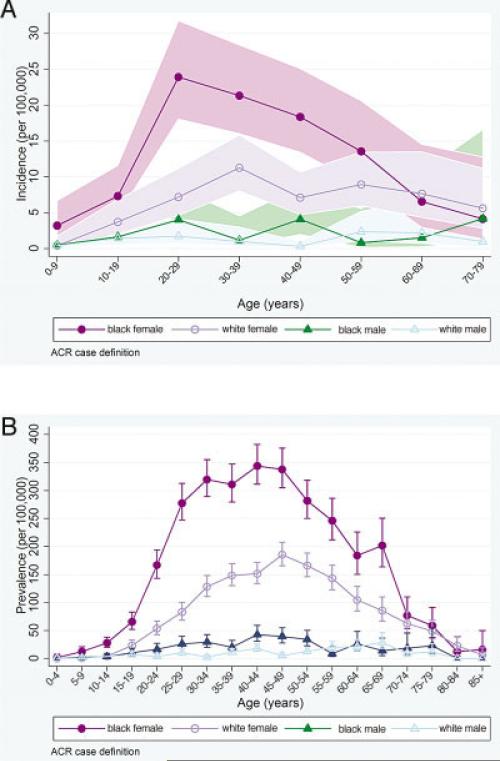
The overall age-adjusted incidence and prevalence (ACR definition) per 100,000 persons were 5.5 (95% confidence interval 95% CI 5.0–6.1) and 72.8 (95% CI 70.8–74.8). Among females, the incidence was 9.3 per 100,000 persons and the prevalence was 128.7 per 100,000 persons. Only 7 cases were estimated to have been missed by capture–recapture, adjustment for which did not materially affect the rates. SLE prevalence was 2.3-fold higher in black persons than in white persons, and 10-fold higher in females than in males. Among incident cases, the mean ± SD age at diagnosis was 39.3 ± 16.6 years. Black SLE patients had a higher proportion of renal disease and end-stage renal disease (ESRD) (40.5% and 15.3%, respectively) as compared to white SLE patients (18.8% and 4.5%, respectively). Black patients with renal disease were diagnosed as having SLE at younger age than white patients with renal disease (mean ± SD 34.4 ± 14.9 years versus 41.9 ± 21.3 years; P = 0.05).
Conclusion
SLE prevalence was higher than has been described in most other population-based studies and reached 1 in 537 among black female persons. There were substantial racial disparities in the burden of SLE, with black patients experiencing earlier age at diagnosis, >2-fold increases in SLE incidence and prevalence, and increased proportions of renal disease and progression to ESRD as compared to white patients. -
Subjects:
-
Source:Arthritis Rheumatol. 2014; 66(2):369-378
-
Pubmed ID:24504809
-
Pubmed Central ID:PMC4198147
-
Document Type:
-
Funding:UL1-RR-024986/RR/NCRR NIH HHSUnited States/ ; K12 HD001438/HD/NICHD NIH HHSUnited States/ ; K01 ES019909/ES/NIEHS NIH HHSUnited States/ ; K12-HD-001438/HD/NICHD NIH HHSUnited States/ ; K01-ES-019909/ES/NIEHS NIH HHSUnited States/ ; U58/DP001441/DP/NCCDPHP CDC HHSUnited States/ ; U58 DP001441/DP/NCCDPHP CDC HHSUnited States/ ; UL1 RR024986/RR/NCRR NIH HHSUnited States/
-
Volume:66
-
Issue:2
-
Download URL:
-
File Type:
 [PDF - 1.12 MB]
 -
Collection(s):
-
Main Document Checksum:urn:sha256:6ab1a06e4aade89d219b9925eb9220c53cf224389538ca26457a5d65af0f7dbe
Supporting Files


File Language:
English
 Was this page helpful?
 Found an issue?



CDC STACKS serves as an archival repository of CDC-published products including
scientific findings, journal articles, guidelines, recommendations, or other public health information authored or
co-authored by CDC or funded partners.
As a repository, CDC STACKS retains documents in their original published format to ensure public access to scientific information.
As a repository, CDC STACKS retains documents in their original published format to ensure public access to scientific information.
You May Also Like
COLLECTION
CDC Public Access