



Cause-specific mortality among HIV-infected individuals, by CD4+ cell count at HAART initiation, compared with HIV-uninfected individuals
Supporting Files

-
1 14 2014 ; 1-14-
-
Available in CDC Stacks on 2014-09-15T00:00:00Z
File Language:
English
Details
-
Alternative Title:AIDS
-
Personal Author:
-
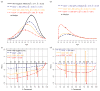
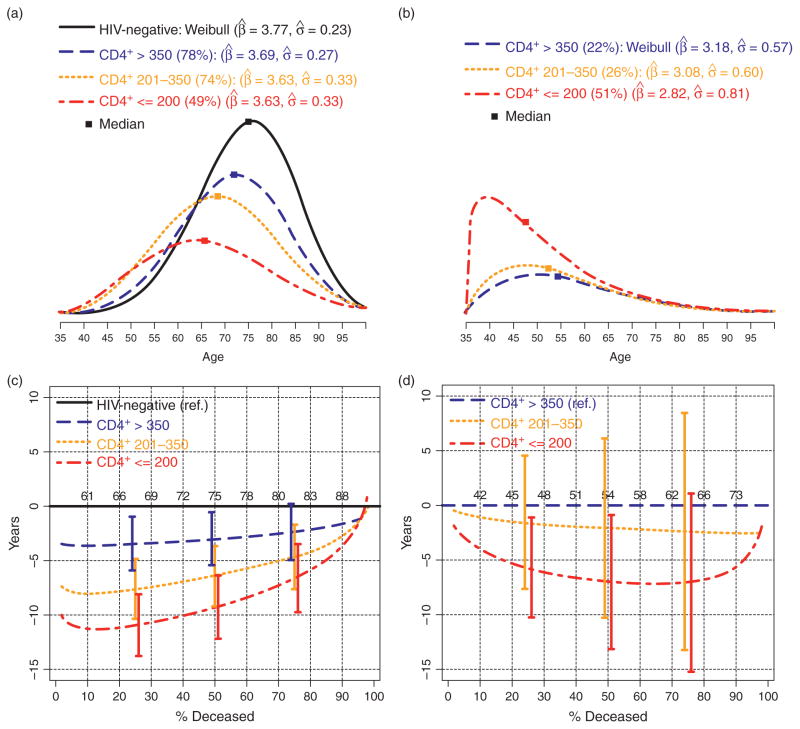
Description:Objectives ; To compare the proportion, timing and hazards of non-AIDS death and AIDS death among men and women who initiated HAART at different CD4+ cell counts to mortality risks of HIV-uninfected persons with similar risk factors. ; Design ; Prospective cohort studies. ; Methods ; We used parametric mixture models to compare proportions of AIDS and non-AIDS mortality and ages at death, and multivariable Cox models to compare cause-specific hazards of mortality, across levels of CD4+ cell count at HAART initiation (≤200 cells/μl: ‘late’, 201–350 cells/μl: ‘intermediate’, >350 cells/μl: ‘early’) and with HIV-uninfected individuals from the Multicenter AIDS Cohort Study and the Women’s Interagency HIV Study. We used multiple imputation methods to address lead-time bias in sensitivity analysis. ; Results ; Earlier initiators were more likely to die of non-AIDS causes (early: 78%, intermediate: 74%, late: 49%), and at older ages (median years 72, 69, 66), relative to later initiators. Estimated median ages at non-AIDS death for each CD4+ cell count category were lower than that estimated for the HIV-uninfected group (75 years). In multivariable analysis, non-AIDS death hazard ratios relative to early initiators were 2.15 for late initiators (P < 0.01) and 1.66 for intermediate initiators (P = 0.01); AIDS death hazard ratios were 3.26 for late initiators (P <0.01) and 1.20 for intermediate initiators (P = 0.28). Strikingly, the adjusted hazards for non-AIDS death among HIV-uninfected individuals and early initiators were nearly identical (hazard ratio 1.01). Inferences were unchanged after adjustment for lead-time bias. ; Conclusion ; Results suggest the possibility of reducing the risk of non-AIDS mortality among HIV-infected individuals to approximate that faced by comparable HIV-uninfected individuals.
-
Keywords:
-
Source:AIDS. 2014; 28(2):257-265
-
Pubmed ID:24105030
-
Pubmed Central ID:PMC4164055
-
Document Type:
-
Funding:U01 AI035042/AI/NIAID NIH HHSUnited States/ ; M01 RR000079/RR/NCRR NIH HHSUnited States/ ; UO1-AI-34994/AI/NIAID NIH HHSUnited States/ ; UO1-AI-34989/AI/NIAID NIH HHSUnited States/ ; UO1-AI-35042/AI/NIAID NIH HHSUnited States/ ; U01 AI035004/AI/NIAID NIH HHSUnited States/ ; UO1-CH-32632/CH/OID CDC HHSUnited States/ ; UO1-AI-35040/AI/NIAID NIH HHSUnited States/ ; U01 AI034989/AI/NIAID NIH HHSUnited States/ ; UO1-AI-35004/AI/NIAID NIH HHSUnited States/ ; UM1 AI035043/AI/NIAID NIH HHSUnited States/ ; UO1-AI-34993/AI/NIAID NIH HHSUnited States/ ; U01 AI034994/AI/NIAID NIH HHSUnited States/ ; MO1-RR-00079/RR/NCRR NIH HHSUnited States/ ; UL1-RR025005/RR/NCRR NIH HHSUnited States/ ; UO1-AI-35039/AI/NIAID NIH HHSUnited States/ ; U01 AI034993/AI/NIAID NIH HHSUnited States/ ; U01 AI035039/AI/NIAID NIH HHSUnited States/ ; UL1 RR025005/RR/NCRR NIH HHSUnited States/ ; MO1-RR-00083/RR/NCRR NIH HHSUnited States/ ; U01 AI031834/AI/NIAID NIH HHSUnited States/ ; UO1-AI-35041/AI/NIAID NIH HHSUnited States/ ; M01 RR000071/RR/NCRR NIH HHSUnited States/ ; U01 AI035041/AI/NIAID NIH HHSUnited States/ ; UM1-AI-35043/AI/NIAID NIH HHSUnited States/ ; UO1-AI-42590/AI/NIAID NIH HHSUnited States/ ; U01 AI035040/AI/NIAID NIH HHSUnited States/ ; UO1-AI-31834/AI/NIAID NIH HHSUnited States/ ; M01 RR000083/RR/NCRR NIH HHSUnited States/ ; MO1-RR-00071/RR/NCRR NIH HHSUnited States/ ; U01 HD032632/HD/NICHD NIH HHSUnited States/ ; U01 AI042590/AI/NIAID NIH HHSUnited States/
-
Volume:28
-
Issue:2
-
Download URL:
-
File Type:
 [PDF - 380.43 KB]
 -
Collection(s):
-
Main Document Checksum:urn:sha256:468e8044e56bf841881c8d81c7326ad03bfad14b8938f136153c3018f8f5c884
Supporting Files


File Language:
English
 Was this page helpful?
 Found an issue?

CDC STACKS serves as an archival repository of CDC-published products including
scientific findings, journal articles, guidelines, recommendations, or other public health information authored or
co-authored by CDC or funded partners.
As a repository, CDC STACKS retains documents in their original published format to ensure public access to scientific information.
As a repository, CDC STACKS retains documents in their original published format to ensure public access to scientific information.
You May Also Like
COLLECTION
CDC Public Access