



Lipid Bilayer Vesicle Generation Using Microfluidic Jetting
Supporting Files

-
Feb 21 2014
-
Available in CDC Stacks on 2014-08-21T00:00:00Z
Details
-
Alternative Title:J Vis Exp
-
Personal Author:
-
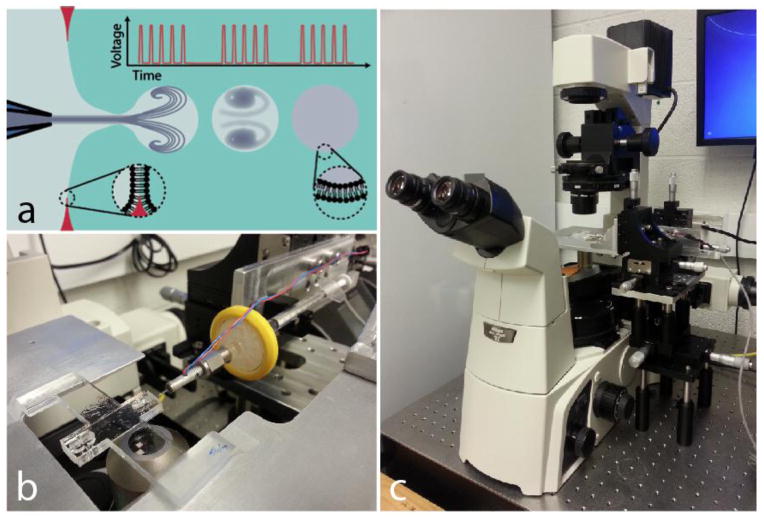
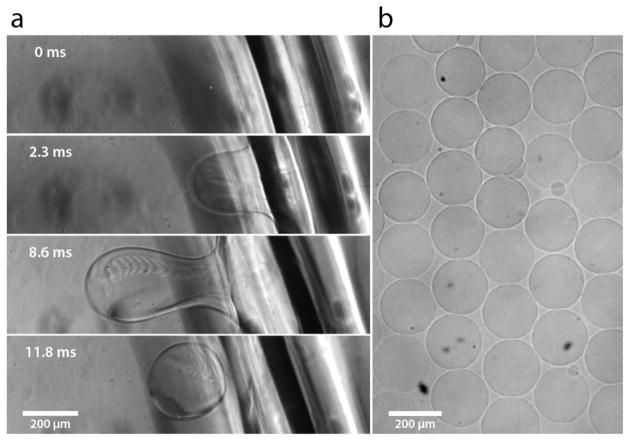
Description:SHORT ABSTRACT ; Microfluidic jetting against a droplet interface lipid bilayer provides a reliable way to generate vesicles with control over membrane asymmetry, incorporation of transmembrane proteins, and encapsulation of material. This technique can be applied to study a variety of biological systems where compartmentalized biomolecules are desired. ; LONG ABSTRACT ; Bottom-up synthetic biology presents a novel approach for investigating and reconstituting biochemical systems and, potentially, minimal organisms. This emerging field engages engineers, chemists, biologists, and physicists to design and assemble basic biological components into complex, functioning systems from the bottom up. Such bottom-up systems could lead to the development of artificial cells for fundamental biological inquiries and innovative therapies1,2. Giant unilamellar vesicles (GUVs) can serve as a model platform for synthetic biology due to their cell-like membrane structure and size. Microfluidic jetting, or microjetting, is a technique that allows for the generation of GUVs with controlled size, membrane composition, transmembrane protein incorporation, and encapsulation3. The basic principle of this method is the use of multiple, high-frequency fluid pulses generated by a piezo-actuated inkjet device to deform a suspended lipid bilayer into a GUV. The process is akin to blowing soap bubbles from a soap film. By varying the composition of the jetted solution, the composition of the encompassing solution, and/or the components included in the bilayer, researchers can apply this technique to create customized vesicles. This paper describes the procedure to generate simple vesicles from a droplet interface bilayer by microjetting.
-
Subjects:
-
Source:J Vis Exp. (84):e51510.
-
Pubmed ID:24637415
-
Pubmed Central ID:PMC4130367
-
Document Type:
-
Funding:
-
Download URL:
-
File Type:
 [PDF - 592.71 KB]
 -
Collection(s):
-
Main Document Checksum:urn:sha256:87ad49987c8faaed1e64800c6e37002cec7ebb68d47405f572bd3b4e431196dc
Supporting Files


 Was this page helpful?
 Found an issue?



CDC STACKS serves as an archival repository of CDC-published products including
scientific findings, journal articles, guidelines, recommendations, or other public health information authored or
co-authored by CDC or funded partners.
As a repository, CDC STACKS retains documents in their original published format to ensure public access to scientific information.
As a repository, CDC STACKS retains documents in their original published format to ensure public access to scientific information.
You May Also Like
COLLECTION
CDC Public Access