


Addressing Population Health and Health Inequalities: The Role of Fundamental Causes
Supporting Files

-
Sep 2014
-
File Language:
English
Details
-
Alternative Title:Am J Public Health
-
Personal Author:
-
Description:Objectives
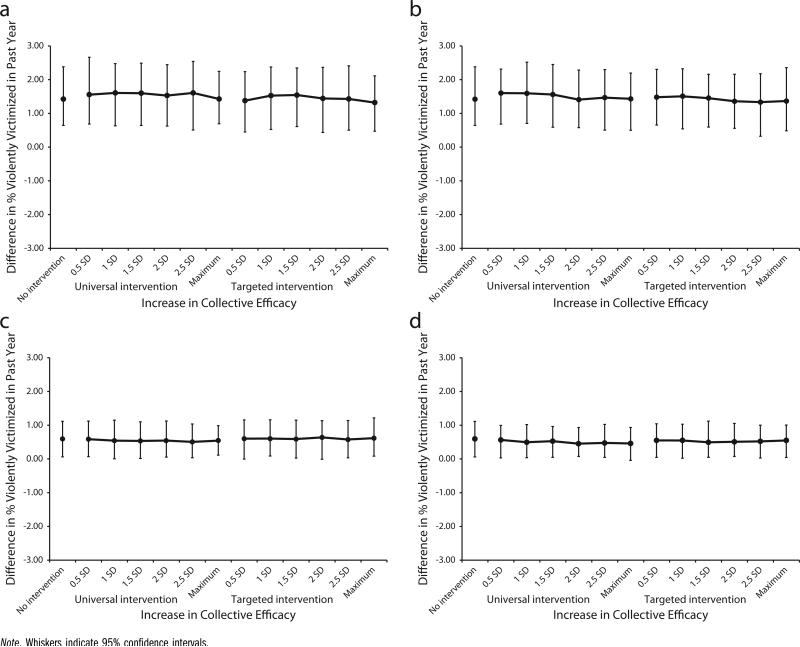
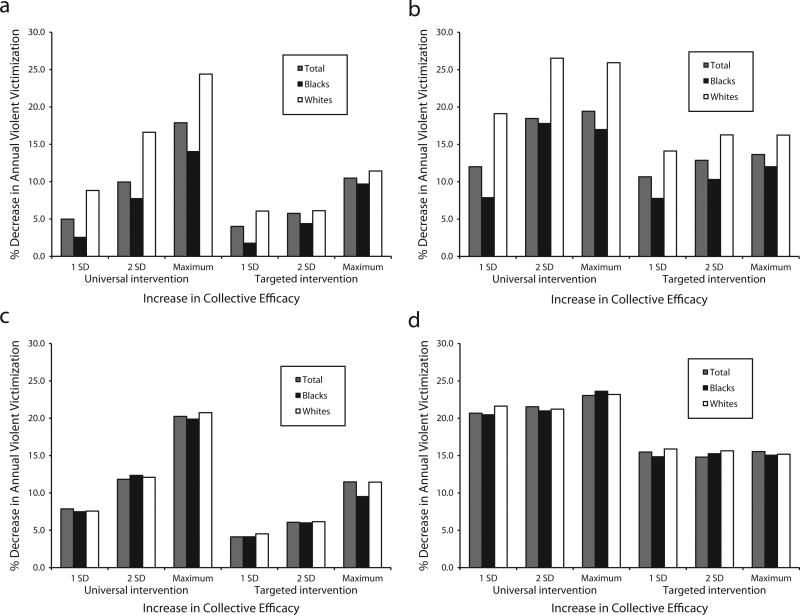
As a case study of the impact of universal versus targeted interventions on population health and health inequalities, we used simulations to examine (1) whether universal or targeted manipulations of collective efficacy better reduced population-level rates and racial/ethnic inequalities in violent victimization; and (2) whether experiments reduced disparities without addressing fundamental causes.
Methods
We applied agent-based simulation techniques to the specific example of an intervention on neighborhood collective efficacy to reduce population-level rates and racial/ethnic inequalities in violent victimization. The agent population consisted of 4000 individuals aged 18 years and older with sociodemographic characteristics assigned to match distributions of the adult population in New York City according to the 2000 US Census.
Results
Universal experiments reduced rates of victimization more than targeted experiments. However, neither experiment reduced inequalities. To reduce inequalities, it was necessary to eliminate racial/ethnic residential segregation.
Conclusions
These simulations support the use of universal intervention but suggest that it is not possible to address inequalities in health without first addressing fundamental causes.
-
Subjects:
-
Source:Am J Public Health. 104(0 4):S609-S619.
-
Pubmed ID:25100428
-
Pubmed Central ID:PMC4126171
-
Document Type:
-
Funding:
-
Volume:104
-
Collection(s):
-
Main Document Checksum:urn:sha256:1667726052b1ae51210049767f6ca8f3e8eed601e09fbb885cd9bd4716922905
-
Download URL:
-
File Type:
 [PDF
- 2.06 MB
]
[PDF
- 2.06 MB
]
Supporting Files


File Language:
English
ON THIS PAGE




CDC STACKS serves as an archival repository of CDC-published products including
scientific findings,
journal articles, guidelines, recommendations, or other public health information authored or
co-authored by CDC or funded partners.
As a repository, CDC STACKS retains documents in their original published format to ensure public access to scientific information.
As a repository, CDC STACKS retains documents in their original published format to ensure public access to scientific information.
You May Also Like
COLLECTION
CDC Public Access