


Factors associated with influenza vaccine receipt in community dwelling adults and their children
Supporting Files

-
Feb 12 2014
-
Details
-
Alternative Title:Vaccine
-
Personal Author:
-
Description:Background
Factors associated with influenza vaccine receipt are well studied in healthcare personnel, pregnant women, and the elderly. There has been substantially less research in community dwelling adults and children, and none among entire households. Many studies determine vaccination status by self-report or behavioral intention, outcomes susceptible to misclassification. Given that vaccine is recommended for everyone over six months, re-evaluating these factors is warranted.
Methods
The Household Influenza Vaccine Effectiveness (HIVE) study is a prospective cohort of households with children. In 2010-2011, 549 adults representing 312 households completed surveys evaluating knowledge, attitudes, and practices regarding influenza vaccination for themselves and their children. Using the health belief model (HBM) as a framework, we examined factors associated with documented seasonal influenza vaccine receipt using log-binomial regression models.
Results
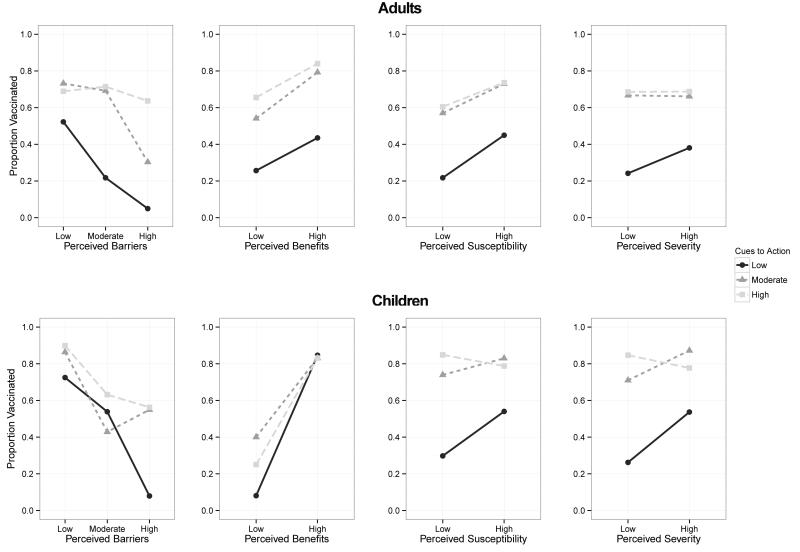
In multivariate models, cues to action such as doctor recommendation, (RR 1.62, 95% CI:1.25-2.10), perceived benefits (RR 1.25, 95% CI:1.04-1.50), and perceived susceptibility (RR 1.21, 95% CI:1.03-1.42) were significantly associated with increased likelihood of vaccine receipt among adults while high perceived barriers were associated with decreased likelihood (RR 0.38, 95% CI:0.25-0.59). Similarly, parents reporting higher barriers were less likely (RR 0.58, 95% CI:0.42-0.79) and those perceiving greater benefits (RR 4.16, 95% CI:2.28-7.59) and severity (RR 1.13, 95% CI:1.00-1.27 were more likely to vaccinate their children. The observed effects of perceptions of susceptibility, severity, and benefits were more pronounced at low cues to action for children, as were the effects of perceptions of barriers and severity among adults.
Conclusion
Perceived benefits and barriers are most strongly associated with vaccine receipt. However, the effects of various factors were most pronounced in the absence of cues to action, which may be an important component of targeted interventions.
-
Subjects:
-
Source:Vaccine. 2014; 32(16):1841-1847.
-
Pubmed ID:24530926
-
Pubmed Central ID:PMC4084780
-
Document Type:
-
Funding:
-
Volume:32
-
Issue:16
-
Collection(s):
-
Main Document Checksum:urn:sha256:07e73eb7c2371a58a060232647144219963dbef926f74420cab0d929fc3681ea
-
Download URL:
-
File Type:
 [PDF
- 478.99 KB
]
[PDF
- 478.99 KB
]
Supporting Files


ON THIS PAGE



CDC STACKS serves as an archival repository of CDC-published products including
scientific findings,
journal articles, guidelines, recommendations, or other public health information authored or
co-authored by CDC or funded partners.
As a repository, CDC STACKS retains documents in their original published format to ensure public access to scientific information.
As a repository, CDC STACKS retains documents in their original published format to ensure public access to scientific information.
You May Also Like
COLLECTION
CDC Public Access