



The influence of genetic ancestry and ethnicity on breast cancer survival associated with genetic variation in the TGF-β-signaling pathway: The Breast Cancer Health Disparities Study
Supporting Files

-
Dec 12 2013
-
Available in CDC Stacks on 2015-03-01T00:00:00Z
File Language:
English
Details
-
Alternative Title:Cancer Causes Control
-
Personal Author:
-
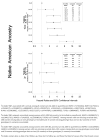
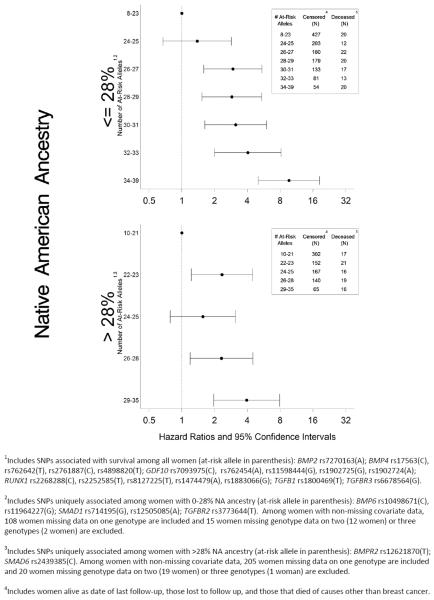
Description:The TGF-β signaling pathway regulates cellular proliferation and differentiation. We evaluated genetic variation in this pathway, its association with breast cancer survival, and survival differences by genetic ancestry and self-reported ethnicity. The Breast Cancer Health Disparities Study includes participants from the 4-Corners Breast Cancer Study (n = 1,391 cases) and the San Francisco Bay Area Breast Cancer Study (n = 946 cases) who have been followed for survival. We evaluated 28 genes in the TGF-β signaling pathway using a tagSNP approach. Adaptive rank truncated product (ARTP) was used to test the gene and pathway significance by Native American (NA) ancestry and by self-reported ethnicity (non-Hispanic white (NHW) and Hispanic/NA). Genetic variation in the TGF-β signaling pathway was associated with overall breast cancer survival (P ARTP = 0.05), especially for women with low NA ancestry (P ARTP = 0.007) and NHW women (P ARTP = 0.006). BMP2, BMP4, RUNX1, and TGFBR3 were significantly associated with breast cancer survival overall (P ARTP = 0.04, 0.02, 0.002, and 0.04, respectively). Among women with low NA, ancestry associations were as follows: BMP4 (P ARTP = 0.007), BMP6 (P ARTP = 0.001), GDF10 (P ARTP = 0.05), RUNX1 (P ARTP = 0.002), SMAD1 (P ARTP = 0.05), and TGFBR2 (P ARTP = 0.02). A polygenic risk model showed that women with low NA ancestry and high numbers of at-risk alleles had twice the risk of dying from breast cancer as did women with high NA ancestry. Our data suggest that genetic variation in the TGF-β signaling pathway influences breast cancer survival. Associations were similar when the analyses were stratified by genetic ancestry or by self-reported ethnicity.
-
Subjects:
-
Source:Cancer Causes Control. 25(3):293-307.
-
Pubmed ID:24337772
-
Pubmed Central ID:PMC3946243
-
Document Type:
-
Funding:1U58 DP000807-01/DP/NCCDPHP CDC HHS/United States ; CA078552/CA/NCI NIH HHS/United States ; CA078682/CA/NCI NIH HHS/United States ; CA078762/CA/NCI NIH HHS/United States ; CA078802/CA/NCI NIH HHS/United States ; CA14002/CA/NCI NIH HHS/United States ; CA63446/CA/NCI NIH HHS/United States ; CA77305/CA/NCI NIH HHS/United States ; N01-PC-67000/PC/NCI NIH HHS/United States ; R01 CA078682/CA/NCI NIH HHS/United States ; R01 CA140002/CA/NCI NIH HHS/United States
-
Volume:25
-
Issue:3
-
Download URL:
-
File Type:
 [PDF - 1.08 MB]
 -
Collection(s):
-
Main Document Checksum:urn:sha256:fab0cc95193574d09723c1e04575fdb1a30be2544223fadd263665b78bba9120
Supporting Files


File Language:
English
 Was this page helpful?
 Found an issue?



CDC STACKS serves as an archival repository of CDC-published products including
scientific findings, journal articles, guidelines, recommendations, or other public health information authored or
co-authored by CDC or funded partners.
As a repository, CDC STACKS retains documents in their original published format to ensure public access to scientific information.
As a repository, CDC STACKS retains documents in their original published format to ensure public access to scientific information.
You May Also Like
COLLECTION
CDC Public Access