



Genetic ancestry and risk of mortality among U.S. Latinas with breast cancer
Supporting Files

-
Oct 31 2013
-
Available in CDC Stacks on 2014-12-15T00:00:00Z
File Language:
English
Details
-
Alternative Title:Cancer Res
-
Personal Author:
-
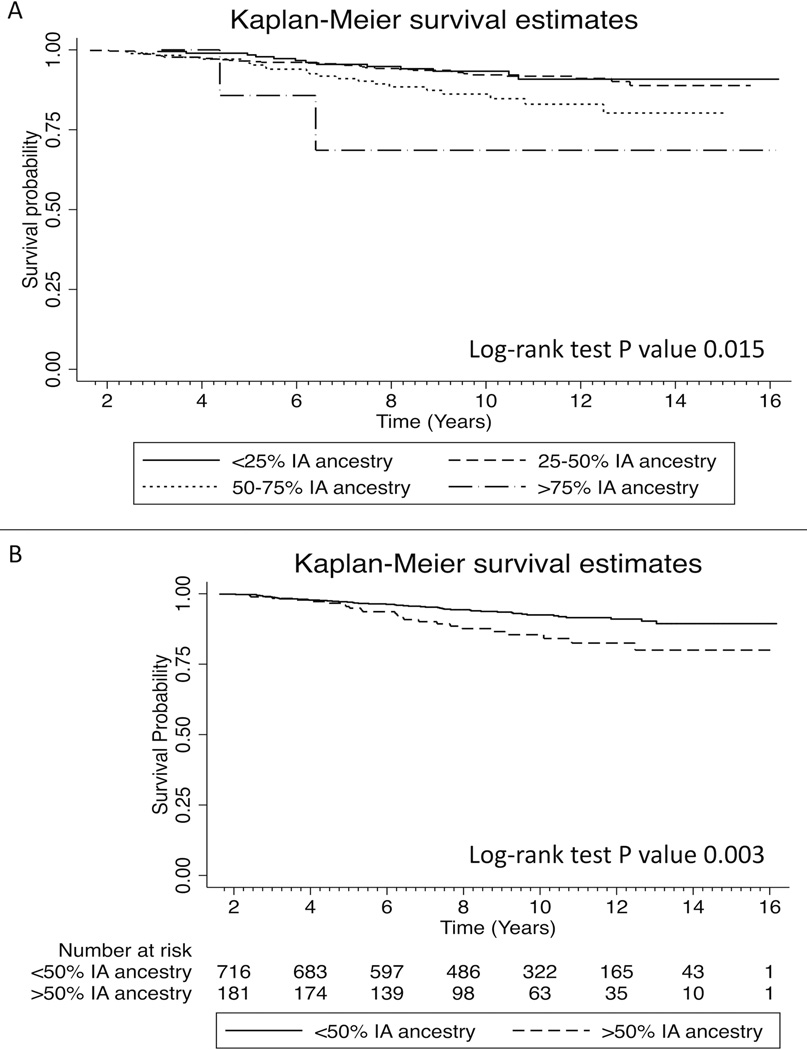
Description:Multiple studies have reported that Latina women in the United States are diagnosed with breast cancer at more advanced stages and have poorer survival than non-Latina White women. However, Latinas are a heterogeneous group with individuals having different proportions of European, Indigenous American, and African genetic ancestry. In this study, we evaluated the association between genetic ancestry and survival after breast cancer diagnosis among 899 Latina women from the San Francisco Bay area. Genetic ancestry was estimated from single-nucleotide polymorphisms from an Affymetrix 6.0 array and we used Cox proportional hazards models to evaluate the association between genetic ancestry and breast cancer-specific mortality (tests were two-sided). Women were followed for an average of 9 years during which 75 died from breast cancer. Our results showed that Individuals with higher Indigenous American ancestry had increased risk of breast cancer-specific mortality HR: 1.57 per 25% increase in Indigenous American ancestry; 95% confidence interval (CI): 1.08-2.29. Adjustment for demographic factors, tumor characteristics, and some treatment information did not explain the observed association (HR: 1.75; 95%CI, 1.12-2.74). In an analysis in which ancestry was dichotomized, the hazard of mortality showed a two-fold increase when comparing women with less than 50% Indigenous American ancestry to women with 50% or more HR, 1.89, 95%CI, 1.10-3.24. This was also reflected by Kaplan-Meier survival estimates (P for log-rank test of 0.003). Overall, results suggest that genetic factors and/or unmeasured differences in treatment or access to care should be further explored to understand and reduce ethnic disparities in breast cancer outcomes.
-
Subjects:
-
Source:Cancer Res. 73(24):7243-7253.
-
Pubmed ID:24177181
-
Pubmed Central ID:PMC3881587
-
Document Type:
-
Funding:1U54CA153511/CA/NCI NIH HHS/United States ; CA 160607/CA/NCI NIH HHS/United States ; CA120120/CA/NCI NIH HHS/United States ; CA63446/CA/NCI NIH HHS/United States ; CA77305/CA/NCI NIH HHS/United States ; HHSN261201000034C/PHS HHS/United States ; HHSN261201000140C/PHS HHS/United States ; K01 CA160607/CA/NCI NIH HHS/United States ; K24 CA169004/CA/NCI NIH HHS/United States ; P30 AG015272/AG/NIA NIH HHS/United States ; P30-AG15272/AG/NIA NIH HHS/United States ; R01 CA120120/CA/NCI NIH HHS/United States ; U58DP003862-01/DP/NCCDPHP CDC HHS/United States ; UM1 CA164920/CA/NCI NIH HHS/United States
-
Place as Subject:
-
Volume:73
-
Issue:24
-
Download URL:
-
File Type:
 [PDF - 840.81 KB]
 -
Collection(s):
-
Main Document Checksum:urn:sha256:83478f2cce19b7c5af4e6197ac3e0789b0e3c6d38d6f1bc90b8fabd91d6f83bf
Supporting Files


File Language:
English
 Was this page helpful?
 Found an issue?

CDC STACKS serves as an archival repository of CDC-published products including
scientific findings, journal articles, guidelines, recommendations, or other public health information authored or
co-authored by CDC or funded partners.
As a repository, CDC STACKS retains documents in their original published format to ensure public access to scientific information.
As a repository, CDC STACKS retains documents in their original published format to ensure public access to scientific information.
You May Also Like
COLLECTION
CDC Public Access