


Angiotensin receptor blockers: are they related to lung cancer?
Supporting Files

-
Aug 2013
-
File Language:
English
Details
-
Alternative Title:J Hypertens
-
Personal Author:
-
Description:Introduction
Angiotensin receptor blockers (ARBs) are commonly used antihypertensive medication with several other additional proven benefits. Recent controversy on association of lung cancer and other solid malignancy with the use of ARBs is concerning, although the follow-up studies have shown no such association.
Methods
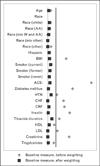
We used data from the Department of Veterans Affairs electronic medical record system and registries to conduct a retrospective cohort study that compared first-time ARB users with nonusers in 1:15 ratio, after balancing for many baseline differences using inverse probability of treatment weights. We conducted time-to-event survival analyses on the weighted cohort.
Results
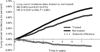
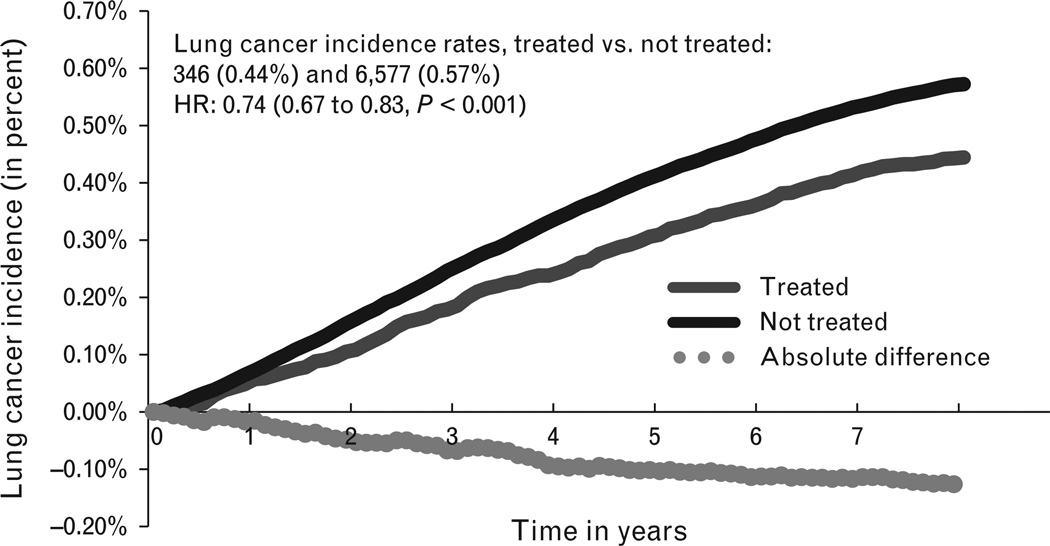
Of the 1 229 902 patients in the analytic cohort, 346 (0.44%) of the 78 075 treated individuals had a newly incident lung cancer and 6577 (0.57%) of 1 151 826 nontreated individuals were diagnosed with lung cancer. On double robust regression, the weighted hazard ratio was 0.74 (0.67–0.83, P<0.0001), suggesting a lung cancer reduction effect with ARB use. There was no difference in rates by ARB subtype.
Conclusion
In this large nationwide cohort of United States Veterans, we found no evidence to support any concern of increased risk of lung cancer among new users of ARBs compared with nonusers. Our findings were consistent with a protective effect of ARBs.
-
Subjects:
-
Source:J Hypertens. 2013; 31(8):1669-1675.
-
Pubmed ID:23822929
-
Pubmed Central ID:PMC3879726
-
Document Type:
-
Funding:
-
Name as Subject:
-
Place as Subject:
-
Volume:31
-
Issue:8
-
Collection(s):
-
Main Document Checksum:urn:sha256:8063930112778504190978dc804d376c7f0354954544acf6238367c4d09fe01d
-
Download URL:
-
File Type:
 [PDF
- 909.19 KB
]
[PDF
- 909.19 KB
]
Supporting Files


File Language:
English
ON THIS PAGE


CDC STACKS serves as an archival repository of CDC-published products including
scientific findings,
journal articles, guidelines, recommendations, or other public health information authored or
co-authored by CDC or funded partners.
As a repository, CDC STACKS retains documents in their original published format to ensure public access to scientific information.
As a repository, CDC STACKS retains documents in their original published format to ensure public access to scientific information.
You May Also Like
COLLECTION
CDC Public Access