


Prevalence of bifid median nerves and persistent median arteries and their association with carpal tunnel syndrome in a sample of Latino poultry processors and other manual workers
Supporting Files

-
Aug 27 2013
-
File Language:
English
Details
-
Alternative Title:Muscle Nerve
-
Personal Author:
-
Description:Introduction
The prevalence of bifid median nerves and persistent median arteries, their co-occurrence, and their relationship to carpal tunnel syndrome (CTS) are only understood partially.
Methods
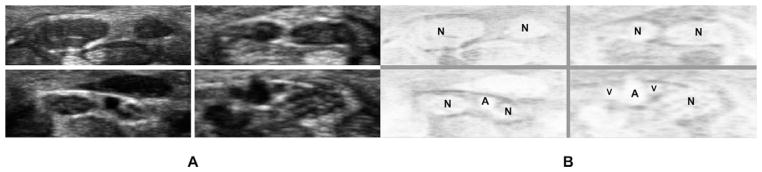
We screened 1026 wrists of 513 Latino manual laborers in North Carolina for bifid median nerves and persistent median arteries using electrodiagnosis and ultrasound.
Results
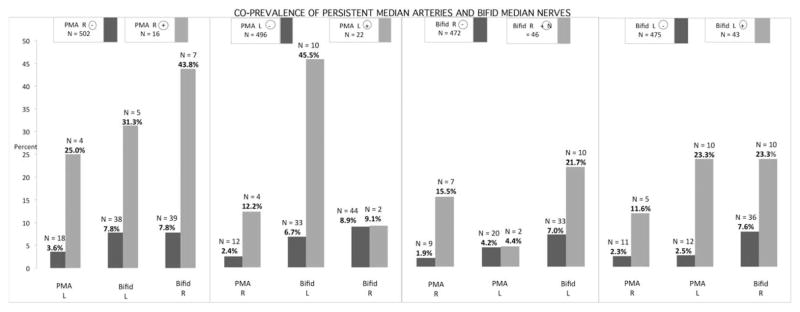
A total of 8.6% of wrists had a bifid median nerve, and 3.7% of wrists had a persistent median artery independent of subgroup ethnicity, age, gender, or type of work. An association with definite carpal tunnel syndrome was not found. The presence of either anatomic variant was associated with a high likelihood of co-occurrence of another variant in the same or the contralateral wrist.
Conclusions
The occurrence of median anatomic variants can be determined in field studies using ultrasound. Persistent median arteries and bifid median nerves tend to co-occur but do not put manual laborers at additional risk of developing CTS.
-
Subjects:
-
Source:Muscle Nerve. 2013; 48(4):539-544.
-
Pubmed ID:24037717
-
Pubmed Central ID:PMC3836559
-
Document Type:
-
Funding:
-
Place as Subject:
-
Volume:48
-
Issue:4
-
Collection(s):
-
Main Document Checksum:urn:sha256:9443490d12ac1ad011897ed56578c7b1dabf1325febc6799071b2180c7a39695
-
Download URL:
-
File Type:
 [PDF
- 292.81 KB
]
[PDF
- 292.81 KB
]
Supporting Files


File Language:
English
ON THIS PAGE


CDC STACKS serves as an archival repository of CDC-published products including
scientific findings,
journal articles, guidelines, recommendations, or other public health information authored or
co-authored by CDC or funded partners.
As a repository, CDC STACKS retains documents in their original published format to ensure public access to scientific information.
As a repository, CDC STACKS retains documents in their original published format to ensure public access to scientific information.
You May Also Like
COLLECTION
CDC Public Access