


Longitudinal design for sonographic measurement of median nerve swelling with controlled exposure to physical work using an animal model
Supporting Files

-
Oct 16 2013
-
File Language:
English
Details
-
Alternative Title:Ultrasound Med Biol
-
Personal Author:
-
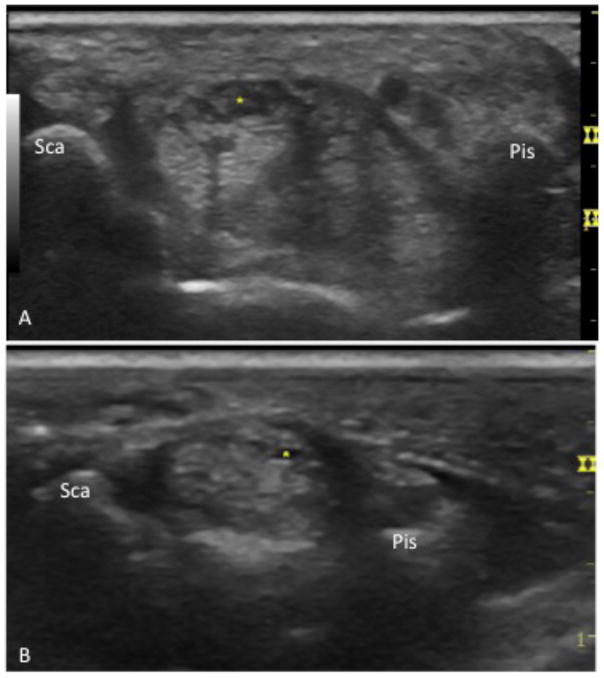
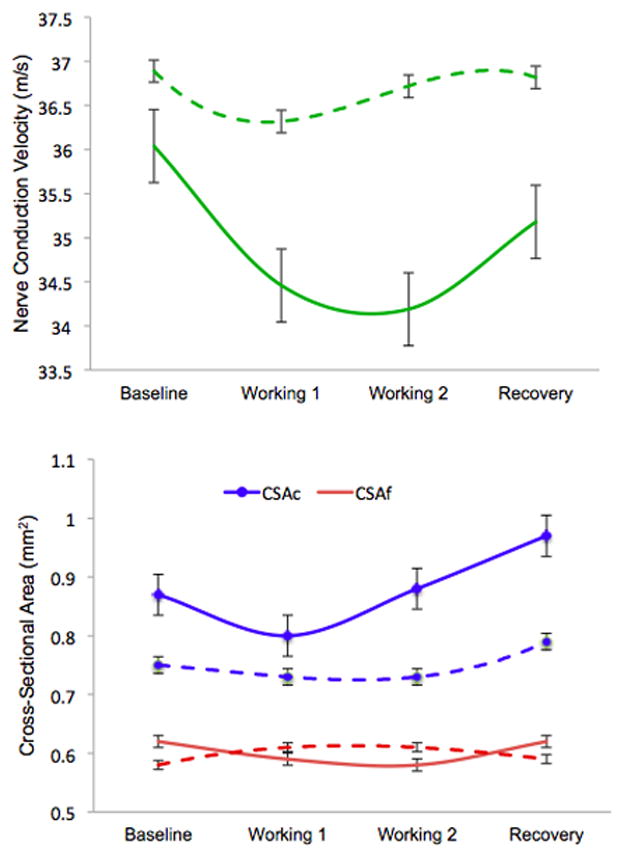
Description:In the study described here, we examined the feasibility of a longitudinal design to measure sonographically swelling of the median nerve caused by controlled exposure to a work task and to evaluate the relationship of changes in morphology to diagnostic standards. Fifteen macaques, Macaca fascicularis, pinched a lever in various wrist positions at a self-regulated pace (8 h/d, 5 d/wk, 18-20 wk). Nerve conduction velocity (NCV) and cross-sectional area (CSA) were measured every 2 wk from baseline through working and a 6-wk recovery. Trending across all subjects revealed that NCV slowed and CSA at the carpal tunnel increased in the working arm, whereas no changes were observed in CSA either at the forearm or for any measure in the non-working arm. There was a small negative correlation between NCV and CSA in the working arm. This study provides validation that swelling can be observed using a longitudinal design. Longitudinal human studies are needed to describe the trajectory of nerve swelling for early identification of median nerve pathology.
-
Subjects:
-
Source:Ultrasound Med Biol. 39(12):2492-2497.
-
Pubmed ID:24139197
-
Pubmed Central ID:PMC3834154
-
Document Type:
-
Funding:
-
Volume:39
-
Issue:12
-
Collection(s):
-
Main Document Checksum:urn:sha256:1be47edfa8fb35f0abffe8ee80e31ec2237ec2156f26596c634f395674fc1e55
-
Download URL:
-
File Type:
 [PDF
- 284.30 KB
]
[PDF
- 284.30 KB
]
Supporting Files


File Language:
English
ON THIS PAGE



CDC STACKS serves as an archival repository of CDC-published products including
scientific findings,
journal articles, guidelines, recommendations, or other public health information authored or
co-authored by CDC or funded partners.
As a repository, CDC STACKS retains documents in their original published format to ensure public access to scientific information.
As a repository, CDC STACKS retains documents in their original published format to ensure public access to scientific information.
You May Also Like
COLLECTION
CDC Public Access