


Modeling Seizure Self-Prediction: An E-Diary Study
Supporting Files

-
Sep 20 2013
-
Details
-
Alternative Title:Epilepsia
-
Personal Author:
-
Description:Purpose
A subset of patients with epilepsy successfully self-predicted seizures in a paper diary study. We conducted an e-diary study to ensure that prediction precedes seizures, and to characterize the prodromal features and time windows that underlie self-prediction.
Methods
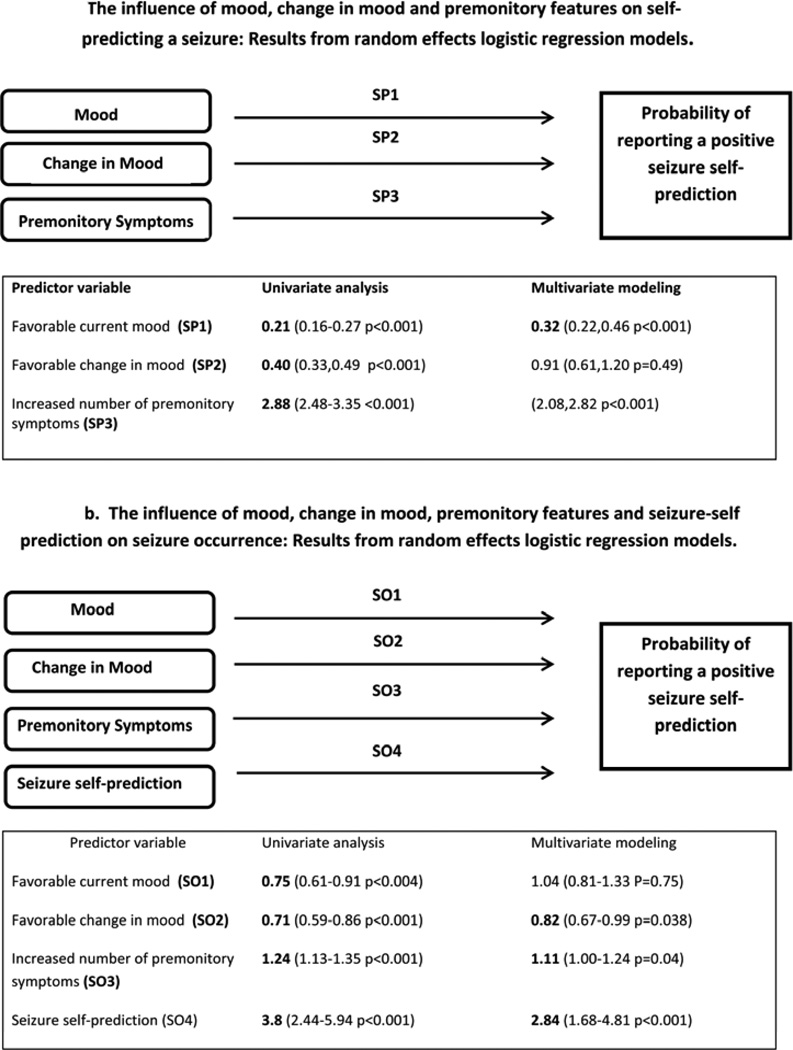
Subjects 18 or older with LRE and ≥3 seizures/month maintained an e-diary, reporting AM/PM data daily, including mood, premonitory symptoms, and all seizures. Self-prediction was rated by, “How likely are you to experience a seizure [time frame]”? Five choices ranged from almost certain (>95% chance) to very unlikely. Relative odds of seizure (OR) within time frames was examined using Poisson models with log normal random effects to adjust for multiple observations.
Key Findings
Nineteen subjects reported 244 eligible seizures. OR for prediction choices within 6hrs was as high as 9.31 (1.92,45.23) for “almost certain”. Prediction was most robust within 6hrs of diary entry, and remained significant up to 12hrs. For 9 best predictors, average sensitivity was 50%. Older age contributed to successful self-prediction, and self-prediction appeared to be driven by mood and premonitory symptoms. In multivariate modeling of seizure occurrence, self-prediction (2.84; 1.68,4.81), favorable change in mood (0.82; 0.67,0.99) and number of premonitory symptoms (1,11; 1.00,1.24) were significant.
Significance
Some persons with epilepsy can self-predict seizures. In these individuals, the odds of a seizure following a positive prediction are high. Predictions were robust, not attributable to recall bias, and were related to self awareness of mood and premonitory features. The 6-hour prediction window is suitable for the development of pre-emptive therapy.
-
Subjects:
-
Source:Epilepsia. 54(11):1960-1967.
-
Pubmed ID:24111898
-
Pubmed Central ID:PMC3833277
-
Document Type:
-
Funding:1R01DA031275-01A1/DA/NIDA NIH HHS/United States ; 5P60AA003510-33/AA/NIAAA NIH HHS/United States ; 5R01AA016599-03/AA/NIAAA NIH HHS/United States ; 5R01AA12827-07/AA/NIAAA NIH HHS/United States ; K23AG030857/AG/NIA NIH HHS/United States ; K23NS05140901A1/NS/NINDS NIH HHS/United States ; K23NS47256/NS/NINDS NIH HHS/United States ; P01 AG003949/AG/NIA NIH HHS/United States ; P01 AG027734/AG/NIA NIH HHS/United States ; P01 AG03949/AG/NIA NIH HHS/United States ; P30 CA13330-35/CA/NCI NIH HHS/United States ; R01 AG022092/AG/NIA NIH HHS/United States ; R01 AG034087/AG/NIA NIH HHS/United States ; R01 NS053998/NS/NINDS NIH HHS/United States ; R01AG022374-06A2/AG/NIA NIH HHS/United States ; R01AG025119/AG/NIA NIH HHS/United States ; R01AG034119/AG/NIA NIH HHS/United States ; R01AG12101/AG/NIA NIH HHS/United States ; R21 AG036935/AG/NIA NIH HHS/United States ; U01-OH10411/OH/NIOSH CDC HHS/United States ; U01-OH10412/OH/NIOSH CDC HHS/United States ; UL1-RR025750-01/RR/NCRR NIH HHS/United States
-
Volume:54
-
Issue:11
-
Collection(s):
-
Main Document Checksum:urn:sha256:157faf1bcbf34cc3bf41d413ad1f88df12a735ec1f7060e37d697afe79403ef5
-
Download URL:
-
File Type:
 [PDF
- 955.60 KB
]
[PDF
- 955.60 KB
]
Supporting Files


ON THIS PAGE


CDC STACKS serves as an archival repository of CDC-published products including
scientific findings,
journal articles, guidelines, recommendations, or other public health information authored or
co-authored by CDC or funded partners.
As a repository, CDC STACKS retains documents in their original published format to ensure public access to scientific information.
As a repository, CDC STACKS retains documents in their original published format to ensure public access to scientific information.
You May Also Like
COLLECTION
CDC Public Access