



Head Impact Exposure Sustained by Football Players on Days of Diagnosed Concussion
Supporting Files

-
Apr 2013
-
Available in CDC Stacks on 2014-04-01T00:00:00Z
File Language:
English
Details
-
Alternative Title:Med Sci Sports Exerc
-
Personal Author:Beckwith, Jonathan G. ; Greenwald, Richard M. ; Chu, Jeffrey J. ; Crisco, Joseph J. ; Rowson, Steven ; Duma, Stefan M. ; Broglio, Steven P. ; McAllister, Thomas W. ; Guskiewicz, Kevin M. ; Mihalik, Jason P. ; Anderson, Scott ; Schnebel, Brock ; Brolinson, P. Gunnar ; Collins, Michael W.
-
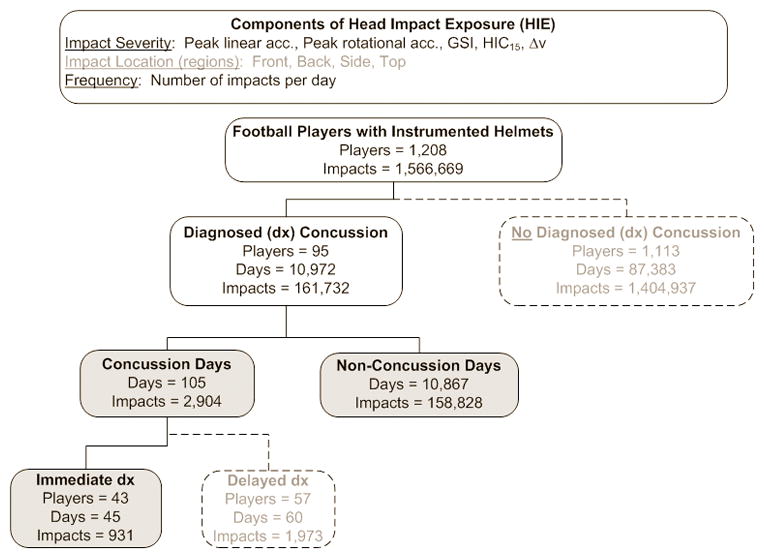
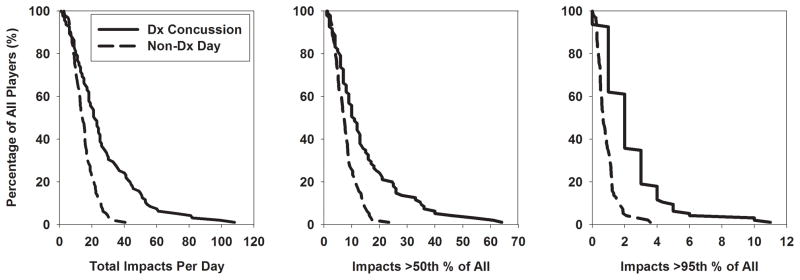
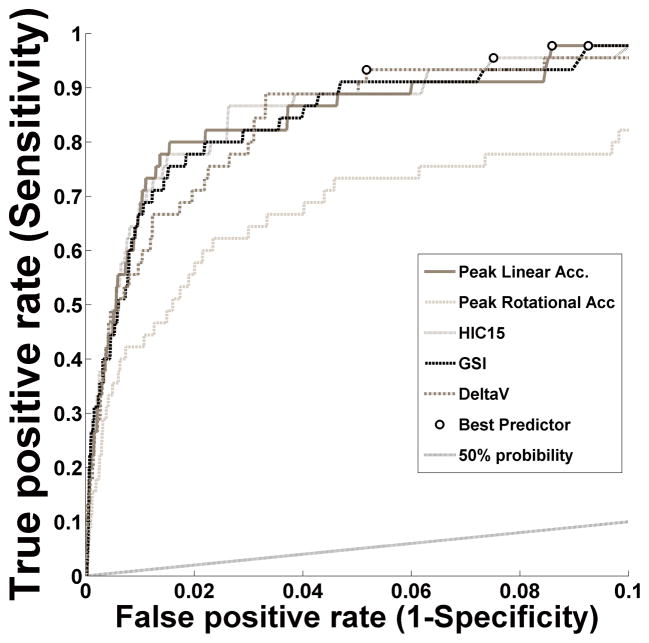
Description:Purpose ; This study compares the frequency and severity of head impacts sustained by football players on days with and without diagnosed concussion and to identify the sensitivity and specificity of single impact severity measures to diagnosed injury. ; Methods ; 1,208 players from eight collegiate and six high school football teams wore instrumented helmets to measure head impacts during all team sessions, of which 95 players were diagnosed with concussion. Eight players sustained two injuries and one three, providing 105 injury cases. Measures of head kinematics (peak linear and rotational acceleration, Gadd Severity Index (GSI), Head Injury Criteria (HIC15), change in head velocity (Δv)) and the number of head impacts sustained by individual players were compared between days with and without diagnosed concussion. Receiver operator characteristic curves were generated to evaluate the sensitivity and specificity of each kinematic measure to diagnosed concussion using only those impacts that directly preceded diagnosis. ; Results ; Players sustained a higher frequency of impacts and impacts with more severe kinematic properties on days of diagnosed concussion than on days without diagnosed concussion. Forty-five injury cases were immediately diagnosed following head impact. For these cases, peak linear acceleration and HIC15 were most sensitive to immediately diagnosed concussion (AUC = 0.983). Peak rotational acceleration was less sensitive to diagnosed injury than all other kinematic measures (p = 0.01) which are derived from linear acceleration (peak linear, HIC15, GSI, and Δv). ; Conclusions ; Players sustain more impacts and impacts of higher severity on days of diagnosed concussion than on days without diagnosed concussion. Additionally, of historical measures of impact severity, those associated with peak linear acceleration are the best predictors of immediately diagnosed concussion.
-
Subjects:
-
Source:Med Sci Sports Exerc. 2012; 45(4):737-746.
-
Document Type:
-
Funding:5R49CE000196/CE/NCIPC CDC HHS/United States ; P20 GM104937/GM/NIGMS NIH HHS/United States ; R01 HD048638/HD/NICHD NIH HHS/United States ; R01 NS055020/NS/NINDS NIH HHS/United States ; R01CE001254/CE/NCIPC CDC HHS/United States ; R01NS055020/NS/NINDS NIH HHS/United States ; R44HD40473/HD/NICHD NIH HHS/United States
-
Place as Subject:
-
Volume:45
-
Issue:4
-
Download URL:
-
File Type:
 [PDF - 554.41 KB]
 -
Collection(s):
-
Main Document Checksum:urn:sha256:e82903bdc4a1c74ee9ab052f9453f6f3f9d16ed1b934716cbde4d3d2340f7d22
Supporting Files


File Language:
English
 Was this page helpful?
 Found an issue?


CDC STACKS serves as an archival repository of CDC-published products including
scientific findings, journal articles, guidelines, recommendations, or other public health information authored or
co-authored by CDC or funded partners.
As a repository, CDC STACKS retains documents in their original published format to ensure public access to scientific information.
As a repository, CDC STACKS retains documents in their original published format to ensure public access to scientific information.
You May Also Like
COLLECTION
CDC Public Access