



Promotion of lung adenocarcinoma following inhalation exposure to multi-walled carbon nanotubes
Supporting Files
Public Domain

-
Jan 09 2014
Details
-
Alternative Title:Part Fibre Toxicol
-
Personal Author:Sargent, Linda M. ; Porter, Dale W. ; Staska, Lauren M. ; Hubbs, Ann F. ; Lowry, David T. ; Battelli, Lori ; Siegrist, Katelyn J. ; Kashon, Michael L. ; Mercer, Robert R. ; Bauer, Alison K. ; Chen, Bean T. ; Salisbury, Jeffrey L. ; Frazer, David ; McKinney, Walter ; Andrew, Michael ; Tsuruoka, Shuji ; Endo, Morinobu ; Fluharty, Kara L. ; Castranova, Vince ; Reynolds, Steven H.
-
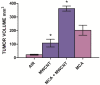
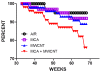
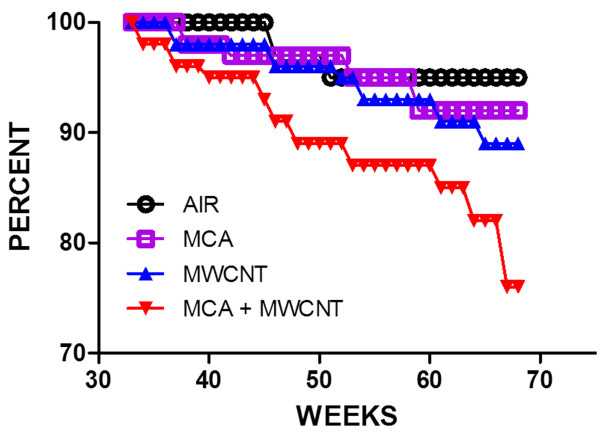
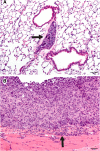
Description:Background ; Engineered carbon nanotubes are currently used in many consumer and industrial products such as paints, sunscreens, cosmetics, toiletries, electronic processes and industrial lubricants. Carbon nanotubes are among the more widely used nanoparticles and come in two major commercial forms, single-walled carbon nanotubes (SWCNT) and the more rigid, multi-walled carbon nanotubes (MWCNT). The low density and small size of these particles makes respiratory exposures likely. Many of the potential health hazards have not been investigated, including their potential for carcinogenicity. We, therefore, utilized a two stage initiation/promotion protocol to determine whether inhaled MWCNT act as a complete carcinogen and/or promote the growth of cells with existing DNA damage. Six week old, male, B6C3F1 mice received a single intraperitoneal (ip) injection of either the initiator methylcholanthrene(MCA, 10 μg/g BW, i.p.), or vehicle (corn oil). One week after i.p. injections, mice were exposed by inhalation to MWCNT (5 mg/m3, 5 hours/day, 5 days/week) or filtered air (controls) for a total of 15 days. At 17 months post-exposure, mice were euthanized and examined for lung tumor formation. ; Results ; Twenty-three percent of the filtered air controls, 26.5% of the MWCNT-exposed, and 51.9% of the MCA-exposed mice, had lung bronchiolo-alveolar adenomas and lung adenocarcinomas. The average number of tumors per mouse was 0.25, 0.81 and 0.38 respectively. By contrast, 90.5% of the mice which received MCA followed by MWCNT had bronchiolo-alveolar adenomas and adenocarcinomas with an average of 2.9 tumors per mouse 17months after exposure. Indeed, 62% of the mice exposed to MCA followed by MWCNT had bronchiolo-alveolar adenocarcinomas compared to 13% of the mice that received filtered air, 22% of the MCA-exposed, or 14% of the MWCNT-exposed. Mice with early morbidity resulting in euthanasia had the highest rate of metastatic disease. Three mice exposed to both MCA and MWCNT that were euthanized early had lung adenocarcinoma with evidence of metastasis (5.5%). Five mice (9%) exposed to MCA and MWCNT and 1 (1.6%) exposed to MCA developed serosal tumors morphologically consistent with sarcomatous mesotheliomas, whereas mice administered MWCNT or air alone did not develop similar neoplasms. ; Conclusions ; These data demonstrate that some MWCNT exposures promote the growth and neoplastic progression of initiated lung cells in B6C3F1 mice. In this study, the mouse MWCNT lung burden of 31.2 μg/mouse approximates feasible human occupational exposures. Therefore, the results of this study indicate that caution should be used to limit human exposures to MWCNT.
-
Subjects:
-
Source:Part Fibre Toxicol. 2014; 11:3.
-
Document Type:
-
Volume:11
-
Download URL:
-
File Type:
 [PDF - 2.21 MB]
 -
Collection(s):
-
Main Document Checksum:urn:sha256:b384514b2df84d7a90d12efaaa68c424ba480b265ac570ce1a281683eeb21b91
Supporting Files


 Was this page helpful?
 Found an issue?








CDC STACKS serves as an archival repository of CDC-published products including
scientific findings, journal articles, guidelines, recommendations, or other public health information authored or
co-authored by CDC or funded partners.
As a repository, CDC STACKS retains documents in their original published format to ensure public access to scientific information.
As a repository, CDC STACKS retains documents in their original published format to ensure public access to scientific information.
You May Also Like
COLLECTION
CDC Public Access