


Biomechanical risk factors for carpal tunnel syndrome: a pooled study of 2474 workers
Supporting Files

-
Oct 16 2014
-
File Language:
English
Details
-
Alternative Title:Occup Environ Med
-
Personal Author:
-
Description:Background
Between 2001 and 2010, five research groups conducted coordinated prospective studies of carpal tunnel syndrome (CTS) incidence among US workers from various industries and collected detailed subject-level exposure information with follow-up of symptoms, electrophysiological measures and job changes.
Objective
This analysis examined the associations between workplace biomechanical factors and incidence of dominant-hand CTS, adjusting for personal risk factors.
Methods
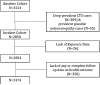
2474 participants, without CTS or possible polyneuropathy at enrolment, were followed up to 6.5 years (5102 person-years). Individual workplace exposure measures of the dominant hand were collected for each task and included force, repetition, duty cycle and posture. Task exposures were combined across the workweek using time-weighted averaging to estimate job-level exposures. CTS case-criteria were based on symptoms and results of electrophysiological testing. HRs were estimated using Cox proportional hazard models.
Results
After adjustment for covariates, analyst (HR=2.17; 95% CI 1.38 to 3.43) and worker (HR=2.08; 95% CI 1.31 to 3.39) estimated peak hand force, forceful repetition rate (HR=1.84; 95% CI 1.19 to 2.86) and per cent time spent (eg, duty cycle) in forceful hand exertions (HR=2.05; 95% CI 1.34 to 3.15) were associated with increased risk of incident CTS. Associations were not observed between total hand repetition rate, per cent duration of all hand exertions, or wrist posture and incident CTS.
Conclusions
In this prospective multicentre study of production and service workers, measures of exposure to forceful hand exertion were associated with incident CTS after controlling for important covariates. These findings may influence the design of workplace safety programmes for preventing work-related CTS.
-
Subjects:
-
Source:Occup Environ Med. 2014; 72(1):33-41.
-
Pubmed ID:25324489
-
Pubmed Central ID:PMC4270859
-
Document Type:
-
Funding:
-
Place as Subject:
-
Volume:72
-
Issue:1
-
Collection(s):
-
Main Document Checksum:urn:sha256:104452255ecb466568986d6eda942cf306b845c8ad0427fb9727fae3f0548a65
-
Download URL:
-
File Type:
 [PDF
- 569.89 KB
]
[PDF
- 569.89 KB
]
Supporting Files


File Language:
English
ON THIS PAGE


CDC STACKS serves as an archival repository of CDC-published products including
scientific findings,
journal articles, guidelines, recommendations, or other public health information authored or
co-authored by CDC or funded partners.
As a repository, CDC STACKS retains documents in their original published format to ensure public access to scientific information.
As a repository, CDC STACKS retains documents in their original published format to ensure public access to scientific information.
You May Also Like
COLLECTION
CDC Public Access