


Direct Effect of 10-Valent Conjugate Pneumococcal Vaccination on Pneumococcal Carriage in Children Brazil
Supporting Files
Public Domain

-
Jun 03 2014
-
File Language:
English
Details
-
Alternative Title:PLoS One
-
Personal Author:Andrade, Ana Lucia ; Ternes, Yves Mauro ; Vieira, Maria Aparecida ; Moreira, Weslley Garcia ; Lamaro-Cardoso, Juliana ; Kipnis, André ; Cardoso, Maria Regina ; Brandileone, Maria Cristina ; Moura, Iaci ; Pimenta, Fabiana C. ; da Gloria Carvalho, Maria ; Saraiva, Fabricia Oliveira ; Toscano, Cristiana Maria ; Minamisava, Ruth
-
Description:Background
10-valent conjugate pneumococcal vaccine/PCV10 was introduced in the Brazilian National Immunization Program along the year of 2010. We assessed the direct effectiveness of PCV10 vaccination in preventing nasopharyngeal/NP pneumococcal carriage in infants.
Methods
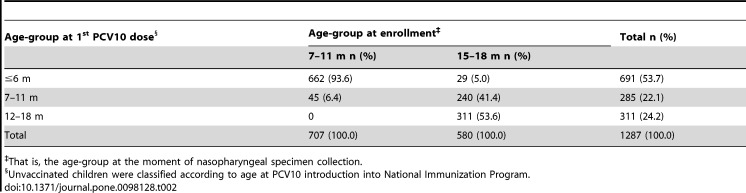
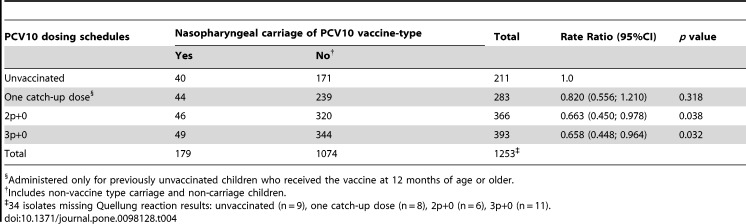
A cross-sectional population-based household survey was conducted in Goiania Brazil, from December/2010-February/2011 targeting children aged 7–11 m and 15–18 m. Participants were selected using a systematic sampling. NP swabs, demographic data, and vaccination status were collected from 1,287 children during home visits. Main outcome and exposure of interest were PCV10 vaccine-type carriage and dosing schedules (3p+0, 2p+0, and one catch-up dose), respectively. Pneumococcal carriage was defined by a positive culture and serotyping was performed by Quellung reaction. Rate ratio/RR was calculated as the ratio between the prevalence of vaccine-types carriage in children exposed to different schedules and unvaccinated for PCV10. Adjusted RR was estimated using Poisson regression. PCV10 effectiveness/VE on vaccine-type carriage was calculated as 1-RR*100.
Results
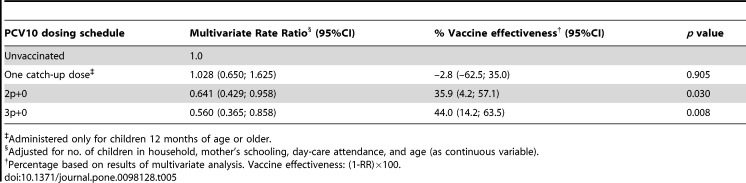
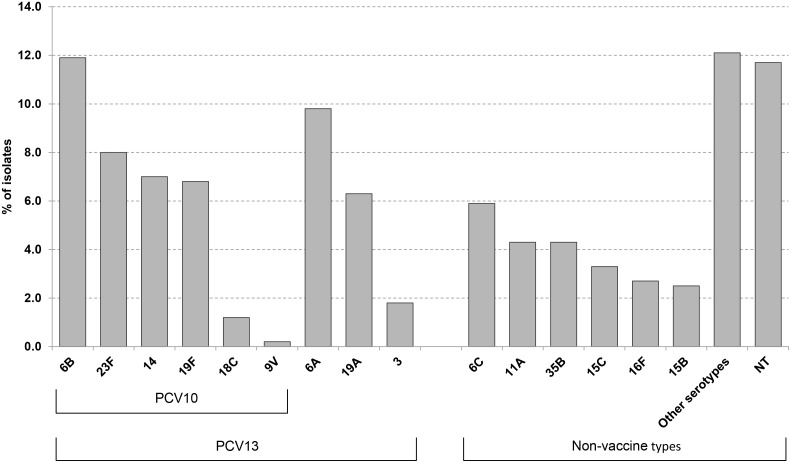
The prevalence of pneumococcal carriage was 41.0% (95%CI: 38.4–43.7). Serotypes covered by PCV10 and PCV13 were 35.2% and 53.0%, respectively. Vaccine serotypes 6B (11.6%), 23F (7.8%), 14 (6.8%), and 19F (6.6%) were the most frequently observed. After adjusted for confounders, children who had received 2p+0 or 3p+0 dosing schedule presented a significant reduction in pneumococcal vaccine-type carriage, with PCV10 VE equal to 35.9% (95%CI: 4.2–57.1; p = 0.030) and 44.0% (95%CI: 14.–63.5; p = 0.008), respectively, when compared with unvaccinated children. For children who received one catch-up dose, no significant VE was detected (p = 0.905).
Conclusion
PCV10 was associated with high protection against vaccine-type carriage with 2p+0 and 3p+0 doses for children vaccinated before the second semester of life. The continuous evaluation of carriage serotypes distribution is likely to be useful for evaluating the long-term effectiveness and impact of pneumococcal vaccination on serotypes reduction.
-
Subjects:
-
Source:PLoS One. 2014; 9(6).
-
Document Type:
-
Place as Subject:
-
Volume:9
-
Issue:6
-
Collection(s):
-
Main Document Checksum:urn:sha256:b9fc23de29d0e524f0119fe37cf10f0d6805f963203b86fd032a5c10a5ce6418
-
Download URL:
-
File Type:
 [PDF
- 263.36 KB
]
[PDF
- 263.36 KB
]
Supporting Files


File Language:
English
ON THIS PAGE









CDC STACKS serves as an archival repository of CDC-published products including
scientific findings,
journal articles, guidelines, recommendations, or other public health information authored or
co-authored by CDC or funded partners.
As a repository, CDC STACKS retains documents in their original published format to ensure public access to scientific information.
As a repository, CDC STACKS retains documents in their original published format to ensure public access to scientific information.
You May Also Like
COLLECTION
CDC Public Access