



Molecular Evolution of Peste des Petits Ruminants Virus
Supporting Files
Public Domain

-
Dec 2014
Details
-
Alternative Title:Emerg Infect Dis
-
Personal Author:Muniraju, Murali ; Munir, Muhammad ; Parthiban, AravindhBabu R. ; Banyard, Ashley C. ; Bao, Jingyue ; Wang, Zhiliang ; Ayebazibwe, Chrisostom ; Ayelet, Gelagay ; El Harrak, Mehdi ; Mahapatra, Mana ; Libeau, Geneviève ; Batten, Carrie ; Parida, Satya
-
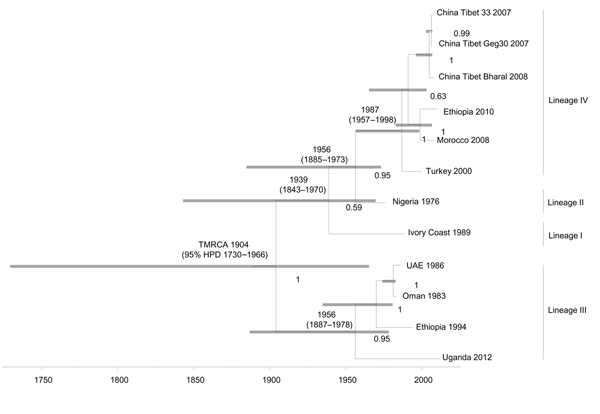
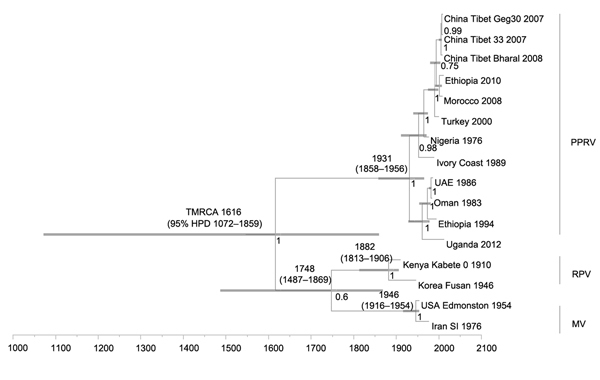
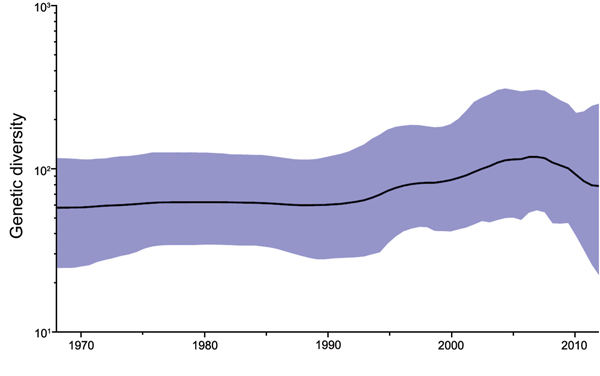
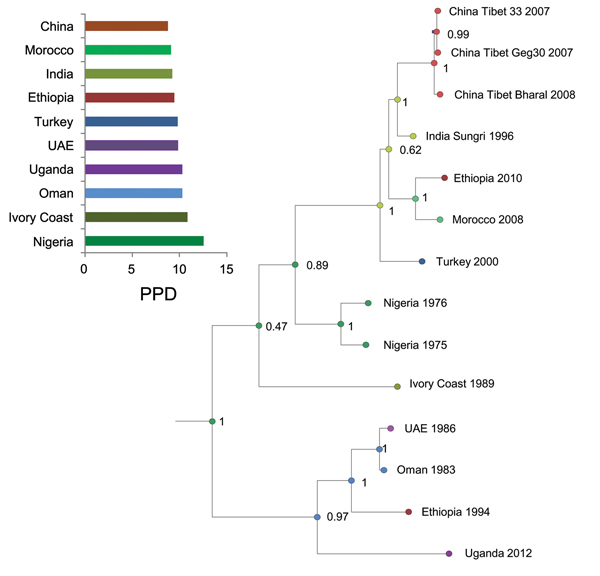
Description:Despite safe and efficacious vaccines against peste des petits ruminants virus (PPRV), this virus has emerged as the cause of a highly contagious disease with serious economic consequences for small ruminant agriculture across Asia, the Middle East, and Africa. We used complete and partial genome sequences of all 4 lineages of the virus to investigate evolutionary and epidemiologic dynamics of PPRV. A Bayesian phylogenetic analysis of all PPRV lineages mapped the time to most recent common ancestor and initial divergence of PPRV to a lineage III isolate at the beginning of 20th century. A phylogeographic approach estimated the probability for root location of an ancestral PPRV and individual lineages as being Nigeria for PPRV, Senegal for lineage I, Nigeria/Ghana for lineage II, Sudan for lineage III, and India for lineage IV. Substitution rates are critical parameters for understanding virus evolution because restrictions in genetic variation can lead to lower adaptability and pathogenicity.
-
Subjects:
- Research
- Molecular Evolution of Peste des Petits Ruminants Virus
- peste des petits ruminants virus
- PPRV
- rinderpest virus
- measles virus
- viruses
- emergence
- Bayesian phylogenetics
- phylogeography
- nucleotide substitution rates
- time to most recent common ancestor
- TMRCA
- divergence
- evolution
- selection pressure
- small ruminants
- wildlife
-
Source:Emerg Infect Dis. 20(12):2023-2033.
-
Document Type:
-
Volume:20
-
Issue:12
-
Download URL:
-
File Type:
 [PDF - 685.96 KB]
 -
Collection(s):
-
Main Document Checksum:urn:sha256:cbd3c58e2de9652e0890aca0807cb101465833665985fa3726154d9c3562cc8f
Supporting Files


 Was this page helpful?
 Found an issue?




CDC STACKS serves as an archival repository of CDC-published products including
scientific findings, journal articles, guidelines, recommendations, or other public health information authored or
co-authored by CDC or funded partners.
As a repository, CDC STACKS retains documents in their original published format to ensure public access to scientific information.
As a repository, CDC STACKS retains documents in their original published format to ensure public access to scientific information.
You May Also Like
COLLECTION
Emerging Infectious Diseases