



Multidrug-Resistant and Methicillin-Resistant Staphylococcus aureus (MRSA) in Hog Slaughter and Processing Plant Workers and Their Community in North Carolina (USA)
Supporting Files
Peer Reviewed

-
2014/02/07
File Language:
English
Details
-
Journal Article:Environmental Health Perspectives
-
Personal Author:
-
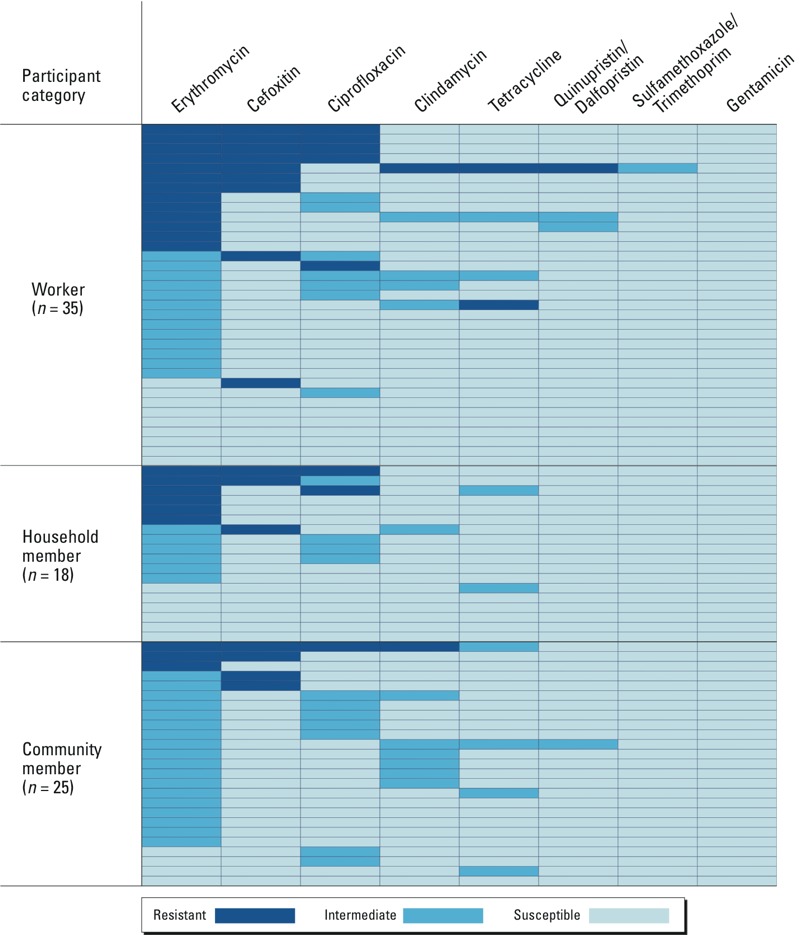
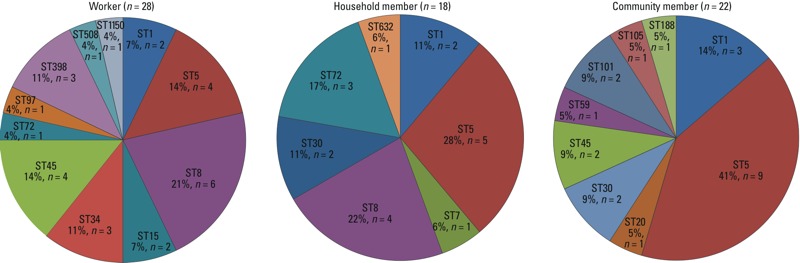
Description:BACKGROUND: Use of antimicrobials in industrial food-animal production is associated with the presence of antimicrobial-resistant Staphylococcus aureus (S. aureus) among animals and humans. Hog slaughter/processing plants process large numbers of animals from industrial animal operations and are environments conducive to the exchange of bacteria between animals and workers. OBJECTIVES: We compared the prevalence of multidrug-resistant S. aureus (MDRSA) and methicillin-resistant S. aureus (MRSA) carriage among processing plant workers, their household members, and community residents. METHODS: We conducted a cross-sectional study of hog slaughter/processing plant workers, their household members, and community residents in North Carolina. Participants responded to a questionnaire and provided a nasal swab. Swabs were tested for S. aureus, and isolates were tested for antimicrobial susceptibility and subjected to multilocus sequence typing. RESULTS: The prevalence of S. aureus was 21.6%, 30.2%, and 22.5% among 162 workers, 63 household members, and 111 community residents, respectively. The overall prevalence of MDRSA and MRSA tested by disk diffusion was 6.9% and 4.8%, respectively. The adjusted prevalence of MDRSA among workers was 1.96 times (95% CI: 0.71, 5.45) the prevalence in community residents. The adjusted average number of antimicrobial classes to which S. aureus isolates from workers were resistant was 2.54 times (95% CI: 1.16, 5.56) the number among isolates from community residents. We identified two MDRSA isolates and one MRSA isolate from workers as sequence type 398, a type associated with exposure to livestock. CONCLUSIONS: Although the prevalence of S. aureus and MRSA was similar in hog slaughter/processing plant workers and their household and community members, S. aureus isolates from workers were resistant to a greater number of antimicrobial classes. These findings may be related to the nontherapeutic use of antimicrobials in food-animal production. Description provided by NIOSH
-
Subjects:
-
Keywords:
-
Source:Environ Health Perspect 2014 May; 122(5):471-477
-
ISSN:0091-6765
-
Pubmed ID:24508836
-
Pubmed Central ID:PMC4014760
-
Document Type:
-
Funding:
-
Genre:
-
Place as Subject:
-
CIO:
-
Topic:
-
Location:
-
Pages in Document:7 pdf pages
-
Volume:122
-
Issue:5
-
NIOSHTIC Number:nn:20045484
-
Contact Point Address:E.K. Silbergeld, Department of Environmental Health Sciences, Johns Hopkins Bloomberg School of Public Health, 615 N. Wolfe St., Baltimore, MD 21205
-
Email:esilberg@jhsph.edu
-
Federal Fiscal Year:2014
-
Performing Organization:Johns Hopkins University - Baltimore
-
Peer Reviewed:True
-
Download URL:
-
File Type:
 [PDF - 261.66 KB]
 -
Collection(s):
-
Main Document Checksum:urn:sha-512:2b7788b0d0d9e035acda836b84a5534ae3f5e8bf493641aa6b31dbc39e0462fafdcb0355029b4e72b607c1a1110168b97698002b398e00dcdc19a367ac97c960
Supporting Files


File Language:
English
 Was this page helpful?
 Found an issue?


CDC STACKS serves as an archival repository of CDC-published products including
scientific findings, journal articles, guidelines, recommendations, or other public health information authored or
co-authored by CDC or funded partners.
As a repository, CDC STACKS retains documents in their original published format to ensure public access to scientific information.
As a repository, CDC STACKS retains documents in their original published format to ensure public access to scientific information.
You May Also Like