


Dietary Sources of Methylated Arsenic Species in Urine of the United States Population, NHANES 2003–2010
Supporting Files
Public Domain

-
Sep 24 2014
-
File Language:
English
Details
-
Alternative Title:PLoS One
-
Personal Author:
-
Description:Background
Arsenic is an ubiquitous element linked to carcinogenicity, neurotoxicity, as well as adverse respiratory, gastrointestinal, hepatic, and dermal health effects.
Objective
Identify dietary sources of speciated arsenic: monomethylarsonic acid (MMA), and dimethylarsinic acid (DMA).
Methods
Age-stratified, sample-weighted regression of NHANES (National Health and Nutrition Examination Survey) 2003–2010 data (∼8,300 participants ≥6 years old) characterized the association between urinary arsenic species and the additional mass consumed of USDA-standardized food groups (24-hour dietary recall data), controlling for potential confounders.
Results
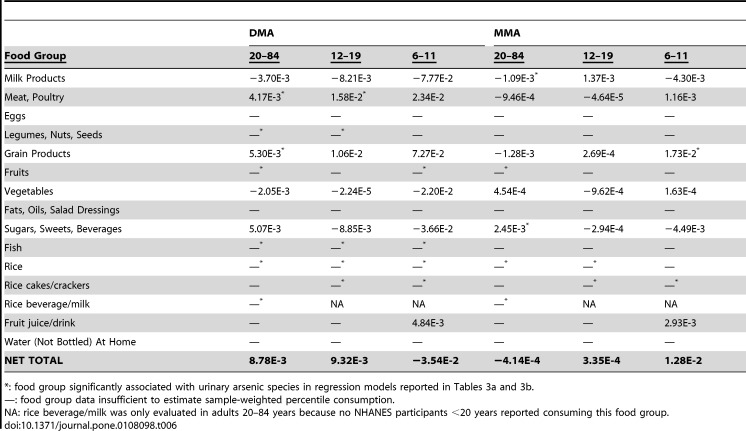
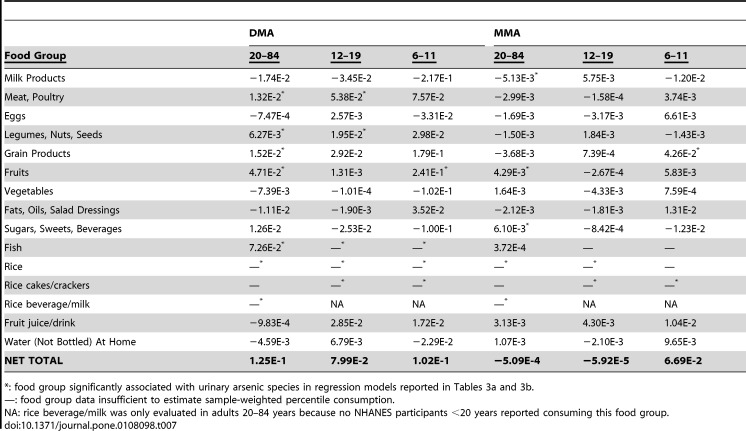
For all arsenic species, the rank-order of age strata for median urinary molar concentration was children 6–11 years > adults 20–84 years > adolescents 12–19 years, and for all age strata, the rank-order was DMA > MMA. Median urinary molar concentrations of methylated arsenic species ranged from 0.56 to 3.52 µmol/mol creatinine. Statistically significant increases in urinary arsenic species were associated with increased consumption of: fish (DMA); fruits (DMA, MMA); grain products (DMA, MMA); legumes, nuts, seeds (DMA); meat, poultry (DMA); rice (DMA, MMA); rice cakes/crackers (DMA, MMA); and sugars, sweets, beverages (MMA). And, for adults, rice beverage/milk (DMA, MMA). In addition, based on US (United States) median and 90th percentile consumption rates of each food group, exposure from the following food groups was highlighted: fish; fruits; grain products; legumes, nuts, seeds; meat, poultry; and sugars, sweets, beverages.
Conclusions
In a nationally representative sample of the US civilian, noninstitutionalized population, fish (adults), rice (children), and rice cakes/crackers (adolescents) had the largest associations with urinary DMA. For MMA, rice beverage/milk (adults) and rice cakes/crackers (children, adolescents) had the largest associations.
-
Subjects:
-
Source:PLoS One. 2014; 9(9).
-
Document Type:
-
Name as Subject:
-
Place as Subject:
-
Volume:9
-
Issue:9
-
Collection(s):
-
Main Document Checksum:urn:sha256:e2b04f72fdfbf8e3860bcd58dd15b256c55c81d2fdf8f2d40904f304fa78597d
-
Download URL:
-
File Type:
 [PDF
- 319.25 KB
]
[PDF
- 319.25 KB
]
Supporting Files


File Language:
English
ON THIS PAGE









CDC STACKS serves as an archival repository of CDC-published products including
scientific findings,
journal articles, guidelines, recommendations, or other public health information authored or
co-authored by CDC or funded partners.
As a repository, CDC STACKS retains documents in their original published format to ensure public access to scientific information.
As a repository, CDC STACKS retains documents in their original published format to ensure public access to scientific information.
You May Also Like
COLLECTION
CDC Public Access