


Evaluation of Dried Blood Spots with a Multiplex Assay for Measuring Recent HIV-1 Infection
Supporting Files
Public Domain

-
Sep 18 2014
-
File Language:
English
Details
-
Alternative Title:PLoS One
-
Personal Author:
-
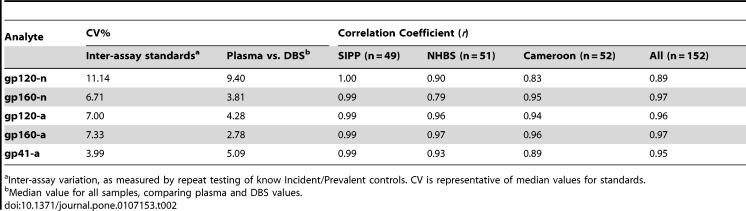
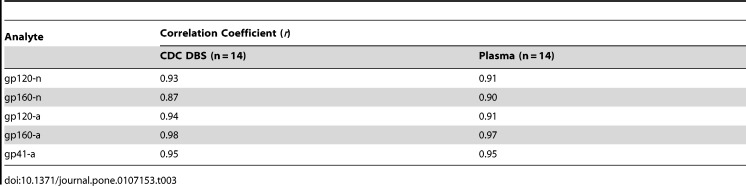
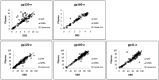
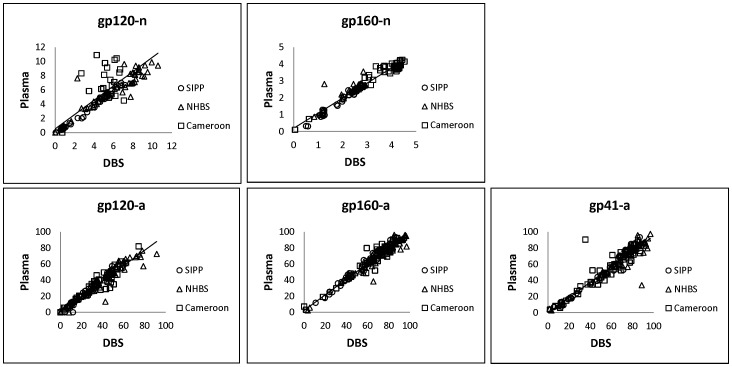
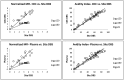
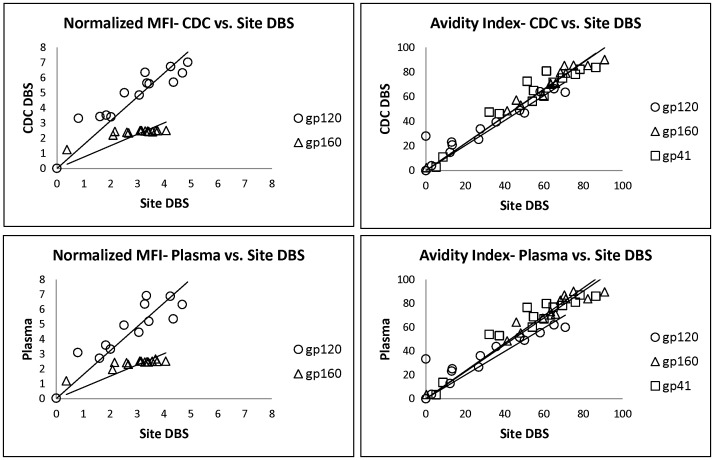
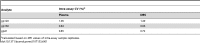
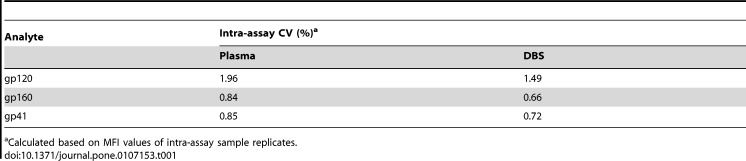
Description:Laboratory-based HIV tests for recent infection (TRIs), which primarily measure a specific serological biomarker(s) that distinguishes recent from long-term HIV infection, have facilitated the estimation of population-based incidence. Dried blood spots (DBS) on filter paper are an attractive sample source for HIV surveillance, given the simplified and cost-effective methods of specimen collection, storage, and shipment. Here, we evaluated the use of DBS in conjunction with an in-house multiplex TRI, the HIV-1-specific Bio-Plex assay, which measures direct antibody binding and avidity to multiple HIV-1 analytes. The assay performance was comparable between matched plasma and DBS samples from HIV-1 infected individuals obtained from diverse sources. The coefficients of variation, comparing the median antibody reactivity for each analyte between plasma and DBS, ranged from 2.78% to 9.40% and the correlation coefficients between the two sample types ranged from 0.89 to 0.97, depending on the analyte. The correlation in antibody reactivity between laboratory and site-prepared DBS for each analyte ranged from 0.87 to 0.98 and from 0.90 to 0.97 between site-prepared DBS and plasma. The correlation in assay measures between plasma and DBS indicate that the sample types can be used interchangeably with the Bio-Plex format, without negatively impacting the misclassification rate of the assay.
-
Subjects:
-
Source:PLoS One. 2014; 9(9).
-
Document Type:
-
Volume:9
-
Issue:9
-
Collection(s):
-
Main Document Checksum:urn:sha256:f4c21e4f5c08b56ef510485837b5ec0662444dd5c72de1e86f88b38898faaa7f
-
Download URL:
-
File Type:
 [PDF
- 276.67 KB
]
[PDF
- 276.67 KB
]
Supporting Files


File Language:
English
ON THIS PAGE



CDC STACKS serves as an archival repository of CDC-published products including
scientific findings,
journal articles, guidelines, recommendations, or other public health information authored or
co-authored by CDC or funded partners.
As a repository, CDC STACKS retains documents in their original published format to ensure public access to scientific information.
As a repository, CDC STACKS retains documents in their original published format to ensure public access to scientific information.
You May Also Like
COLLECTION
CDC Public Access