


Monitoring long-lasting insecticidal net (LLIN) durability to validate net serviceable life assumptions, in Rwanda
Supporting Files
Public Domain

-
Sep 01 2014
-
File Language:
English
Details
-
Alternative Title:Malar J
-
Personal Author:
-
Description:Background
To validate assumptions about the length of the distribution–replacement cycle for long-lasting insecticidal nets (LLINs) in Rwanda, the Malaria and other Parasitic Diseases Division, Rwanda Ministry of Health, used World Health Organization methods to independently confirm the three-year LLIN serviceable life span recommendation of WHO.
Methods
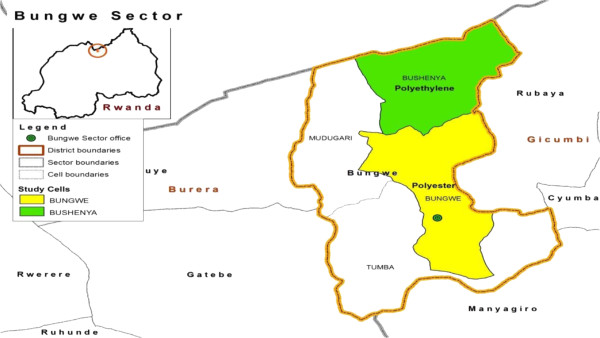
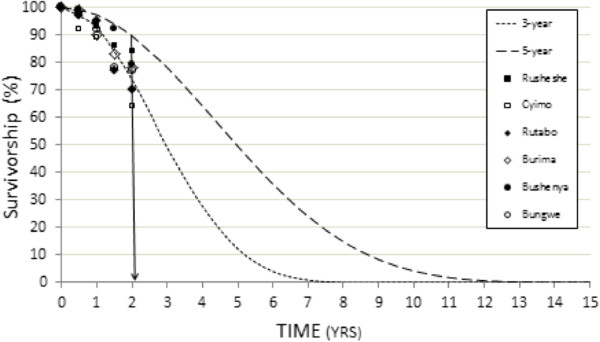
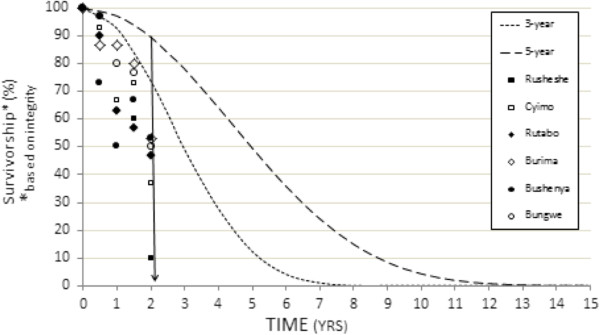
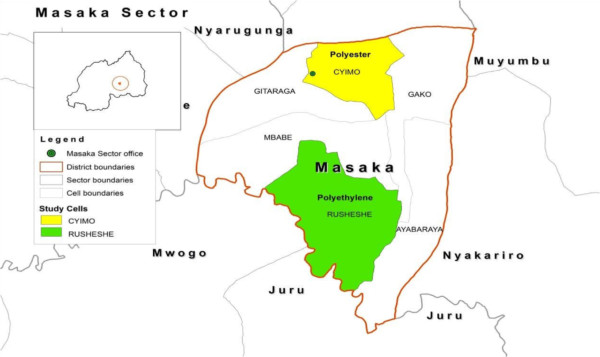
Approximately 3,000 coded LLINs, distributed as part of a national campaign, were monitored in six sites, by means of six–monthly visits to selected houses. Two indicators, survivorship/attrition, a measure of the number of nets remaining, and fabric integrity, the proportion of remaining nets in either ‘good’, ‘serviceable’ or ‘needs replacement’ condition, based on holes in the net material, were tracked. To validate the assumption that the intervention would remain effective for three years, LLIN coverage, calculated using either survivorship, or integrity, by removing nets in the ‘needs replacement’ category from the survivorship total, was compared with the predicted proportion of nets remaining, derived from a net loss model, that assumes an LLIN serviceable life of three years.
Results
After two years, there was close agreement between estimated LLIN survivorship at all sites, 75% (range 64-84%), and the predicted proportion of nets remaining, 75%. However, when integrity was considered, observed survivorship at all sites, declined to 42% (range 10-54%).
Conclusions
More than half, 58%, of the LLINs fell into the ‘needs replacement’ category after two years. While these nets were counted for survivorship, they were judged to be of little-to-no benefit to a user. Therefore, when integrity was taken into account, survivorship was significantly lower than predicted, suggesting that net serviceable life was actually closer to two, rather than three years, and, by extension, that the impact of the intervention during year three of the LLIN distribution-replacement cycle could be well below that seen in years one and two.
-
Subjects:
-
Source:Malar J. 13(1).
-
Document Type:
-
Place as Subject:
-
Volume:13
-
Issue:1
-
Collection(s):
-
Main Document Checksum:urn:sha256:89b5cc7bb863e6d6842c896d51d3f194b73d08839653c015a93e92ab8f103e4f
-
Download URL:
-
File Type:
 [PDF
- 830.84 KB
]
[PDF
- 830.84 KB
]
Supporting Files


File Language:
English
ON THIS PAGE




CDC STACKS serves as an archival repository of CDC-published products including
scientific findings,
journal articles, guidelines, recommendations, or other public health information authored or
co-authored by CDC or funded partners.
As a repository, CDC STACKS retains documents in their original published format to ensure public access to scientific information.
As a repository, CDC STACKS retains documents in their original published format to ensure public access to scientific information.
You May Also Like
COLLECTION
CDC Public Access