


Nutritional Factors and Preservation of C-Peptide in Youth With Recently Diagnosed Type 1 Diabetes
Supporting Files

-
Jul 2013
-
File Language:
English
Details
-
Alternative Title:Diabetes Care
-
Personal Author:
-
Description:OBJECTIVE
To test the novel hypothesis that nutritional factors previously associated with type 1 diabetes etiology or with insulin secretion are prospectively associated with fasting C-peptide (FCP) concentration among youth recently diagnosed with type 1 diabetes.
RESEARCH DESIGN AND METHODS
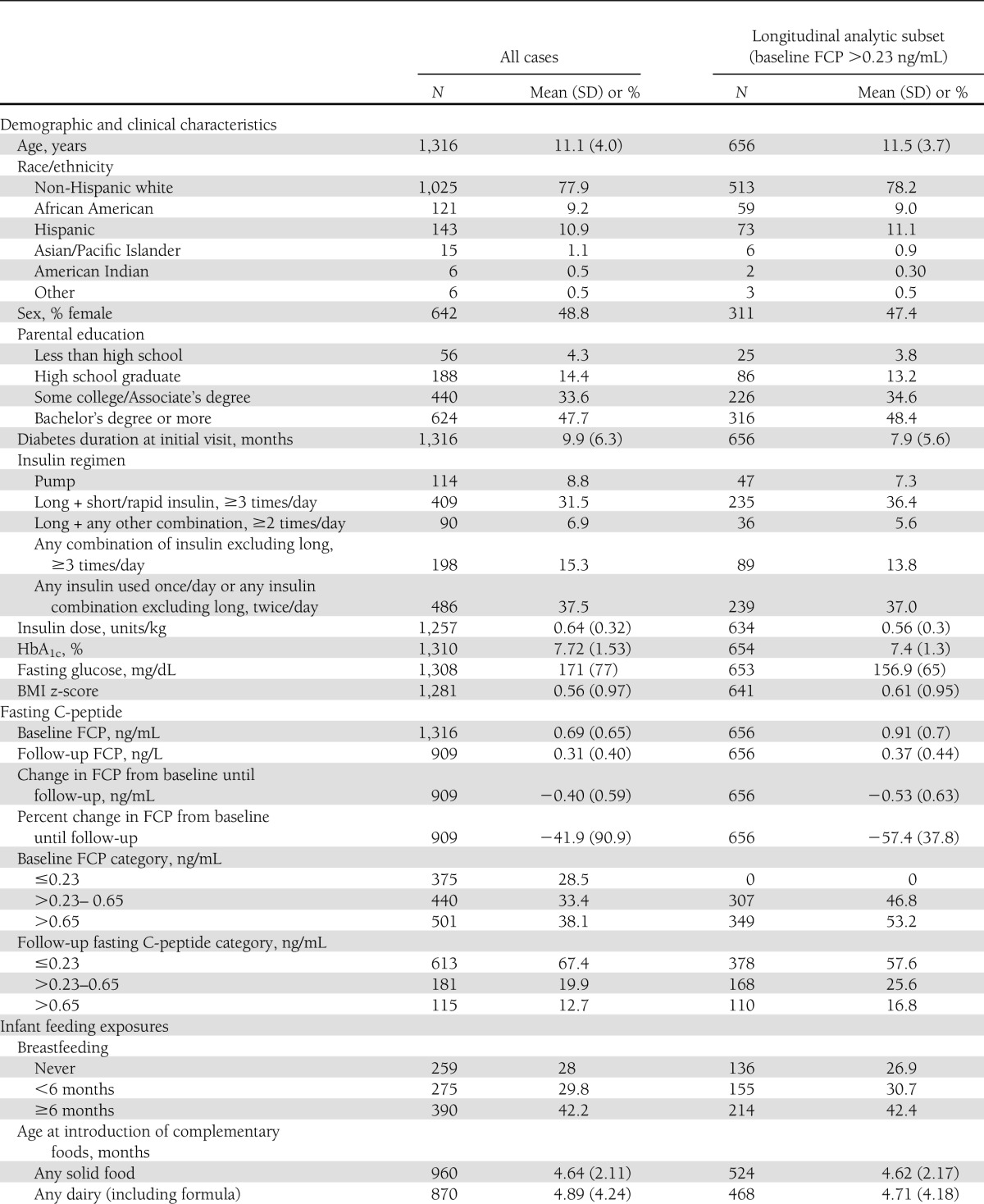
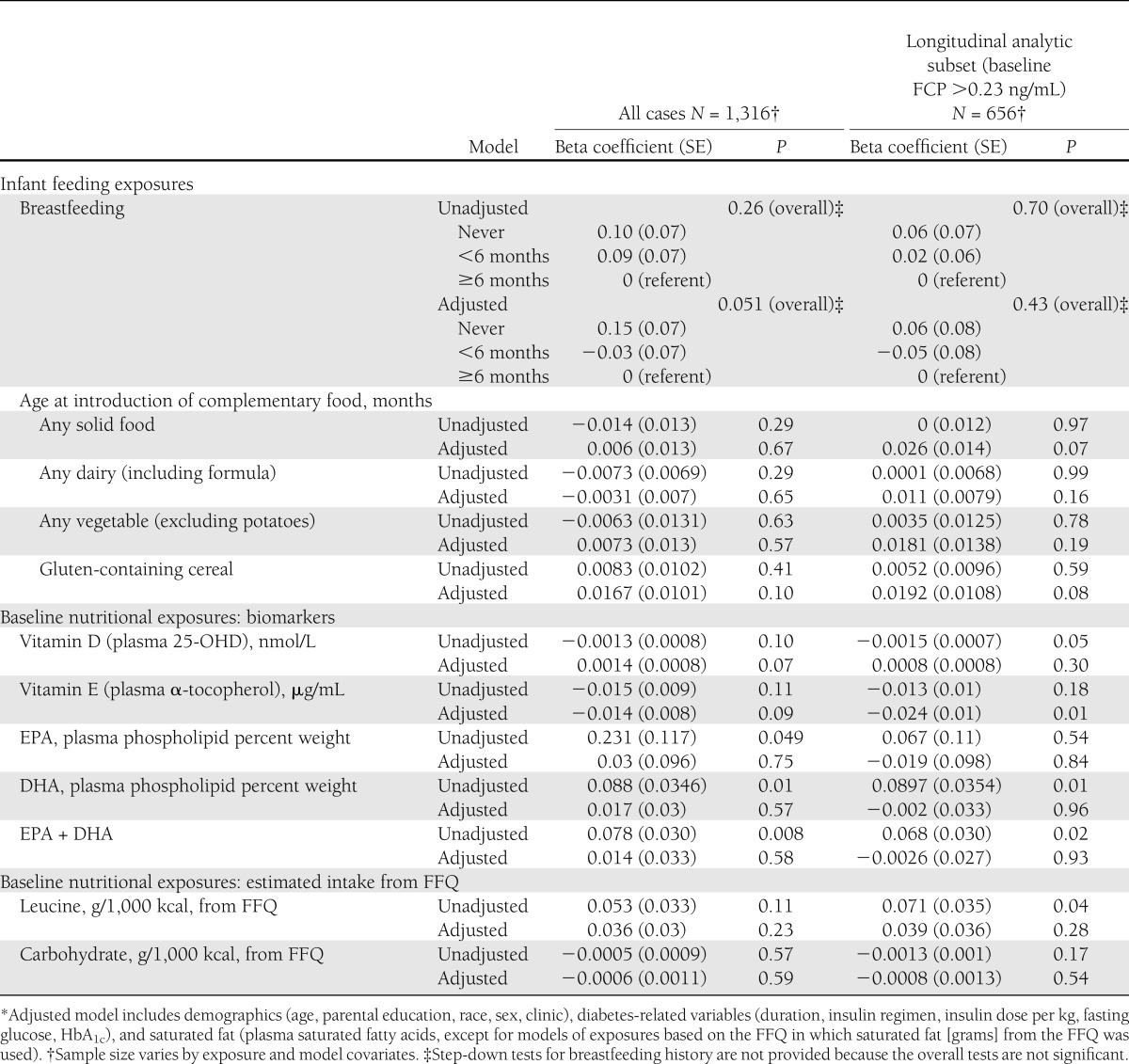
Included were 1,316 youth with autoantibody-positive type 1 diabetes who participated in the SEARCH for Diabetes in Youth study (baseline disease duration, 9.9 months; SD, 6.3). Nutritional exposures included breastfeeding and age at introduction of complementary foods, baseline plasma long-chain omega-3 fatty acids including eicosapentaenoic acid (EPA) and docosahexaenoic acid (DHA), vitamin D, vitamin E, and, from a baseline food frequency questionnaire, estimated intake of the branched-chain amino acid leucine and total carbohydrate. Multiple linear regression models were conducted to relate each nutritional factor to baseline FCP adjusted for demographics, disease-related factors, and other confounders. Prospective analyses included the subset of participants with preserved β-cell function at baseline (baseline FCP ≥0.23 ng/mL) with additional adjustment for baseline FCP and time (mean follow-up, 24.3 months; SD, 8.2; n = 656). FCP concentration was analyzed as log(FCP).
RESULTS
In adjusted prospective analyses, baseline EPA (P = 0.02), EPA plus DHA (P = 0.03), and leucine (P = 0.03) were each associated positively and significantly with FCP at follow-up. Vitamin D was unexpectedly inversely associated with FCP (P = 0.002).
CONCLUSIONS
Increased intake of branched-chain amino acids and long-chain omega-3 fatty acids may support preservation of β-cell function. This represents a new direction for research to improve prognosis for type 1 diabetes.
-
Subjects:
-
Source:Diabetes Care. 2013; 36(7):1842-1850.
-
Pubmed ID:23801797
-
Pubmed Central ID:PMC3687285
-
Document Type:
-
Funding:1U18DP002709/DP/NCCDPHP CDC HHS/United States ; 1UL1RR026314-01/RR/NCRR NIH HHS/United States ; 200-2010-35171/PHS HHS/United States ; DK056350/DK/NIDDK NIH HHS/United States ; DP-05-069/DP/NCCDPHP CDC HHS/United States ; DP-10-001/DP/NCCDPHP CDC HHS/United States ; M01 RR00069/RR/NCRR NIH HHS/United States ; M01RR00037/RR/NCRR NIH HHS/United States ; P30 DK57516/DK/NIDDK NIH HHS/United States ; R01 DK077949/DK/NIDDK NIH HHS/United States ; U01 DP000244/DP/NCCDPHP CDC HHS/United States ; U01 DP000245/DP/NCCDPHP CDC HHS/United States ; U01 DP000246/DP/NCCDPHP CDC HHS/United States ; U01 DP000247/DP/NCCDPHP CDC HHS/United States ; U01 DP000248/DP/NCCDPHP CDC HHS/United States ; U01 DP000250/DP/NCCDPHP CDC HHS/United States ; U01 DP000254/DP/NCCDPHP CDC HHS/United States ; U18DP000247-06A1/DP/NCCDPHP CDC HHS/United States ; U18DP002708-01/DP/NCCDPHP CDC HHS/United States ; U18DP002710-01/DP/NCCDPHP CDC HHS/United States ; U18DP002714/DP/NCCDPHP CDC HHS/United States ; U48/CCU419249/PHS HHS/United States ; U48/CCU519239/PHS HHS/United States ; U48/CCU819241-3/PHS HHS/United States ; U48/CCU919219/PHS HHS/United States ; U58/CCU019235-4/PHS HHS/United States ; U58CCU919256/PHS HHS/United States ; UL1 TR000077/TR/NCATS NIH HHS/United States ; UL1RR029882/RR/NCRR NIH HHS/United States
-
Place as Subject:
-
Volume:36
-
Issue:7
-
Collection(s):
-
Main Document Checksum:urn:sha256:1fa0ab8b6410f02d3dece47fb8fe8a5f1c19721c292cf1f50b9b4d7ea37c2101
-
Download URL:
-
File Type:
 [PDF
- 147.54 KB
]
[PDF
- 147.54 KB
]
Supporting Files


File Language:
English
ON THIS PAGE



CDC STACKS serves as an archival repository of CDC-published products including
scientific findings,
journal articles, guidelines, recommendations, or other public health information authored or
co-authored by CDC or funded partners.
As a repository, CDC STACKS retains documents in their original published format to ensure public access to scientific information.
As a repository, CDC STACKS retains documents in their original published format to ensure public access to scientific information.
You May Also Like
COLLECTION
CDC Public Access