


Antimicrobial Drug Resistance in Escherichia coli from Humans and Food Animals, United States, 1950–2002
Supporting Files
Public Domain

-
May 2012
-
File Language:
English
Details
-
Alternative Title:Emerg Infect Dis
-
Personal Author:
-
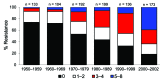
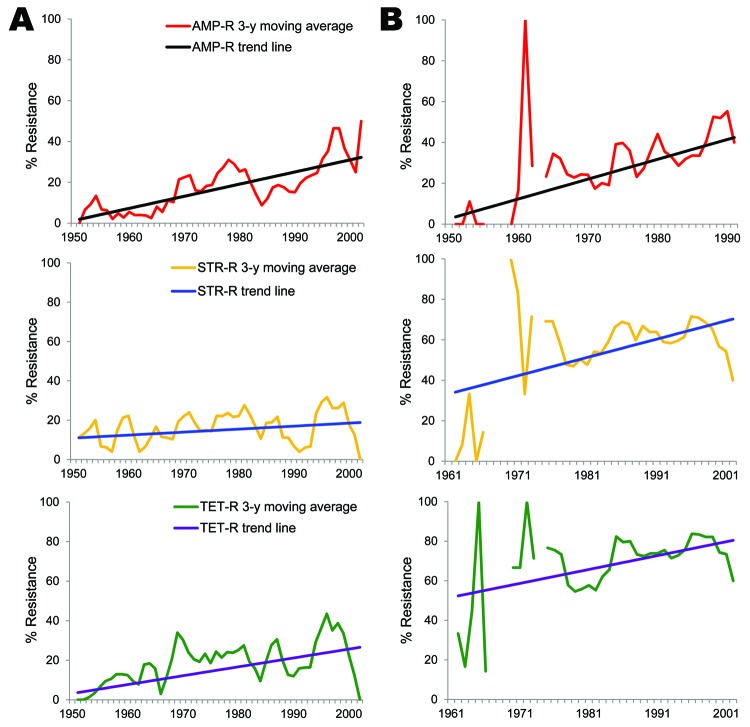
Description:We conducted a retrospective study of Escherichia coli isolates recovered from human and food animal samples during 1950-2002 to assess historical changes in antimicrobial drug resistance. A total of 1,729 E. coli isolates (983 from humans, 323 from cattle, 138 from chickens, and 285 from pigs) were tested for susceptibility to 15 antimicrobial drugs. A significant upward trend in resistance was observed for ampicillin (p<0.001), sulfonamide (p<0.001), and tetracycline (p<0.001). Animal strains showed increased resistance to 11/15 antimicrobial agents, including ampicillin (p<0.001), sulfonamide (p<0.01), and gentamicin (p<0.001). Multidrug resistance (≥3 antimicrobial drug classes) in E. coli increased from 7.2% during the 1950s to 63.6% during the 2000s. The most frequent co-resistant phenotype observed was to tetracycline and streptomycin (29.7%), followed by tetracycline and sulfonamide (29.0%). These data describe the evolution of resistance after introduction of new antimicrobial agents into clinical medicine and help explain the range of resistance in modern E. coli isolates.
-
Subjects:
-
Source:Emerg Infect Dis. 18(5):741-749.
-
Document Type:
-
Place as Subject:
-
Volume:18
-
Issue:5
-
Collection(s):
-
Main Document Checksum:urn:sha256:a302fca795c9b4f9b6ec3005743ee8aa67904a5691b9c3246cf6495ef5ee5d62
-
Download URL:
-
File Type:
 [PDF
- 483.77 KB
]
[PDF
- 483.77 KB
]
Supporting Files


File Language:
English
ON THIS PAGE


CDC STACKS serves as an archival repository of CDC-published products including
scientific findings,
journal articles, guidelines, recommendations, or other public health information authored or
co-authored by CDC or funded partners.
As a repository, CDC STACKS retains documents in their original published format to ensure public access to scientific information.
As a repository, CDC STACKS retains documents in their original published format to ensure public access to scientific information.
You May Also Like
COLLECTION
Emerging Infectious Diseases