



Using Genotyping and Geospatial Scanning to Estimate Recent Mycobacterium tuberculosis Transmission, United States
Supporting Files
Public Domain

-
Mar 2012
File Language:
English
Details
-
Alternative Title:Emerg Infect Dis
-
Personal Author:
-
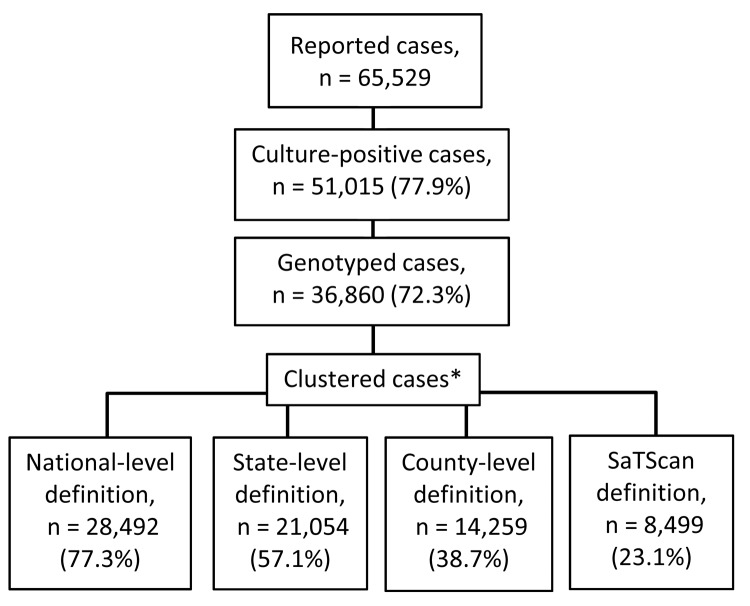
Description:To determine the proportion of reported tuberculosis (TB) cases due to recent transmission in the United States, we conducted a cross-sectional study to examine culture-positive TB cases with complete genotype results (spoligotyping and 12-locus mycobacterial interspersed repetitive unit-variable-number tandem repeat typing) reported during January 2005-December 2009. Recently transmitted cases were defined as cases with matching results reported within statistically significant geospatial zones (identified by a spatial span statistic within a sliding 3-year window). Approximately 1 in 4 TB cases reported in the United States may be attributed to recent transmission. Groups at greatest risk for recent transmission appear to be men, persons born in the United States, members of a minority race or ethnic group, persons who abuse substances, and the homeless. Understanding transmission dynamics and establishing strategies for rapidly detecting recent transmission among these populations are essential for TB elimination in the United States.
-
Subjects:
-
Source:Emerg Infect Dis. 18(3):458-465.
-
Document Type:
-
Place as Subject:
-
Location:
-
Volume:18
-
Issue:3
-
Download URL:
-
File Type:
 [PDF - 173.94 KB]
 -
Collection(s):
-
Main Document Checksum:urn:sha256:350199114e7aa0e9ffcf0384a2ebd115f730bf7ef4cc0ad5d0f2bf11252b3df9
Supporting Files


File Language:
English
 Was this page helpful?
 Found an issue?


CDC STACKS serves as an archival repository of CDC-published products including
scientific findings, journal articles, guidelines, recommendations, or other public health information authored or
co-authored by CDC or funded partners.
As a repository, CDC STACKS retains documents in their original published format to ensure public access to scientific information.
As a repository, CDC STACKS retains documents in their original published format to ensure public access to scientific information.
You May Also Like
COLLECTION
Emerging Infectious Diseases