



Comparative Genomics of Vibrio cholerae from Haiti, Asia, and Africa
Supporting Files
Public Domain

-
Nov 2011
Details
-
Alternative Title:Emerg Infect Dis
-
Personal Author:Reimer, Aleisha R. ; Van Domselaar, Gary ; Stroika, Steven ; Walker, Matthew ; Kent, Heather ; Tarr, Cheryl ; Talkington, Deborah ; Rowe, Lori ; Olsen-Rasmussen, Melissa ; Frace, Michael ; Sammons, Scott ; Dahourou, Georges Anicet ; Boncy, Jacques ; Smith, Anthony M. ; Mabon, Philip ; Petkau, Aaron ; Graham, Morag ; Gilmour, Matthew W. ; Gerner-Smidt, Peter
-
Corporate Authors:
-
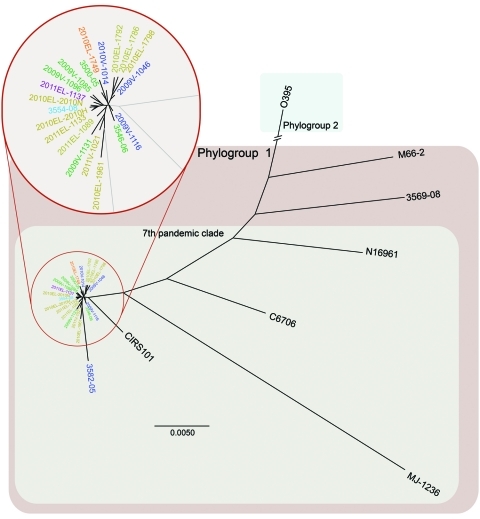
Description:Cholera was absent from the island of Hispaniola at least a century before an outbreak that began in Haiti in the fall of 2010. Pulsed-field gel electrophoresis (PFGE) analysis of clinical isolates from the Haiti outbreak and recent global travelers returning to the United States showed indistinguishable PFGE fingerprints. To better explore the genetic ancestry of the Haiti outbreak strain, we acquired 23 whole-genome Vibrio cholerae sequences: 9 isolates obtained in Haiti or the Dominican Republic, 12 PFGE pattern-matched isolates linked to Asia or Africa, and 2 nonmatched outliers from the Western Hemisphere. Phylogenies for whole-genome sequences and core genome single-nucleotide polymorphisms showed that the Haiti outbreak strain is genetically related to strains originating in India and Cameroon. However, because no identical genetic match was found among sequenced contemporary isolates, a definitive genetic origin for the outbreak in Haiti remains speculative.
-
Subjects:
- Research
- Vibrio cholerae
- cholera
- bacteria
- genomics
- whole-genome sequencing
- public health
- outbreak
- epidemiology
- travel
- Alleles
- Bacterial Proteins
- Cholera
- Cholera Toxin
- Disease Outbreaks
- Electrophoresis, Gel, Pulsed-Field
- Gene Order
- Genome, Bacterial
- Humans
- Interspersed Repetitive Sequences
- Phylogeny
- Prophages
- Sequence Homology, Amino Acid
-
Source:Emerg Infect Dis. 17(11):2113-2121.
-
Document Type:
-
Place as Subject:
-
Location:
-
Volume:17
-
Issue:11
-
Download URL:
-
File Type:
 [PDF - 359.64 KB]
 -
Collection(s):
-
Main Document Checksum:urn:sha256:96a35ea2509fd5c642b2dc8912b5a151a6f469f234383df2dbd44d29af0e6076
Supporting Files


 Was this page helpful?
 Found an issue?





CDC STACKS serves as an archival repository of CDC-published products including
scientific findings, journal articles, guidelines, recommendations, or other public health information authored or
co-authored by CDC or funded partners.
As a repository, CDC STACKS retains documents in their original published format to ensure public access to scientific information.
As a repository, CDC STACKS retains documents in their original published format to ensure public access to scientific information.
You May Also Like
COLLECTION
Emerging Infectious Diseases