



Human Papillomavirus Prevalence in Oropharyngeal Cancer before Vaccine Introduction, United States
Multi-Language
Supporting Files

-
May 2014
File Language:
Details
-
Alternative Title:Emerg Infect Dis
-
Personal Author:Steinau, Martin ; Saraiya, Mona ; Goodman, Marc T. ; Peters, Edward S. ; Watson, Meg ; Cleveland, Jennifer L. ; Lynch, Charles F. ; Wilkinson, Edward J. ; Hernandez, Brenda Y. ; Copeland, Glen ; Saber, Maria S. ; Hopenhayn, Claudia ; Huang, Youjie ; Cozen, Wendy ; Lyu, Christopher ; Unger, Elizabeth R.
-
Corporate Authors:
-
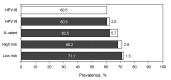
Description:We conducted a study to determine prevalence of HPV types in oropharyngeal cancers in the United States and establish a prevaccine baseline for monitoring the impact of vaccination. HPV DNA was extracted from tumor tissue samples from patients in whom cancer was diagnosed during 1995-2005. The samples were obtained from cancer registries and Residual Tissue Repository Program sites in the United States. HPV was detected and typed by using PCR reverse line blot assays. Among 557 invasive oropharyngeal squamous cell carcinomas, 72% were positive for HPV and 62% for vaccine types HPV16 or 18. Prevalence of HPV-16/18 was lower in women (53%) than in men (66%), and lower in non-Hispanic Black patients (31%) than in other racial/ethnic groups (68%-80%). Results indicate that vaccines could prevent most oropharyngeal cancers in the United States, but their effect may vary by demographic variables.
-
Subjects:
-
Source:Emerg Infect Dis. 20(5):822-828.
-
Document Type:
-
Funding:
-
Place as Subject:
-
Location:
-
Volume:20
-
Issue:5
-
Download URL:
-
File Type:
 [PDF - 957.79 KB]
 -
Collection(s):
-
Main Document Checksum:urn:sha256:41cd8a1d31802d5956e6b3406d7e078979ce6a14560c6188fddd899c137e7072
Supporting Files


File Language:
 Was this page helpful?
 Found an issue?


CDC STACKS serves as an archival repository of CDC-published products including
scientific findings, journal articles, guidelines, recommendations, or other public health information authored or
co-authored by CDC or funded partners.
As a repository, CDC STACKS retains documents in their original published format to ensure public access to scientific information.
As a repository, CDC STACKS retains documents in their original published format to ensure public access to scientific information.
You May Also Like
COLLECTION
Emerging Infectious Diseases