


Longitudinal histories as predictors of future diagnoses of domestic abuse: modelling study
Supporting Files

-
Sep 29 2009
File Language:
English
Details
-
Alternative Title:BMJ
-
Personal Author:
-
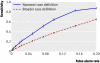
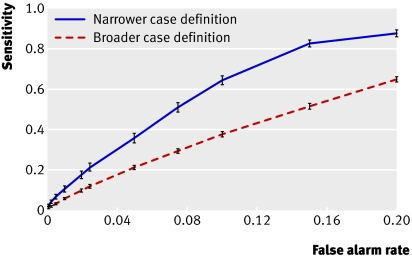
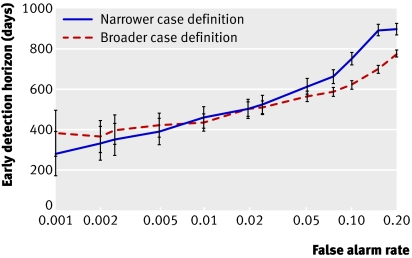
Description:To determine whether longitudinal data in patients' historical records, commonly available in electronic health record systems, can be used to predict a patient's future risk of receiving a diagnosis of domestic abuse.|Bayesian models, known as intelligent histories, used to predict a patient's risk of receiving a future diagnosis of abuse, based on the patient's diagnostic history. Retrospective evaluation of the model's predictions using an independent testing set.|A state-wide claims database covering six years of inpatient admissions to hospital, admissions for observation, and encounters in emergency departments. Population All patients aged over 18 who had at least four years between their earliest and latest visits recorded in the database (561,216 patients).|Timeliness of detection, sensitivity, specificity, positive predictive values, and area under the ROC curve.|1.04% (5829) of the patients met the narrow case definition for abuse, while 3.44% (19,303) met the broader case definition for abuse. The model achieved sensitive, specific (area under the ROC curve of 0.88), and early (10-30 months in advance, on average) prediction of patients' future risk of receiving a diagnosis of abuse. Analysis of model parameters showed important differences between sexes in the risks associated with certain diagnoses.|Commonly available longitudinal diagnostic data can be useful for predicting a patient's future risk of receiving a diagnosis of abuse. This modelling approach could serve as the basis for an early warning system to help doctors identify high risk patients for further screening.
-
Subjects:
-
Source:BMJ. 339.
-
Pubmed ID:19789406
-
Pubmed Central ID:PMC2755036
-
Document Type:
-
Funding:
-
Volume:339
-
Collection(s):
-
Main Document Checksum:urn:sha256:fedbfb9c6908f055797bc94dd0729e9acafbcb34949ed34a3b29ad0bf306e13e
-
Download URL:
-
File Type:
 [PDF
- 294.15 KB
]
[PDF
- 294.15 KB
]
Supporting Files


File Language:
English
ON THIS PAGE




CDC STACKS serves as an archival repository of CDC-published products including
scientific findings,
journal articles, guidelines, recommendations, or other public health information authored or
co-authored by CDC or funded partners.
As a repository, CDC STACKS retains documents in their original published format to ensure public access to scientific information.
As a repository, CDC STACKS retains documents in their original published format to ensure public access to scientific information.
You May Also Like
COLLECTION
CDC Public Access