



Self-reported chemicals exposure, beliefs about disease causation, and risk of breast cancer in the Cape Cod Breast Cancer and Environment Study: a case-control study
Supporting Files

-
Jul 20 2010
File Language:
English
Details
-
Alternative Title:Environ Health
-
Personal Author:
-
Description:Background
Household cleaning and pesticide products may contribute to breast cancer because many contain endocrine disrupting chemicals or mammary gland carcinogens. This population-based case-control study investigated whether use of household cleaners and pesticides increases breast cancer risk.
Methods
Participants were 787 Cape Cod, Massachusetts, women diagnosed with breast cancer between 1988 and 1995 and 721 controls. Telephone interviews asked about product use, beliefs about breast cancer etiology, and established and suspected breast cancer risk factors. To evaluate potential recall bias, we stratified product-use odds ratios by beliefs about whether chemicals and pollutants contribute to breast cancer; we compared these results with odds ratios for family history (which are less subject to recall bias) stratified by beliefs about heredity.
Results
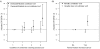
Breast cancer risk increased two-fold in the highest compared with lowest quartile of self-reported combined cleaning product use (Adjusted OR = 2.1, 95% CI: 1.4, 3.3) and combined air freshener use (Adjusted OR = 1.9, 95% CI: 1.2, 3.0). Little association was observed with pesticide use. In stratified analyses, cleaning products odds ratios were more elevated among participants who believed pollutants contribute "a lot" to breast cancer and moved towards the null among the other participants. In comparison, the odds ratio for breast cancer and family history was markedly higher among women who believed that heredity contributes "a lot" (OR = 2.6, 95% CI: 1.9, 3.6) and not elevated among others (OR = 0.7, 95% CI: 0.5, 1.1).
Conclusions
Results of this study suggest that cleaning product use contributes to increased breast cancer risk. However, results also highlight the difficulty of distinguishing in retrospective self-report studies between valid associations and the influence of recall bias. Recall bias may influence higher odds ratios for product use among participants who believed that chemicals and pollutants contribute to breast cancer. Alternatively, the influence of experience on beliefs is another explanation, illustrated by the protective odds ratio for family history among women who do not believe heredity contributes "a lot." Because exposure to chemicals from household cleaning products is a biologically plausible cause of breast cancer and avoidable, associations reported here should be further examined prospectively. -
Subjects:
-
Source:Environ Health. 2010; 9:40.
-
Pubmed ID:20646273
-
Pubmed Central ID:PMC2918587
-
Document Type:
-
Funding:
-
Place as Subject:
-
Volume:9
-
Download URL:
-
File Type:
 [PDF - 338.97 KB]
 -
Collection(s):
-
Main Document Checksum:urn:sha-512:519f7847c6b648f319408d82b7743f06b1a71a4f19e4f680278b698d1ef4309c992c5c0122f45dce38e30df11fbab7e3fb7143bcce2cf3d6910d6eebd003491e
Supporting Files


File Language:
English
 Was this page helpful?
 Found an issue?


CDC STACKS serves as an archival repository of CDC-published products including
scientific findings, journal articles, guidelines, recommendations, or other public health information authored or
co-authored by CDC or funded partners.
As a repository, CDC STACKS retains documents in their original published format to ensure public access to scientific information.
As a repository, CDC STACKS retains documents in their original published format to ensure public access to scientific information.
You May Also Like