



Would school closure for the 2009 H1N1 influenza epidemic have been worth the cost?: a computational simulation of Pennsylvania
Supporting Files

-
May 20 2011
File Language:
English
Details
-
Alternative Title:BMC Public Health
-
Personal Author:Brown, Shawn T. ; Tai, Julie H. Y. ; Bailey, Rachel R. ; Cooley, Philip C. ; Wheaton, William D. ; Potter, Margaret A. ; Voorhees, Ronald E. ; LeJeune, Megan ; Grefenstette, John J. ; Burke, Donald S. ; McGlone, Sarah M. ; Lee, Bruce Y.
-
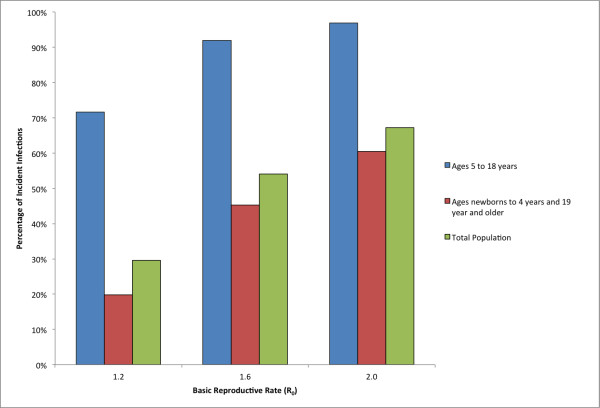
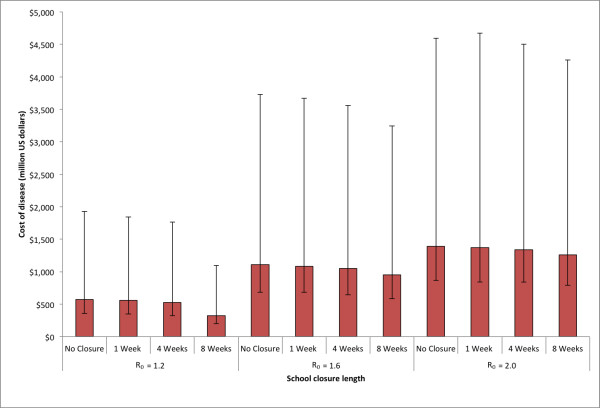
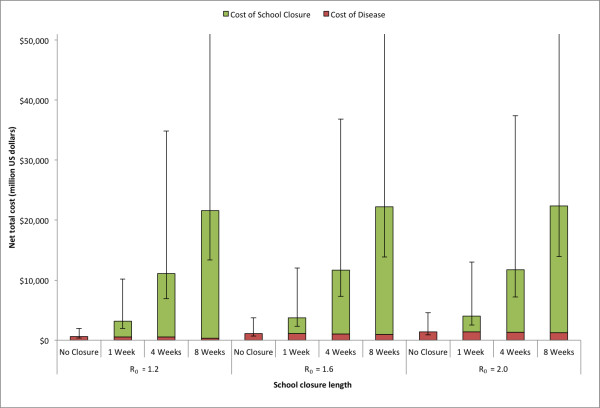
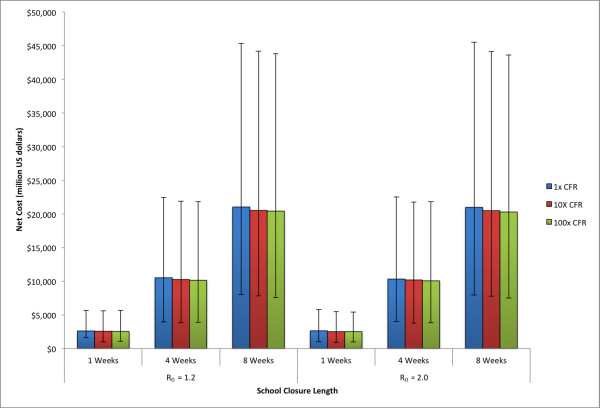
Description:Background ; During the 2009 H1N1 influenza epidemic, policy makers debated over whether, when, and how long to close schools. While closing schools could have reduced influenza transmission thereby preventing cases, deaths, and health care costs, it may also have incurred substantial costs from increased childcare needs and lost productivity by teachers and other school employees. ; Methods ; A combination of agent-based and Monte Carlo economic simulation modeling was used to determine the cost-benefit of closing schools (vs. not closing schools) for different durations (range: 1 to 8 weeks) and symptomatic case incidence triggers (range: 1 to 30) for the state of Pennsylvania during the 2009 H1N1 epidemic. Different scenarios varied the basic reproductive rate (R0) from 1.2, 1.6, to 2.0 and used case-hospitalization and case-fatality rates from the 2009 epidemic. Additional analyses determined the cost per influenza case averted of implementing school closure. ; Results ; For all scenarios explored, closing schools resulted in substantially higher net costs than not closing schools. For R0 = 1.2, 1.6, and 2.0 epidemics, closing schools for 8 weeks would have resulted in median net costs of $21.0 billion (95% Range: $8.0 - $45.3 billion). The median cost per influenza case averted would have been $14,185 ($5,423 - $30,565) for R0 = 1.2, $25,253 ($9,501 - $53,461) for R0 = 1.6, and $23,483 ($8,870 - $50,926) for R0 = 2.0. ; Conclusions ; Our study suggests that closing schools during the 2009 H1N1 epidemic could have resulted in substantial costs to society as the potential costs of lost productivity and childcare could have far outweighed the cost savings in preventing influenza cases.
-
Subjects:
-
Source:BMC Public Health. 2011; 11:353.
-
Pubmed ID:21599920
-
Pubmed Central ID:PMC3119163
-
Document Type:
-
Funding:
-
Place as Subject:
-
Volume:11
-
Download URL:
-
File Type:
 [PDF - 1.20 MB]
 -
Collection(s):
-
Main Document Checksum:urn:sha256:3dccbf2cdf273332e2861f68a61f26fb2cbaae0851c06e30a818a51bf3173818
Supporting Files


File Language:
English
 Was this page helpful?
 Found an issue?










CDC STACKS serves as an archival repository of CDC-published products including
scientific findings, journal articles, guidelines, recommendations, or other public health information authored or
co-authored by CDC or funded partners.
As a repository, CDC STACKS retains documents in their original published format to ensure public access to scientific information.
As a repository, CDC STACKS retains documents in their original published format to ensure public access to scientific information.
You May Also Like
COLLECTION
CDC Public Access