



Use of whole genome sequencing to estimate the mutation rate of Mycobacterium tuberculosis during latent infection
Supporting Files

-
5 2011
-
Available in CDC Stacks on 2011-11-01T00:00:00Z
File Language:
English
Details
-
Alternative Title:Nat Genet
-
Personal Author:Ford, Christopher B. ; Lin, Philana Ling ; Chase, Michael ; Shah, Rupal R. ; Iartchouk, Oleg ; Galagan, James ; Mohaideen, Nilofar ; Ioerger, Thomas R. ; Sacchettini, James C. ; Lipsitch, Marc ; Flynn, JoAnne L. ; Fortune, Sarah M.
-
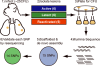
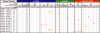
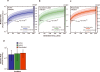
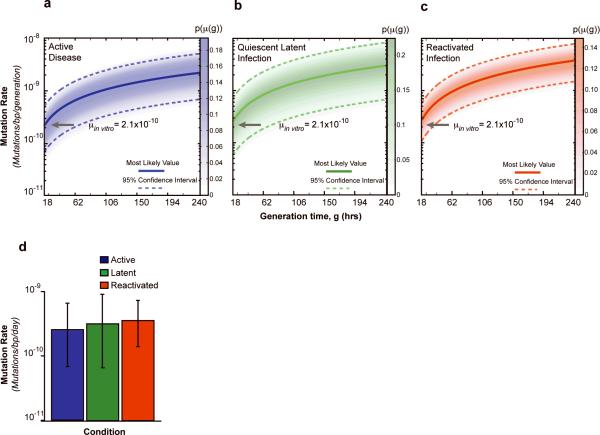
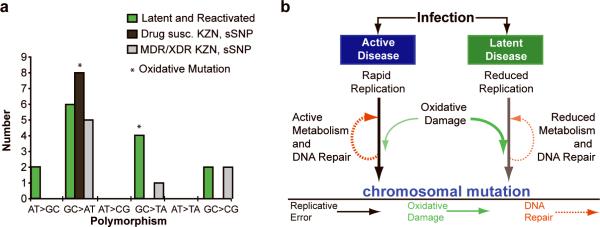
Description:Tuberculosis poses a global health emergency, which has been compounded by the emergence of drug-resistant Mycobacterium tuberculosis (Mtb) strains. We used whole-genome sequencing to compare the accumulation of mutations in Mtb isolated from cynomolgus macaques with active, latent or reactivated disease. We sequenced 33 Mtb isolates from nine macaques with an average genome coverage of 93% and an average read depth of 117×. Based on the distribution of SNPs observed, we calculated the mutation rates for these disease states. We found a similar mutation rate during latency as during active disease or in a logarithmically growing culture over the same period of time. The pattern of polymorphisms suggests that the mutational burden in vivo is because of oxidative DNA damage. We show that Mtb continues to acquire mutations during disease latency, which may explain why isoniazid monotherapy for latent tuberculosis is a risk factor for the emergence of isoniazid resistance.
-
Subjects:
- Animals
- Antitubercular Agents
- Base Sequence
- DNA, Bacterial
- Disease Models, Animal
- Drug Resistance, Bacterial
- Genome, Bacterial
- Humans
- Isoniazid
- Latent Tuberculosis
- Macaca fascicularis
- Models, Genetic
- Mutation
- Mycobacterium tuberculosis
- Polymorphism, Single Nucleotide
- Time Factors
- Tuberculosis, Multidrug-Resistant
-
Source:Nat Genet. 43(5):482-486
-
Pubmed ID:21516081
-
Pubmed Central ID:PMC3101871
-
Document Type:
-
Funding:R01 HL075845/HL/NHLBI NIH HHSUnited States/ ; DP2 0D001378/DP/NCCDPHP CDC HHSUnited States/ ; R33 HL092883-02/HL/NHLBI NIH HHSUnited States/ ; K08 AI063101/AI/NIAID NIH HHSUnited States/ ; U19 AI076217/AI/NIAID NIH HHSUnited States/ ; R33 HL092883/HL/NHLBI NIH HHSUnited States/ ; T32 AI007638/AI/NIAID NIH HHSUnited States/ ; U54 GM088558/GM/NIGMS NIH HHSUnited States/ ; HHSN266200400001C/AO/NIAID NIH HHSUnited States/ ; U54GM088558/GM/NIGMS NIH HHSUnited States/ ; R01 HL075845-05/HL/NHLBI NIH HHSUnited States/ ; R01 HL106804-01/HL/NHLBI NIH HHSUnited States/ ; K08 AI063101-05/AI/NIAID NIH HHSUnited States/ ; R01 HL106804/HL/NHLBI NIH HHSUnited States/
-
Volume:43
-
Issue:5
-
Download URL:
-
File Type:
 [PDF - 505.70 KB]
 -
Collection(s):
-
Main Document Checksum:urn:sha256:d48162ac1a1e5144e2f6e237b62cafd6521bc850fdceb0b0d91694574e1f4ae8
Supporting Files


File Language:
English
 Was this page helpful?
 Found an issue?




CDC STACKS serves as an archival repository of CDC-published products including
scientific findings, journal articles, guidelines, recommendations, or other public health information authored or
co-authored by CDC or funded partners.
As a repository, CDC STACKS retains documents in their original published format to ensure public access to scientific information.
As a repository, CDC STACKS retains documents in their original published format to ensure public access to scientific information.
You May Also Like
COLLECTION
CDC Public Access