


An integer optimization algorithm for robust identification of non-linear gene regulatory networks
Supporting Files

-
Sep 02 2012
File Language:
English
Details
-
Personal Author:
-
Description:Background
Reverse engineering gene networks and identifying regulatory interactions are integral to understanding cellular decision making processes. Advancement in high throughput experimental techniques has initiated innovative data driven analysis of gene regulatory networks. However, inherent noise associated with biological systems requires numerous experimental replicates for reliable conclusions. Furthermore, evidence of robust algorithms directly exploiting basic biological traits are few. Such algorithms are expected to be efficient in their performance and robust in their prediction.
Results
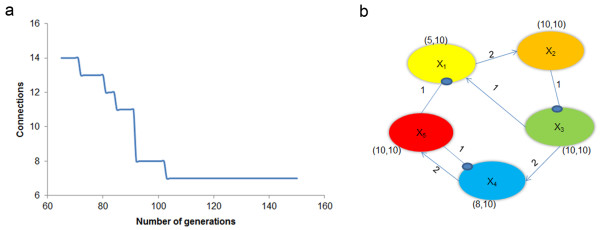
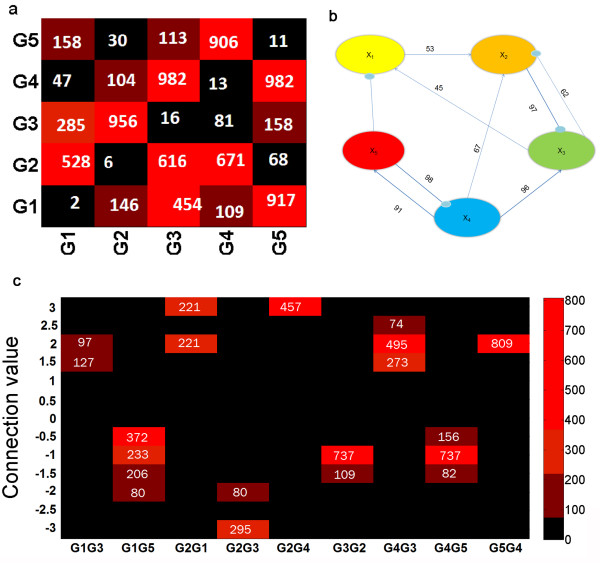
We have developed a network identification algorithm to accurately infer both the topology and strength of regulatory interactions from time series gene expression data in the presence of significant experimental noise and non-linear behavior. In this novel formulism, we have addressed data variability in biological systems by integrating network identification with the bootstrap resampling technique, hence predicting robust interactions from limited experimental replicates subjected to noise. Furthermore, we have incorporated non-linearity in gene dynamics using the S-system formulation. The basic network identification formulation exploits the trait of sparsity of biological interactions. Towards that, the identification algorithm is formulated as an integer-programming problem by introducing binary variables for each network component. The objective function is targeted to minimize the network connections subjected to the constraint of maximal agreement between the experimental and predicted gene dynamics. The developed algorithm is validated using both in silico and experimental data-sets. These studies show that the algorithm can accurately predict the topology and connection strength of the in silico networks, as quantified by high precision and recall, and small discrepancy between the actual and predicted kinetic parameters. Furthermore, in both the in silico and experimental case studies, the predicted gene expression profiles are in very close agreement with the dynamics of the input data.
Conclusions
Our integer programming algorithm effectively utilizes bootstrapping to identify robust gene regulatory networks from noisy, non-linear time-series gene expression data. With significant noise and non-linearities being inherent to biological systems, the present formulism, with the incorporation of network sparsity, is extremely relevant to gene regulatory networks, and while the formulation has been validated against in silico and E. Coli data, it can be applied to any biological system.
-
Subjects:
-
Source:BMC Syst Biol. 2012; 6:119.
-
Pubmed ID:22937832
-
Pubmed Central ID:PMC3444924
-
Document Type:
-
Funding:
-
Volume:6
-
Collection(s):
-
Main Document Checksum:urn:sha-512:63ab0885455a99af53b82290f261de2c1c09de78c416b720833afdb4b319ab6ef0d61d2534b6ad9eb85f7b9f64ad52be2886d4dda9c3dcc2036f65434333898d
-
Download URL:
-
File Type:
 [PDF
- 1.95 MB
]
[PDF
- 1.95 MB
]
Supporting Files


File Language:
English
ON THIS PAGE




CDC STACKS serves as an archival repository of CDC-published products including
scientific findings,
journal articles, guidelines, recommendations, or other public health information authored or
co-authored by CDC or funded partners.
As a repository, CDC STACKS retains documents in their original published format to ensure public access to scientific information.
As a repository, CDC STACKS retains documents in their original published format to ensure public access to scientific information.
You May Also Like
COLLECTION
CDC Public Access