



Spatial cluster detection using dynamic programming
Supporting Files

-
Mar 25 2012
Details
-
Alternative Title:BMC Med Inform Decis Mak
-
Personal Author:
-
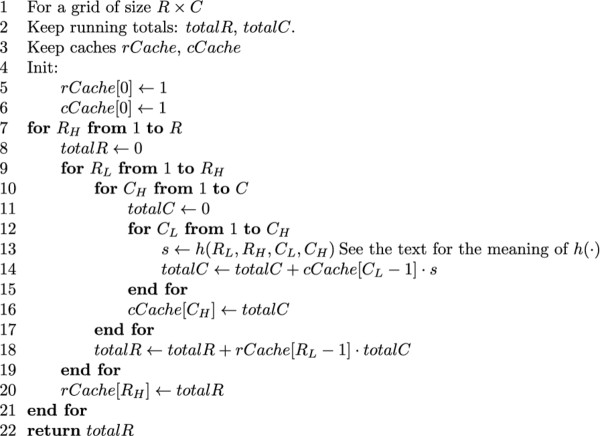
Description:Background ; The task of spatial cluster detection involves finding spatial regions where some property deviates from the norm or the expected value. In a probabilistic setting this task can be expressed as finding a region where some event is significantly more likely than usual. Spatial cluster detection is of interest in fields such as biosurveillance, mining of astronomical data, military surveillance, and analysis of fMRI images. In almost all such applications we are interested both in the question of whether a cluster exists in the data, and if it exists, we are interested in finding the most accurate characterization of the cluster. ; Methods ; We present a general dynamic programming algorithm for grid-based spatial cluster detection. The algorithm can be used for both Bayesian maximum a-posteriori (MAP) estimation of the most likely spatial distribution of clusters and Bayesian model averaging over a large space of spatial cluster distributions to compute the posterior probability of an unusual spatial clustering. The algorithm is explained and evaluated in the context of a biosurveillance application, specifically the detection and identification of Influenza outbreaks based on emergency department visits. A relatively simple underlying model is constructed for the purpose of evaluating the algorithm, and the algorithm is evaluated using the model and semi-synthetic test data. ; Results ; When compared to baseline methods, tests indicate that the new algorithm can improve MAP estimates under certain conditions: the greedy algorithm we compared our method to was found to be more sensitive to smaller outbreaks, while as the size of the outbreaks increases, in terms of area affected and proportion of individuals affected, our method overtakes the greedy algorithm in spatial precision and recall. The new algorithm performs on-par with baseline methods in the task of Bayesian model averaging. ; Conclusions ; We conclude that the dynamic programming algorithm performs on-par with other available methods for spatial cluster detection and point to its low computational cost and extendability as advantages in favor of further research and use of the algorithm.
-
Subjects:
-
Source:BMC Med Inform Decis Mak. 2012; 12:22.
-
Pubmed ID:22443103
-
Pubmed Central ID:PMC3403878
-
Document Type:
-
Funding:
-
Volume:12
-
Download URL:
-
File Type:
 [PDF - 1.82 MB]
 -
Collection(s):
-
Main Document Checksum:urn:sha256:717a6245d8b2bfe248565f7fbb75d0a89b61bfbbf9925cbdebc5a7a1c4ff8794
Supporting Files


 Was this page helpful?
 Found an issue?











CDC STACKS serves as an archival repository of CDC-published products including
scientific findings, journal articles, guidelines, recommendations, or other public health information authored or
co-authored by CDC or funded partners.
As a repository, CDC STACKS retains documents in their original published format to ensure public access to scientific information.
As a repository, CDC STACKS retains documents in their original published format to ensure public access to scientific information.
You May Also Like
COLLECTION
CDC Public Access