



Comparing exposure metrics for classifying ‘dangerous heat’ in heat wave and health warning systems
Supporting Files

-
Jun 05 2012
-
Available in CDC Stacks on 2013-10-01T00:00:00Z
File Language:
English
Details
-
Alternative Title:Environ Int
-
Personal Author:
-
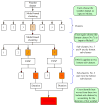
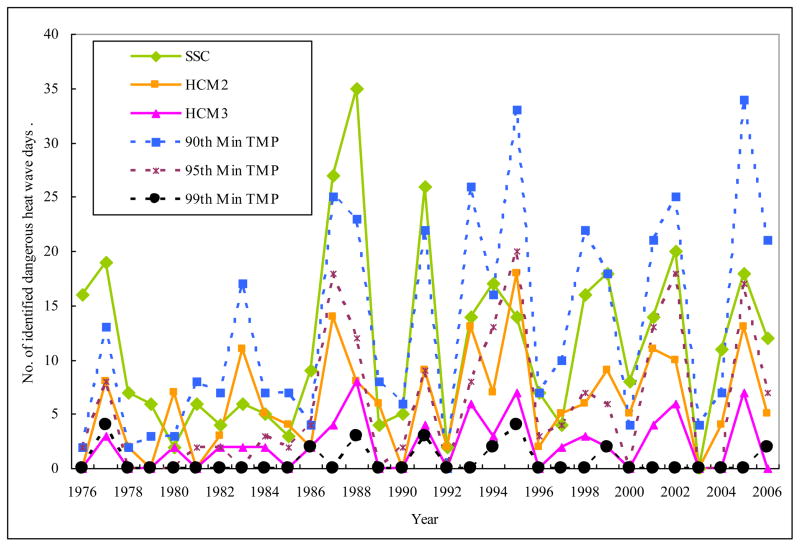
Description:Heat waves have been linked to excess mortality and morbidity, and are projected to increase in frequency and intensity with a warming climate. This study compares exposure metrics to trigger heat wave and health warning systems (HHWS), and introduces a novel multi-level hybrid clustering method to identify potential dangerously hot days. Two-level and three-level hybrid clustering analysis as well as common indices used to trigger HHWS, including spatial synoptic classification (SSC), and the 90th, 95th, and 99th percentiles of minimum and relative minimum temperature (using a 10 day reference period), were calculated using a summertime weather dataset in Detroit from 1976 to 2006. The days classified as 'hot' with hybrid clustering analysis, SSC, minimum and relative minimum temperature methods differed by method type. SSC tended to include the days with, on average, 2.5 °C lower daily minimum temperature and 5.3 °C lower dew point than days identified by other methods. These metrics were evaluated by comparing their performance in predicting excess daily mortality. The 99th percentile of minimum temperature was generally the most predictive, followed by the three-level hybrid clustering method, the 95th percentile of minimum temperature, SSC and others. Our proposed clustering framework has more flexibility and requires less substantial meteorological prior information than the synoptic classification methods. Comparison of these metrics in predicting excess daily mortality suggests that metrics thought to better characterize physiological heat stress by considering several weather conditions simultaneously may not be the same metrics that are better at predicting heat-related mortality, which has significant implications in HHWSs.
-
Subjects:
-
Source:Environ Int. 2012; 46:23-29.
-
Pubmed ID:22673187
-
Pubmed Central ID:PMC3401591
-
Document Type:
-
Funding:
-
Place as Subject:
-
Volume:46
-
Download URL:
-
File Type:
 [PDF - 935.88 KB]
 -
Collection(s):
-
Main Document Checksum:urn:sha256:64a5d0bf0fcecae90ac9815847a6c8b0375fc01c6c83ff9065e24015a808e7c4
Supporting Files


File Language:
English
 Was this page helpful?
 Found an issue?




CDC STACKS serves as an archival repository of CDC-published products including
scientific findings, journal articles, guidelines, recommendations, or other public health information authored or
co-authored by CDC or funded partners.
As a repository, CDC STACKS retains documents in their original published format to ensure public access to scientific information.
As a repository, CDC STACKS retains documents in their original published format to ensure public access to scientific information.
You May Also Like
COLLECTION
CDC Public Access