


Misacylation of tRNA with methionine in Saccharomyces cerevisiae
Supporting Files

-
Aug 31 2012
-
Details
-
Alternative Title:Nucleic Acids Res
-
Personal Author:
-
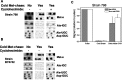
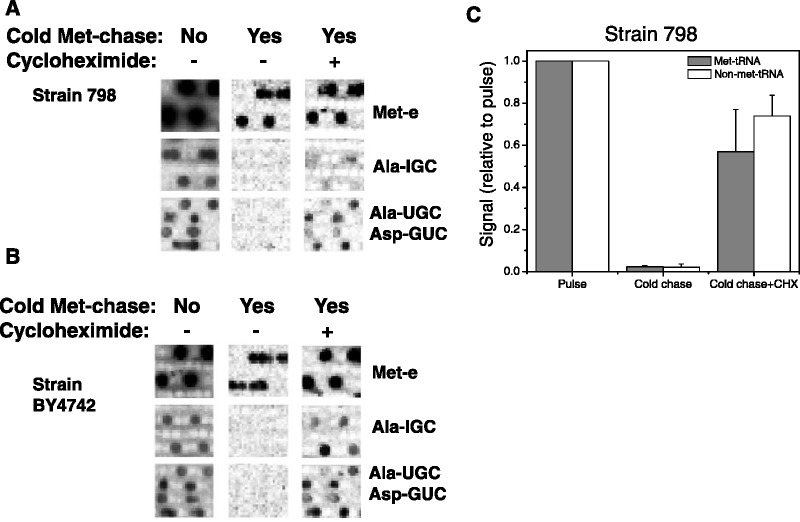
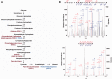
Description:Accurate transfer RNA (tRNA) aminoacylation by aminoacyl-tRNA synthetases controls translational fidelity. Although tRNA synthetases are generally highly accurate, recent results show that the methionyl-tRNA synthetase (MetRS) is an exception. MetRS readily misacylates non-methionyl tRNAs at frequencies of up to 10% in mammalian cells; such mismethionylation may serve a beneficial role for cells to protect their own proteins against oxidative damage. The Escherichia coli MetRS mismethionylates two E. coli tRNA species in vitro, and these two tRNAs contain identity elements for mismethionylation. Here we investigate tRNA mismethionylation in Saccharomyces cerevisiae. tRNA mismethionylation occurs at a similar extent in vivo as in mammalian cells. Both cognate and mismethionylated tRNAs have similar turnover kinetics upon cycloheximide treatment. We identify specific arginine/lysine to methionine-substituted peptides in proteomic mass spectrometry, indicating that mismethionylated tRNAs are used in translation. The yeast MetRS is part of a complex containing the anchoring protein Arc1p and the glutamyl-tRNA synthetase (GluRS). The recombinant Arc1p-MetRS-GluRS complex binds and mismethionylates many tRNA species in vitro. Our results indicate that the yeast MetRS is responsible for extensive misacylation of non-methionyl tRNAs, and mismethionylation also occurs in this evolutionary branch.
-
Subjects:
-
Source:Nucleic Acids Res. 2012; 40(20):10494-10506.
-
Pubmed ID:22941646
-
Pubmed Central ID:PMC3488245
-
Document Type:
-
Funding:
-
Volume:40
-
Issue:20
-
Collection(s):
-
Main Document Checksum:urn:sha256:4b951fff1471fb18f3896daa5506c7adc78db0abdbf6571cbe7acf146fe9f4de
-
Download URL:
-
File Type:
 [PDF
- 8.23 MB
]
[PDF
- 8.23 MB
]
Supporting Files


ON THIS PAGE




CDC STACKS serves as an archival repository of CDC-published products including
scientific findings,
journal articles, guidelines, recommendations, or other public health information authored or
co-authored by CDC or funded partners.
As a repository, CDC STACKS retains documents in their original published format to ensure public access to scientific information.
As a repository, CDC STACKS retains documents in their original published format to ensure public access to scientific information.
You May Also Like
COLLECTION
CDC Public Access