


The spatial distribution of known predictors of autism spectrum disorders impacts geographic variability in prevalence in central North Carolina
Supporting Files

-
Oct 31 2012
-
File Language:
English
Details
-
Alternative Title:Environ Health
-
Personal Author:
-
Description:Background
The causes of autism spectrum disorders (ASD) remain largely unknown and widely debated; however, evidence increasingly points to the importance of environmental exposures. A growing number of studies use geographic variability in ASD prevalence or exposure patterns to investigate the association between environmental factors and ASD. However, differences in the geographic distribution of established risk and predictive factors for ASD, such as maternal education or age, can interfere with investigations of ASD etiology. We evaluated geographic variability in the prevalence of ASD in central North Carolina and the impact of spatial confounding by known risk and predictive factors.
Methods
Children meeting a standardized case definition for ASD at 8 years of age were identified through records-based surveillance for 8 counties biennially from 2002 to 2008 (n=532). Vital records were used to identify the underlying cohort (15% random sample of children born in the same years as children with an ASD, n=11,034), and to obtain birth addresses. We used generalized additive models (GAMs) to estimate the prevalence of ASD across the region by smoothing latitude and longitude. GAMs, unlike methods used in previous spatial analyses of ASD, allow for extensive adjustment of individual-level risk factors (e.g. maternal age and education) when evaluating spatial variability of disease prevalence.
Results
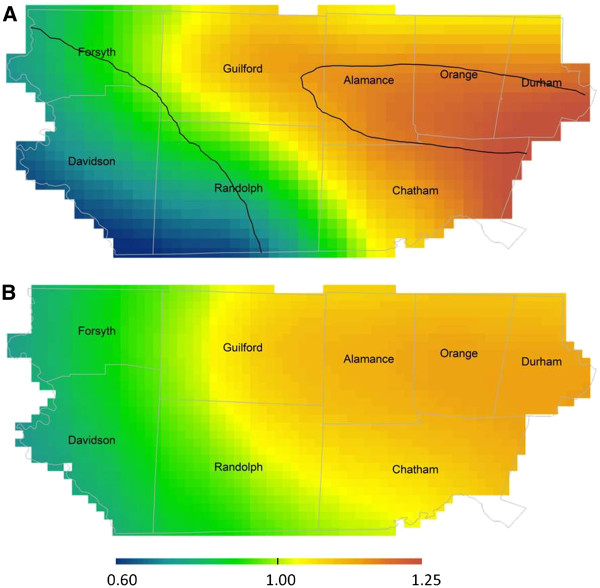
Unadjusted maps revealed geographic variation in surveillance-recognized ASD. Children born in certain regions of the study area were up to 1.27 times as likely to be recognized as having ASD compared to children born in the study area as a whole (prevalence ratio (PR) range across the study area 0.57-1.27; global P=0.003). However, geographic gradients of ASD prevalence were attenuated after adjusting for spatial confounders (adjusted PR range 0.72-1.12 across the study area; global P=0.052).
Conclusions
In these data, spatial variation of ASD in central NC can be explained largely by factors impacting diagnosis, such as maternal education, emphasizing the importance of adjusting for differences in the geographic distribution of known individual-level predictors in spatial analyses of ASD. These results underscore the critical importance of accounting for such factors in studies of environmental exposures that vary across regions.
-
Subjects:
-
Source:Environ Health. 2012; 11:80.
-
Pubmed ID:23113973
-
Pubmed Central ID:PMC3499188
-
Document Type:
-
Funding:
-
Place as Subject:
-
Volume:11
-
Collection(s):
-
Main Document Checksum:urn:sha256:60814dd18df3091c75345cd5ae1e2baf3a55f76fb179082193fb3c2ddf6e4c8e
-
Download URL:
-
File Type:
 [PDF
- 1.09 MB
]
[PDF
- 1.09 MB
]
Supporting Files


File Language:
English
ON THIS PAGE



CDC STACKS serves as an archival repository of CDC-published products including
scientific findings,
journal articles, guidelines, recommendations, or other public health information authored or
co-authored by CDC or funded partners.
As a repository, CDC STACKS retains documents in their original published format to ensure public access to scientific information.
As a repository, CDC STACKS retains documents in their original published format to ensure public access to scientific information.
You May Also Like
COLLECTION
CDC Public Access