


Shared decision making for prostate cancer screening: the results of a combined analysis of two practice-based randomized controlled trials
Supporting Files

-
Nov 13 2012
-
File Language:
English
Details
-
Alternative Title:BMC Med Inform Decis Mak
-
Personal Author:
-
Description:Background
Professional societies recommend shared decision making (SDM) for prostate cancer screening, however, most efforts have promoted informed rather than shared decision making. The objective of this study is to 1) examine the effects of a prostate cancer screening intervention to promote SDM and 2) determine whether framing prostate information in the context of other clearly beneficial men’s health services affects decisions.
Methods
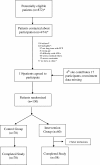
We conducted two separate randomized controlled trials of the same prostate cancer intervention (with or without additional information on more clearly beneficial men’s health services). For each trial, we enrolled a convenience sample of 2 internal medicine practices, and their interested physicians and male patients with no prior history of prostate cancer (for a total of 4 practices, 28 physicians, and 128 men across trials). Within each practice site, we randomized men to either 1) a video-based decision aid and researcher-led coaching session or 2) a highway safety video. Physicians at each site received a 1-hour educational session on prostate cancer and SDM. To assess intervention effects, we measured key components of SDM, intent to be screened, and actual screening. After finding that results did not vary by trial, we combined data across sites, adjusting for the random effects of both practice and physician.
Results
Compared to an attention control, our prostate cancer screening intervention increased men’s perceptions that screening is a decision (absolute difference +41%; 95% CI 25 to 57%) and men’s knowledge about prostate cancer screening (absolute difference +34%; 95% CI 19% to 50%), but had no effect on men’s self-reported participation in shared decisions or their participation at their preferred level. Overall, the intervention decreased screening intent (absolute difference −34%; 95% CI −50% to −18%) and actual screening rates (absolute difference −22%; 95% CI −38 to −7%) with no difference in effect by frame.
Conclusions
SDM interventions can increase men’s knowledge, alter their perceptions of prostate cancer screening, and reduce actual screening. However, they may not guarantee an increase in shared decisions.
Trial registration
#NCT00630188
-
Subjects:
-
Source:BMC Med Inform Decis Mak. 2012; 12:130.
-
Pubmed ID:23148458
-
Pubmed Central ID:PMC3582602
-
Document Type:
-
Funding:
-
Place as Subject:
-
Volume:12
-
Collection(s):
-
Main Document Checksum:urn:sha256:4cc792c755a682eccfaf888fcfa6d0b07cd13afb5eb4d9b73c28472cde3c2739
-
Download URL:
-
File Type:
 [PDF
- 269.22 KB
]
[PDF
- 269.22 KB
]
Supporting Files


File Language:
English
ON THIS PAGE


CDC STACKS serves as an archival repository of CDC-published products including
scientific findings,
journal articles, guidelines, recommendations, or other public health information authored or
co-authored by CDC or funded partners.
As a repository, CDC STACKS retains documents in their original published format to ensure public access to scientific information.
As a repository, CDC STACKS retains documents in their original published format to ensure public access to scientific information.
You May Also Like
COLLECTION
CDC Public Access