


A systematic review of mathematical models of mosquito-borne pathogen transmission: 1970–2010
Supporting Files

-
Feb 13 2013
-
File Language:
English
Details
-
Alternative Title:J R Soc Interface
-
Personal Author:Reiner, Robert C. ; Perkins, T. Alex. ; Barker, Christopher M. ; Niu, Tianchan. ; Chaves, Luis Fernando. ; Ellis, Alicia M. ; George, Dylan B. ; Le Menach, Arnaud. ; Pulliam, Juliet R. C. ; Bisanzio, Donal. ; Buckee, Caroline. ; Chiyaka, Christinah. ; Cummings, Derek A. T. ; Garcia, Andres J. ; Gatton, Michelle L. ; Gething, Peter W. ; Hartley, David M. ; Johnston, Geoffrey. ; Klein, Eili Y. ; Michael, Edwin. ; Lindsay, Steven W. ; Lloyd, Alun L. ; Pigott, David M. ; Reisen, William K. ; Ruktanonchai, Nick. ; Singh, Brajendra K. ; Tatem, Andrew J. ; Kitron, Uriel. ; Hay, Simon I. ; Scott, Thomas W. ; Smith, David L.
-
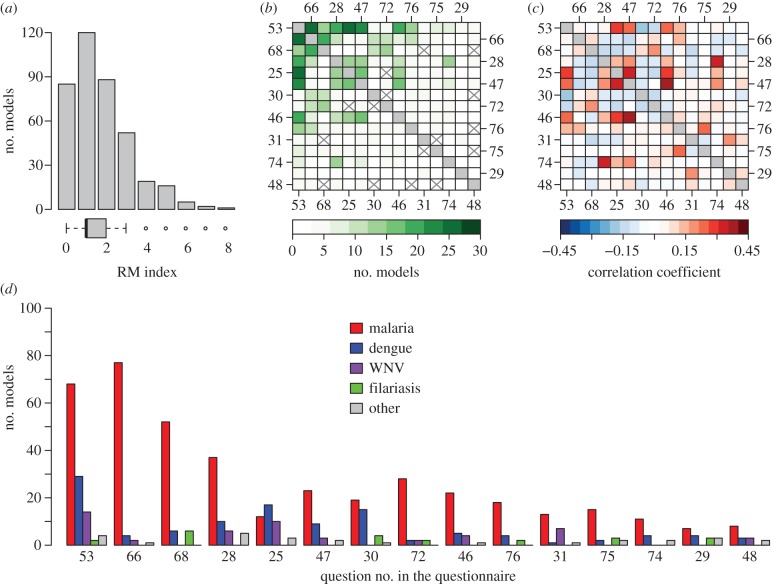
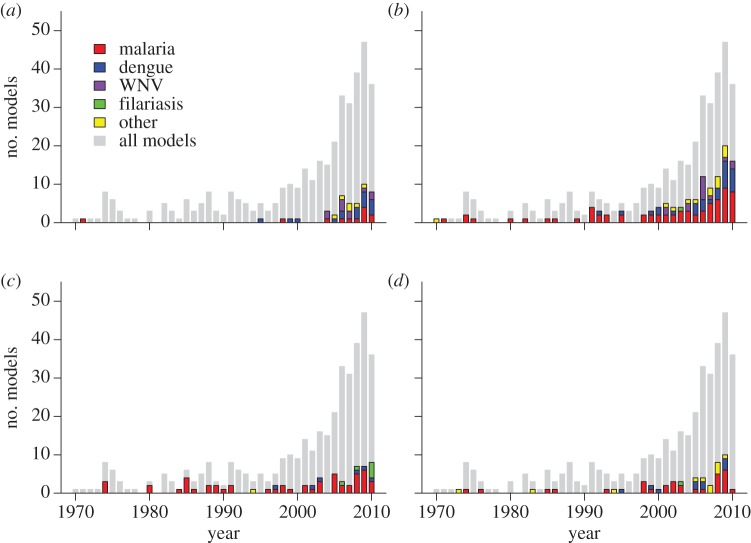
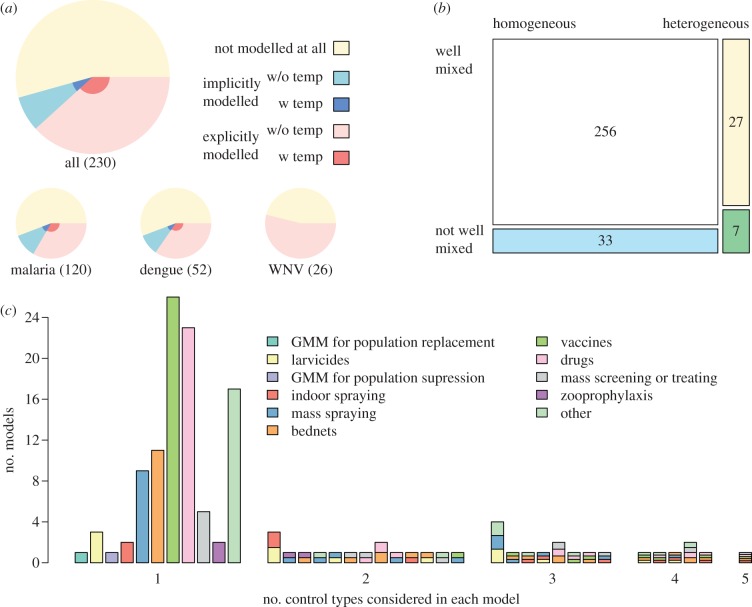
Description:Mathematical models of mosquito-borne pathogen transmission originated in the early twentieth century to provide insights into how to most effectively combat malaria. The foundations of the Ross-Macdonald theory were established by 1970. Since then, there has been a growing interest in reducing the public health burden of mosquito-borne pathogens and an expanding use of models to guide their control. To assess how theory has changed to confront evolving public health challenges, we compiled a bibliography of 325 publications from 1970 through 2010 that included at least one mathematical model of mosquito-borne pathogen transmission and then used a 79-part questionnaire to classify each of 388 associated models according to its biological assumptions. As a composite measure to interpret the multidimensional results of our survey, we assigned a numerical value to each model that measured its similarity to 15 core assumptions of the Ross-Macdonald model. Although the analysis illustrated a growing acknowledgement of geographical, ecological and epidemiological complexities in modelling transmission, most models during the past 40 years closely resemble the Ross-Macdonald model. Modern theory would benefit from an expansion around the concepts of heterogeneous mosquito biting, poorly mixed mosquito-host encounters, spatial heterogeneity and temporal variation in the transmission process.
-
Subjects:
-
Source:J R Soc Interface. 2013; 10(81).
-
Document Type:
-
Funding:095066/Wellcome Trust/United Kingdom ; 5 U01 EH000418/EH/NCEH CDC HHS/United States ; G0900220/Medical Research Council/United Kingdom ; MR/K00669X/1/Medical Research Council/United Kingdom ; R01 AI069387-01A1/AI/NIAID NIH HHS/United States ; R01-AI069341/AI/NIAID NIH HHS/United States ; R01-AI091980/AI/NIAID NIH HHS/United States ; R01-GM08322/GM/NIGMS NIH HHS/United States ; U19 AI089674/AI/NIAID NIH HHS/United States ; U19AI089674/AI/NIAID NIH HHS/United States
-
Volume:10
-
Issue:81
-
Collection(s):
-
Main Document Checksum:urn:sha256:2cd52333968051a296ad18dd4b3f4006d6d1aa7fb79824dd2bcb159f0856ef46
-
Download URL:
-
File Type:
 [PDF
- 618.44 KB
]
[PDF
- 618.44 KB
]
Supporting Files


File Language:
English
ON THIS PAGE




CDC STACKS serves as an archival repository of CDC-published products including
scientific findings,
journal articles, guidelines, recommendations, or other public health information authored or
co-authored by CDC or funded partners.
As a repository, CDC STACKS retains documents in their original published format to ensure public access to scientific information.
As a repository, CDC STACKS retains documents in their original published format to ensure public access to scientific information.
You May Also Like
COLLECTION
CDC Public Access