


Rethinking sources of representative controls for the conduct of case–control studies in minority populations
Supporting Files

-
May 31 2013
-
File Language:
English
Details
-
Alternative Title:BMC Med Res Methodol
-
Personal Author:
-
Description:Background
Recruitment of controls remains a challenge in case–control studies and particularly in studies involving minority populations.
Methods
We compared characteristics of controls recruited through random digit dialing (RDD) to those of community controls enrolled through churches, health events and other outreach sources among women of African ancestry (AA) participating in the Women’s Circle of Health Study, a case–control study of breast cancer. Odds ratios and 95% confidence intervals were also computed using unconditional logistic regression to evaluate the impact of including the community controls for selected variables relevant to breast cancer and for which there were significant differences in distribution between the two control groups.
Results
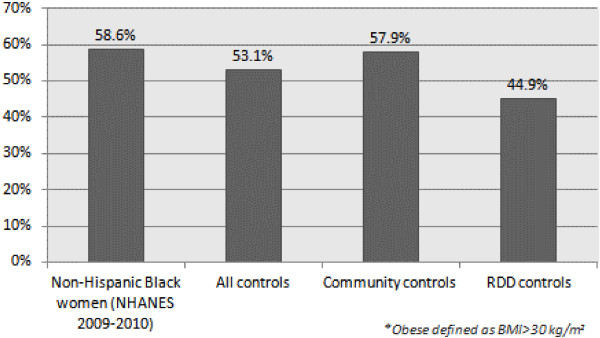
Compared to community controls (n=347), RDD controls (n=207) had more years of education and higher income, lower body mass index, were more likely to have private insurance, and less likely to be single. While the percentage of nulliparous women in the two groups was similar, community controls tended to have more children, have their first child at a younger age, and were less likely to breastfeed their children. Dietary intake was similar in the two groups. Compared to census data, the combination of RDD and community controls seems to be more representative of the general population than RDD controls alone. Furthermore, the inclusion of the community group had little impact on the magnitude of risk estimates for most variables, while enhancing statistical power.
Conclusions
Community-based recruitment was found to be an efficient and feasible method to recruit AA controls.
-
Subjects:
-
Source:BMC Med Res Methodol. 2013; 13:71.
-
Pubmed ID:23721229
-
Pubmed Central ID:PMC3681587
-
Document Type:
-
Funding:
-
Volume:13
-
Collection(s):
-
Main Document Checksum:urn:sha256:9b656c1e3b8471b19538fed3973d09347638396b8cfb153442234998b0db3ee2
-
Download URL:
-
File Type:
 [PDF
- 278.10 KB
]
[PDF
- 278.10 KB
]
Supporting Files


File Language:
English
ON THIS PAGE

CDC STACKS serves as an archival repository of CDC-published products including
scientific findings,
journal articles, guidelines, recommendations, or other public health information authored or
co-authored by CDC or funded partners.
As a repository, CDC STACKS retains documents in their original published format to ensure public access to scientific information.
As a repository, CDC STACKS retains documents in their original published format to ensure public access to scientific information.
You May Also Like
COLLECTION
CDC Public Access