


Equity in Maternal Health in South Africa: Analysis of Health Service Access and Health Status in a National Household Survey
Supporting Files

-
Sep 06 2013
-
File Language:
English
Details
-
Alternative Title:PLoS One
-
Personal Author:
-
Description:Background
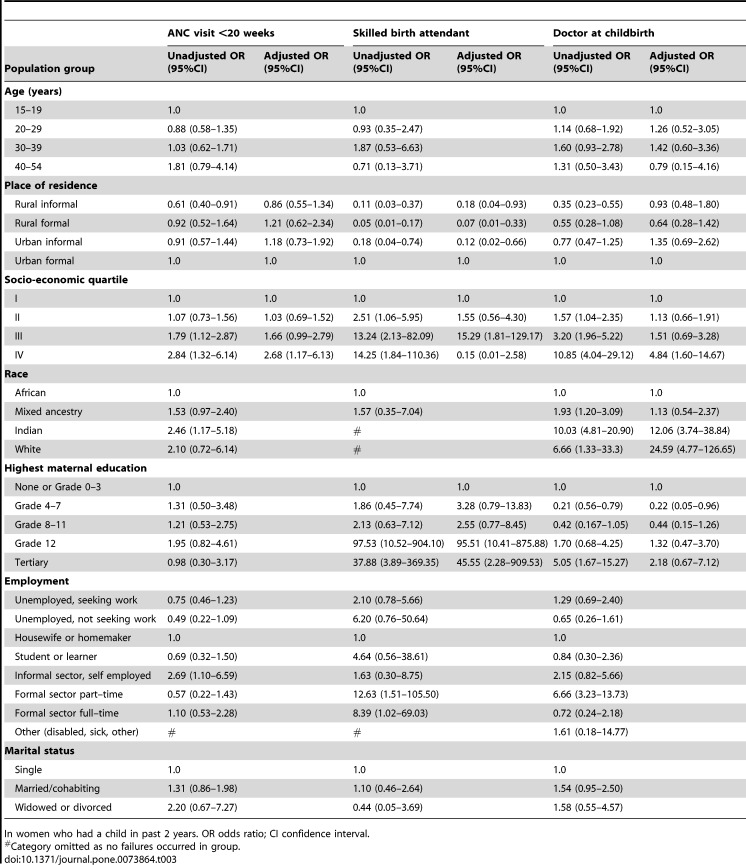
South Africa is increasingly focused on reducing maternal mortality. Documenting variation in access to maternal health services across one of the most inequitable nations could assist in re-direction of resources.
Methods
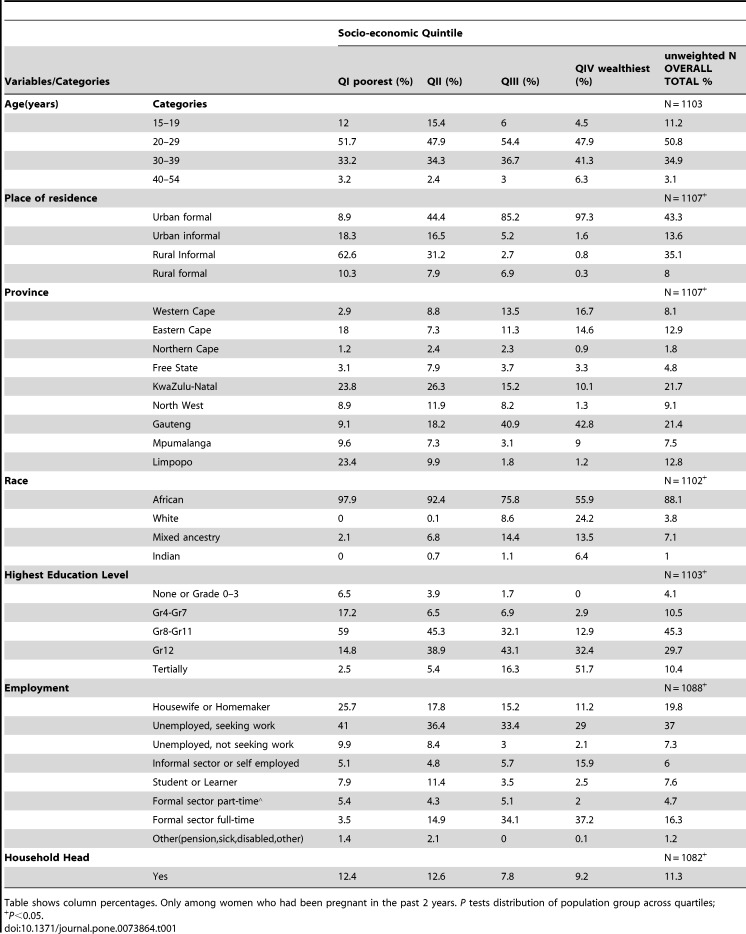
Analysis draws on a population-based household survey that used multistage-stratified sampling. Women, who in the past two years were pregnant (1113) or had a child (1304), completed questionnaires and HIV testing. Distribution of access to maternal health services and health status across socio-economic, education and other population groups was assessed using weighted data.
Findings
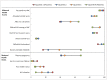
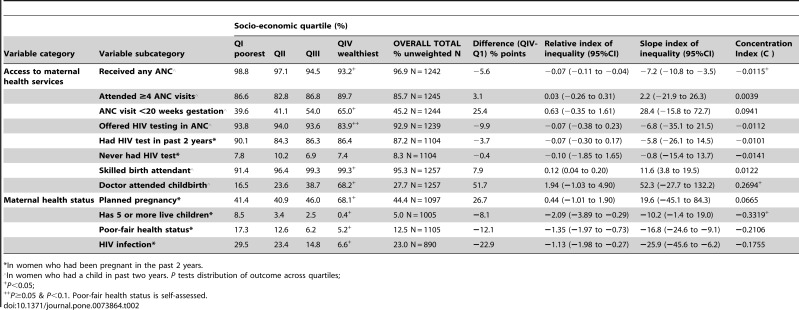
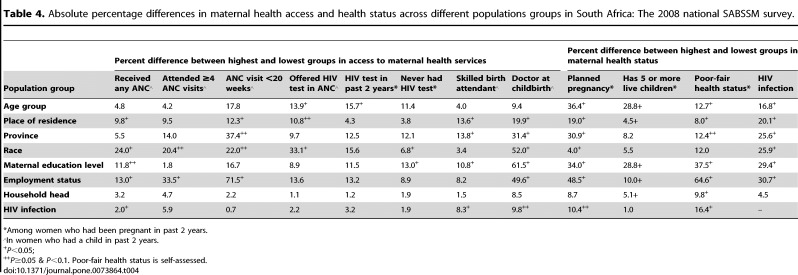
Poorest women had near universal antenatal care coverage (ANC), but only 39.6% attended before 20 weeks gestation; this figure was 2.7-fold higher in the wealthiest quartile (95%CI adjusted odds ratio = 1.2–6.1). Women in rural-formal areas had lowest ANC coverage (89.7%), percentage completing four ANC visits (79.7%) and only 84.0% were offered HIV testing. Testing levels were highest among the poorest quartile (90.1% in past two years), but 10% of women above 40 or with low education had never tested. Skilled birth attendant coverage (overall 95.3%) was lowest in the poorest quartile (91.4%) and rural formal areas (85.6%). Around two thirds of the wealthiest quartile, of white and of formally-employed women had a doctor at childbirth, 11-fold higher than the poorest quartile. Overall, only 44.4% of pregnancies were planned, 31.7% of HIV-infected women and 68.1% of the wealthiest quartile. Self-reported health status also declined considerably with each drop in quartile, education level or age group.
Conclusions
Aside from early ANC attendance and deficiencies in care in rural-formal areas, inequalities in utilisation of services were mostly small, with some measures even highest among the poorest. Considerably larger differences were noted in maternal health status across population groups. This may reflect differences between these groups in quality of care received, HIV infection and in social determinants of health.
-
Subjects:
-
Source:PLoS One. 2013; 8(9).
-
Pubmed ID:24040097
-
Pubmed Central ID:PMC3765324
-
Document Type:
-
Funding:
-
Place as Subject:
-
Volume:8
-
Issue:9
-
Collection(s):
-
Main Document Checksum:urn:sha256:bebf30dc54cef6049c7351adc98f3cfc87e41362d055cdc1872fcec7f158cf6f
-
Download URL:
-
File Type:
 [PDF
- 600.79 KB
]
[PDF
- 600.79 KB
]
Supporting Files


File Language:
English
ON THIS PAGE











CDC STACKS serves as an archival repository of CDC-published products including
scientific findings,
journal articles, guidelines, recommendations, or other public health information authored or
co-authored by CDC or funded partners.
As a repository, CDC STACKS retains documents in their original published format to ensure public access to scientific information.
As a repository, CDC STACKS retains documents in their original published format to ensure public access to scientific information.
You May Also Like
COLLECTION
CDC Public Access