


Challenges to implementation of developmental screening in urban primary care: a mixed methods study
Supporting Files

-
Jan 21 2014
-
File Language:
English
Details
-
Alternative Title:BMC Pediatr
-
Personal Author:
-
Description:Background
Research is needed to identify challenges to developmental screening and strategies for screening in an urban pediatric setting.
Methods
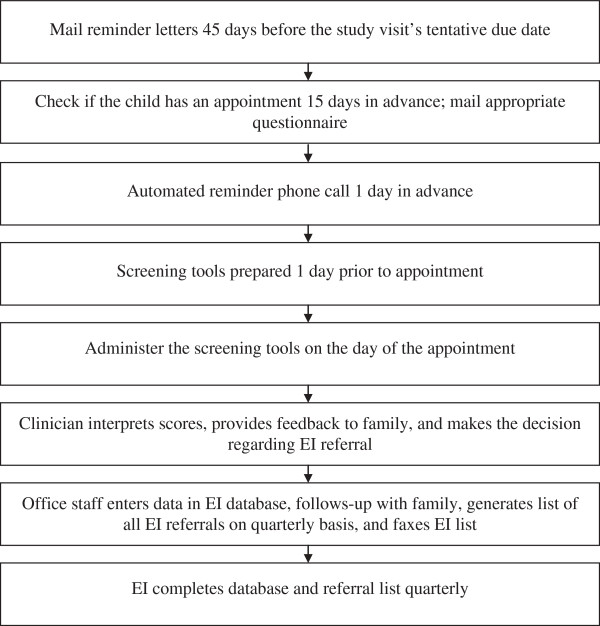
Parents of young children and clinicians at four urban pediatric practices participated in focus groups prior to implementation of screening. Participants were queried regarding attitudes, social norms, and barriers to developmental screening. Using information from the focus groups, workflow strategies were developed for implementing screening. Referral rates and satisfaction with screening were gathered at the conclusion.
Results
Six focus groups of parents and clinicians were conducted. Major themes identified included 1) parents desired greater input on child development and increased time with physicians, 2) physicians did not fully trust parental input, 3) physicians preferred clinical acumen over screening tools, and 4) physicians lacked time and training to conduct screening. For the intervention, developmental screening was implemented at the 9-, 18-, 24-, and 30-month well visits using the Ages & Stages Questionnaire-II and the Modified Checklist for Toddlers. 1397 (98% of eligible) children under 36 months old were enrolled, and 1184 (84%) were screened at least once. 1002 parents (85%) completed a survey at the conclusion of the screening trial. Most parents reported no difficulty completing the screens (99%), felt the screens covered important areas of child development (98%), and felt they learned about their child’s strengths and limitations (88%).
Conclusions
Developmental screening in urban low-income practices is feasible and acceptable, but requires strategies to capture parental input, provide training, facilitate referrals, and develop workflow procedures and electronic decision support.
-
Subjects:
-
Source:BMC Pediatr. 2014; 14:16.
-
Pubmed ID:24447411
-
Pubmed Central ID:PMC3899611
-
Document Type:
-
Funding:
-
Volume:14
-
Collection(s):
-
Main Document Checksum:urn:sha256:0f81cf7ffa32db2148dc47c9859c31a2d606e095cc49dcdce5ae1774f8ad3a08
-
Download URL:
-
File Type:
 [PDF
- 266.10 KB
]
[PDF
- 266.10 KB
]
Supporting Files


File Language:
English
ON THIS PAGE

CDC STACKS serves as an archival repository of CDC-published products including
scientific findings,
journal articles, guidelines, recommendations, or other public health information authored or
co-authored by CDC or funded partners.
As a repository, CDC STACKS retains documents in their original published format to ensure public access to scientific information.
As a repository, CDC STACKS retains documents in their original published format to ensure public access to scientific information.
You May Also Like
COLLECTION
CDC Public Access