


Lymphocytic Choriomeningitis Virus in Employees and Mice at Multipremises Feeder-Rodent Operation, United States, 2012
Multi-Language
Supporting Files
Public Domain

-
Feb 2014
-
File Language:
Details
-
Alternative Title:Emerg Infect Dis
-
Personal Author:Knust, Barbara ; Ströher, Ute ; Edison, Laura ; Albariño, César G. ; Lovejoy, Jodi ; Armeanu, Emilian ; House, Jennifer ; Cory, Denise ; Horton, Clayton ; Fowler, Kathy L. ; Austin, Jessica ; Poe, John ; Humbaugh, Kraig E. ; Guerrero, Lisa ; Campbell, Shelley ; Gibbons, Aridth ; Reed, Zachary ; Cannon, Deborah ; Manning, Craig ; Petersen, Brett ; Metcalf, Douglas ; Marsh, Bret ; Nichol, Stuart T. ; Rollin, Pierre E.
-
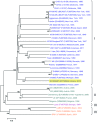
Description:We investigated the extent of lymphocytic choriomeningitis virus (LCMV) infection in employees and rodents at 3 commercial breeding facilities. Of 97 employees tested, 31 (32%) had IgM and/or IgG to LCMV, and aseptic meningitis was diagnosed in 4 employees. Of 1,820 rodents tested in 1 facility, 382 (21%) mice (Mus musculus) had detectable IgG, and 13 (0.7%) were positive by reverse transcription PCR; LCMV was isolated from 8. Rats (Rattus norvegicus) were not found to be infected. S-segment RNA sequence was similar to strains previously isolated in North America. Contact by wild mice with colony mice was the likely source for LCMV, and shipments of infected mice among facilities spread the infection. The breeding colonies were depopulated to prevent further human infections. Future outbreaks can be prevented with monitoring and management, and employees should be made aware of LCMV risks and prevention.
-
Subjects:
-
Source:Emerg Infect Dis. 20(2):240-247.
-
Document Type:
-
Place as Subject:
-
Location:
-
Volume:20
-
Issue:2
-
Collection(s):
-
Main Document Checksum:urn:sha256:3284816fb3f50e56a7a58531a8db060e37ec68365c88539ddb99aa0e0ddc6e92
-
Download URL:
-
File Type:
 [PDF
- 583.25 KB
]
[PDF
- 583.25 KB
]
Supporting Files


File Language:
ON THIS PAGE


CDC STACKS serves as an archival repository of CDC-published products including
scientific findings,
journal articles, guidelines, recommendations, or other public health information authored or
co-authored by CDC or funded partners.
As a repository, CDC STACKS retains documents in their original published format to ensure public access to scientific information.
As a repository, CDC STACKS retains documents in their original published format to ensure public access to scientific information.
You May Also Like
COLLECTION
Emerging Infectious Diseases